
I have a tattoo on my neck that reads D I V I N A.
It is the feminine term for divine, in Spanish. You see, I have chosen to affirm my greatness through my body, and I consider this tattoo a proclamation to myself and an affirmation to my female ancestors. I love this tattoo because it is an indicator for outsiders to know who they are dealing with, when they approach me.
Some might say, I hold my head too high.
My perceived pride, is not pride, it is perseverance. But people ask me, ALL the time: WHY DO YOU THINK SO HIGHLY OF YOURSELF? As if I should not be proud. As if I should simmer down…
But why???? I have parents who maneuvered class mobility with an ease that can only be described as perseverance.
When people made fun of me for not celebrating the Americanized versions of Halloween and Christmas, I had to own that reality or crumble under their snickers. I had to accept my culture.
When people questioned why I wore Goodwill/no-name clothes, instead of brand-name clothes, I had to own that too. I had to accept that we were poor.

A mass of white caps on a disheveled sea crisscrosses the horizon, the aftermath of a hurricane that skidded up the western face of Baja from Cabo past Punta Hughes. The storm made a westerly turn on its northern trajectory, just far enough off the coast to send a small amount of rain and mountainous surf to our small pueblo. Wave after wave, a tight fetch. a disorganized army of marching swell lines with little space between them, and out the far points, close-out walls of water.

It is 10:34 p.m. I am journaling about the difference between what I eat and how I taste it.
In other words, it’s not about the chocolate cake. It’s about the pool of saliva swirling through each bite. It’s about the tongue pressing crumb into ganache, the esophagus readying itself to carry each sweet offering down. It is about my body knowing it is safe. Safe to sit, to enjoy, to receive.

A few summers ago, I sat next to my dog on a pile of ice-coated rocks in the Brooks Range of Alaska, afraid that my soon-to-be-husband had fallen off a cliff.

I read an article in our local newspaper about a high school coach who had just been fired for abusing his male students. I was in my early forties, and remember taking in the article (yes, back in the day when people still read an actual newspaper) and contemplating the unpleasant information that a football coach in a city just north of where I lived had inappropriately touched his male students. My next thought was, Oh, that happened to me.

One of the reasons I love children's books is that there's always an invitation to loosen and lighten up, be poured into, be lulled into a place of deeper reflection—to see yourself in mid-grapple. For that reason, happy to be nappy is much more than a children's story.

I grew up listening to my mom criticize her stomach. Having children had done this, she would say as she ran her hand over her loose stomach. Being pregnant and giving birth had changed her body forever, leaving behind stretch marks and large breasts and a stomach that jiggled and bulged. She didn’t like how her stomach looked, but she didn’t starve herself or excessively exercise. In every fitting room we shared, she commented. If only I could get rid of this, she’d say as she patted her stomach. Look at this, she said, as she shook her head and looked at her side profile in the dressing room mirror. If I didn’t have all this, these would fit better, she would say, while pulling down the pair of pants that didn’t fit. She saw, and continues to see, her stomach as a negative, a defect.

A couple of months ago you were going to several Overeaters Anonymous meetings a week, sometimes every day. But when Elaine told you she couldn’t sponsor you anymore after your suicide attempt, and when she and a friend whom she also sponsored asked you not to attend a couple of their regular meetings, and after your therapist came to the facility you were hospitalized in to tell you she couldn’t work with you anymore, you stopped going to meetings altogether.

Sometimes I wonder why lovers hold hands when they walk around. I wonder how long they have been dating. Are they in that new stage, where it feels like they have to hold on tight, constantly let the other person know that they are there, that they aren’t going anywhere, that they want to touch them, that they want to be touched. Or is it the older couples, the ones who have been together for longer that hold hands. A gesture they don’t even realize they’re doing, their fingers just mindlessly reaching for each other, keeping their connection as they pace around the city.

She was doing Pilates when she saw the first sign. She should have noticed. It was like last summer when the cop stopped her, leaned into the window, and asked if she’d seen the “STOP” sign. Of course she hadn’t, she told him; if she had seen it she’d have stopped. But that, too, was no kind of explanation.
When children asked me why I was so tall for a fourth grader, without any knowledge that migration kept me from school for an entire year, I had to own my age. I had to accept that my migration story was written all over my face.
I cannot afford to be weak, and I never want to be considered “less than” because I do not see myself as “less than.” Despite outsiders considering my culture, class, and migration status indicators of me being “less than,” I cherish mi tierra natal, my Goodwill clothes were a dream, and my migration means I have an entire family back home who all love me.
So I am not proud, I am simply working hard every day to keep you from erasing me from my story.

So discontinue perpetuating your reductionist ideas of humility onto my Latina immigrant feminism. I do not need it.
-Prisca Dorcas Mojica Rodriguez
The hermit crab essay is a term originally coined by Brenda Miller and Suzanne Paola in their craft book Tell It Slant: Creating, Refining, and Publishing Creative Nonfiction. Like its namesake, the hermit crab essay borrows an existing container, such as a list, set of directions, tarot card reading, or real estate listing, and makes it its own.
In this workshop, we’ll explore how different authors use the Hermit Crab Essay as a creative vehicle for approaching topics that may feel too difficult, vulnerable, or traumatic to write about directly. I’ll share writing exercises, practical tools, and techniques that you can take with you to experiment with this form and begin crafting your own next essay.
The success of Gillian Flynn’s Gone Girl (2012) heralded a new era of domestic suspense. Most of the novels that came to define this genre featured white women narrators behaving badly. While this convention invokes the precedent of the pathologization of hysterical women, we must also consider how this convention relies on contemporary white privilege. How do Caro Claire Burke’s Yesteryear (2026), Alice Feeney’s My Husband’s Wife (2026), and Meagan Church’s The Mad Wife (2025) use unreliable narration to suggest that madness is a privileged state?
Women characters are still too often judged by one question: Is she likeable? That question can do a lot of damage on the page. Anger gets softened. Ambition needs an explanation. Bad decisions need a sympathetic reason behind them. A woman can be selfish, difficult, ruthless, jealous, furious, or want something she probably shouldn't, but writers often start sanding those edges down because they're afraid the reader won't like her. But liking a character and wanting to keep reading about her are two very different things. Stop Making Her Likeable is a 90-minute workshop about what actually keeps a reader invested in a complicated woman. We'll look at why readers can become completely absorbed by characters they don't approve of, what makes difficult behaviour fascinating rather than simply frustrating, and how motivation, contradiction, desire, and agency affect the way a reader responds to her. We'll also look at our own pages. Where are we explaining a woman because we're afraid she'll be judged? Where are we making her apologize for wanting something? Where have we given her a tragic reason for behaviour that we might simply allow from a male character? The goal isn't to teach writers how to create an “unlikeable female character.” It's to stop treating likeability as the price a woman has to pay to be worth reading about.
In this course, author Piper L. White will discuss feminism through the use of fairytales and how to take these beloved childhood stories and twist them into our modern writing by delving deep into the psyche of women-identifying people and their everyday horrors to craft their own prose pieces.
This product gives you access to all four weeks of the workshop. Purchase one or more drop-in sessions here.
Build a habit in 20 sessions. In this 4 week workshop that meets Mondays through Fridays from 8:00-9:00 AM CST, we will focus on generating new writing—making headway on a current project, reviving an old project that’s been gathering dust, or writing based off of the daily prompts Leigh provides.
The first 45 minutes of class are a gentle, camera-off, silent writing session. The remaining 15 minutes are an opportunity to share excerpts of our work, reflect on progress made, and set intentions for the following day. Then we will read a passage together on the writing life and close each class with a new learning about habit formation. By the end of this course we’ll have a morning writing habit that is each our own to continue and build upon.
This listing is for an individual class. To purchase access for the full 4-week workshop, click here.
Build a habit in 20 sessions. In this 4 week workshop that meets Mondays through Fridays from 8:00-9:00 AM CST, we will focus on generating new writing—making headway on a current project, reviving an old project that’s been gathering dust, or writing based off of the daily prompts Leigh provides.
The first 45 minutes of class is a gentle, camera-off, silent writing session. The remaining 15 minutes are an opportunity to share excerpts of our work, reflect on progress made, and set intentions for the following day. Then we will read a passage together on the writing life and close each class with a new learning about habit formation. By the end of this course we’ll have a morning writing habit that is each our own to continue and build upon.
Many writers feel drawn to write about their lives but struggle with uncertainty: Why this story? Why now? And who is it really for? This workshop is designed to help writers move beyond doubt and toward clarity by focusing on the deeper meaning and purpose beneath their story.
In this interactive, craft-forward session, participants will be introduced to the Memoir Compass, a practical framework that helps writers articulate their motivation (why they are writing), mission (who the story serves), and message (what meaning or insight the story carries). Through guided reflection and writing exercises, participants will begin shaping a personal narrative rooted in intention rather than overwhelm.
This workshop is ideal for writers interested in memoir or personal narrative, as well as fiction writers drawing from lived experience, who want to move forward with greater confidence, focus, and direction.
Some of the most compelling creative nonfiction begins with the feelings we are tempted to avoid: anger, resentment, shame, fear, or the sense that we have an axe to grind. In this six-week workshop, writers will explore how to follow that emotional heat toward deeper, more honest work—without sacrificing compassion, complexity, or craft. Through close readings, writing exercises, discussion, and constructive feedback, we’ll consider how to transform strong feelings into writing that reaches beyond catharsis and connects with readers.
IT’S NO SECRET THAT FEEDBACK IS AN IMPORTANT PART OF THE WRITING PROCESS.
In fact, we argue that it might be the most important part of the process.
But it’s hard to find a writing community. It’s hard to find the people who are willing to take the time and the effort to read your work and give the feedback you really, truly deserves.
That’s where HerStry Critique Groups come in!
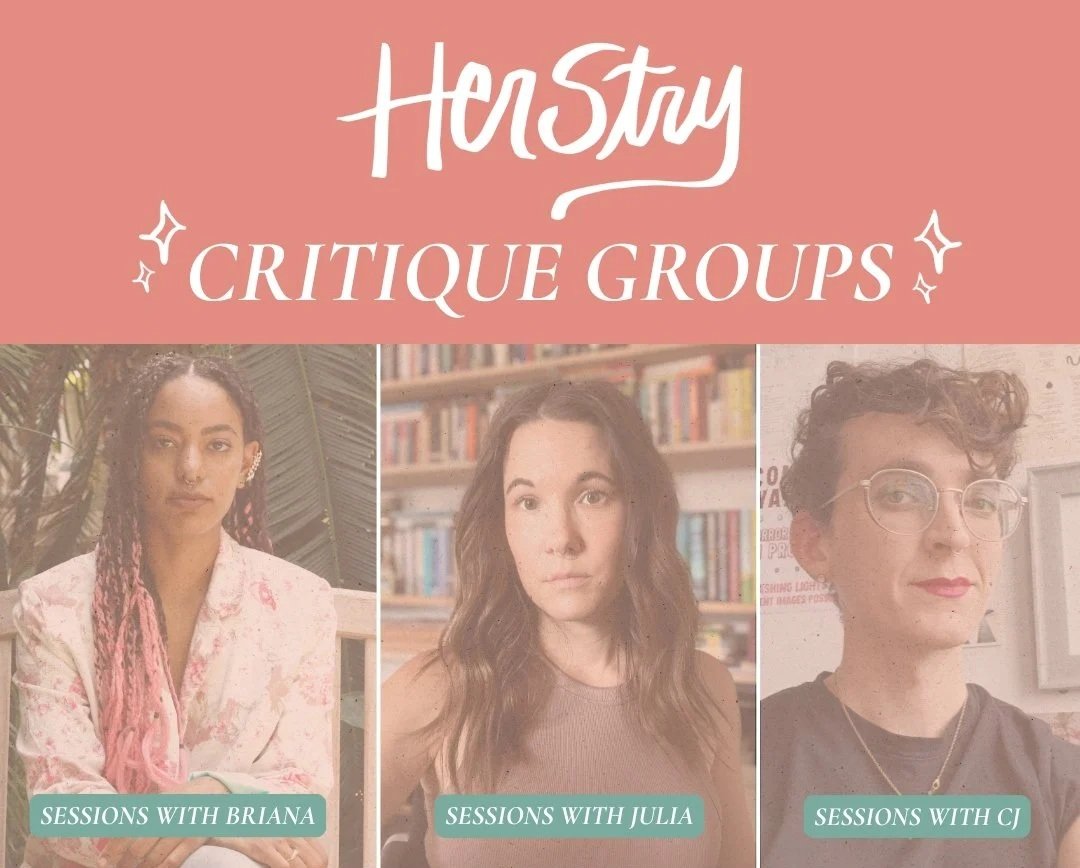
HerStry Critique Groups are small groups of 6 women who gather online for 6 weeks to share their writing, give constructive feedback and gain skills as writers.
Weekly online sessions last approximately ninety minutes, with three women sharing their work each week. Writers of all genres and levels are welcome and you may share both works of fiction and nonfiction.
Sessions take place on Mondays 7PM CT, Tuesdays 11AM CT, Fridays 11AM CT
WHAT’S INCLUDED IN THE HERSTRY CRITIQUE GROUPS?
Six 90 minute live workshop sessions
Three 20 minutes sessions in the “hot seat” to get you work critiqued
Written and verbal feedback from your fellow workshop participants
A weekly in depth edit and critique of your work from the group leader after each session
Weekly writing goals and accountability check ins
Full video recordings of each session to keep for your records
Say goodbye to the lonely, stuck in your head writing life!

LET’S WRITE!
From conception to submission. Let’s make summer sizzle with stories.
Writing a short story doesn’t happen in one session. It takes multiple drafts to get it exactly right, to create characters that come to life for the reader and a world they can’t stop thinking about. In this seven week course we will work on a single short story from conception to submission ready. The seven week session will include generative brainstorming sessions, short story craft talks, multiple workshops for feedback from fellow writers, and detailed line by line feedback and edits from your instructor. Plus, we’ll talk about submission venues, cover letters, and when to know if your story is ‘finished.’
One dreary winter day, nearly two years into dating, he ended things rather oddly: “I don’t think you’ll be okay if we break up,” he explained, “which is why we have to break up.” Though confounding, I suppose it was not surprising—he often resented how much I seemed to need him.