
This is How It Happens

My love snapped this pic, as he does so many of our family moments, and I look at her with eyes of tenderness and weary gratitude tonight. Because earlier today the promise of growing life in my belly was silenced just like the exam room as the nurse searched again and again for the heartbeat at a routine prenatal visit. “Is this how people find out?” I thought, suddenly floating though a cloud of emotionless reality, confused why I had felt kicks just last night in bed. An ultrasound revealed it had been three-and-a-half weeks since another soul was within me, I feel betrayed by my senses, and now I despised the ruse of meaningful fullness in my belly. But this little girl still toddles along, babbling, cooing, exploring, as open and happy and needy as ever and I hold her tighter tonight, bury my lips in her cheeks, run my hands through her hair. And wait for tomorrow to begin this now conscious process of release.
-Alli Parfenov

Photo by Alli Parfenov
This listing is for an individual class. To purchase access for the full 4-week workshop, click here.
Build a habit in 20 sessions. In this 4 week workshop that meets Mondays through Fridays from 8:00-9:00 AM CST, we will focus on generating new writing—making headway on a current project, reviving an old project that’s been gathering dust, or writing based off of the daily prompts Leigh provides.
The first 45 minutes of class is a gentle, camera-off, silent writing session. The remaining 15 minutes are an opportunity to share excerpts of our work, reflect on progress made, and set intentions for the following day. Then we will read a passage together on the writing life and close each class with a new learning about habit formation. By the end of this course we’ll have a morning writing habit that is each our own to continue and build upon.
Many writers feel drawn to write about their lives but struggle with uncertainty: Why this story? Why now? And who is it really for? This workshop is designed to help writers move beyond doubt and toward clarity by focusing on the deeper meaning and purpose beneath their story.
In this interactive, craft-forward session, participants will be introduced to the Memoir Compass, a practical framework that helps writers articulate their motivation (why they are writing), mission (who the story serves), and message (what meaning or insight the story carries). Through guided reflection and writing exercises, participants will begin shaping a personal narrative rooted in intention rather than overwhelm.
This workshop is ideal for writers interested in memoir or personal narrative, as well as fiction writers drawing from lived experience, who want to move forward with greater confidence, focus, and direction.
Some of the most compelling creative nonfiction begins with the feelings we are tempted to avoid: anger, resentment, shame, fear, or the sense that we have an axe to grind. In this six-week workshop, writers will explore how to follow that emotional heat toward deeper, more honest work—without sacrificing compassion, complexity, or craft. Through close readings, writing exercises, discussion, and constructive feedback, we’ll consider how to transform strong feelings into writing that reaches beyond catharsis and connects with readers.
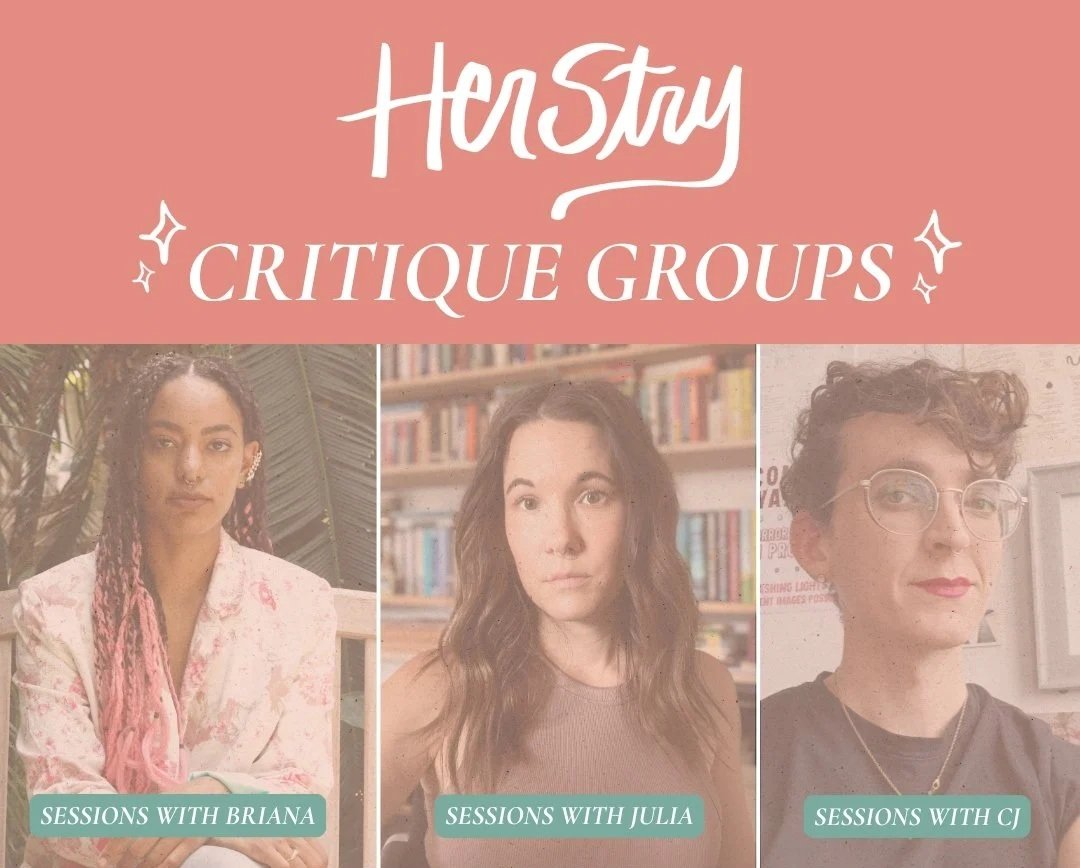
IT’S NO SECRET THAT FEEDBACK IS AN IMPORTANT PART OF THE WRITING PROCESS.
In fact, we argue that it might be the most important part of the process.
But it’s hard to find a writing community. It’s hard to find the people who are willing to take the time and the effort to read your work and give the feedback you really, truly deserves.
That’s where HerStry Critique Groups come in!
HerStry Critique Groups are small groups of 6 women who gather online for 6 weeks to share their writing, give constructive feedback and gain skills as writers.
Weekly online sessions last approximately ninety minutes, with three women sharing their work each week. Writers of all genres and levels are welcome and you may share both works of fiction and nonfiction.
Sessions take place on Mondays 7PM CT, Tuesdays 11AM CT, Fridays 11AM CT
WHAT’S INCLUDED IN THE HERSTRY CRITIQUE GROUPS?
Six 90 minute live workshop sessions
Three 20 minutes sessions in the “hot seat” to get you work critiqued
Written and verbal feedback from your fellow workshop participants
A weekly in depth edit and critique of your work from the group leader after each session
Weekly writing goals and accountability check ins
Full video recordings of each session to keep for your records
Say goodbye to the lonely, stuck in your head writing life!

LET’S WRITE!
From conception to submission. Let’s make summer sizzle with stories.
Writing a short story doesn’t happen in one session. It takes multiple drafts to get it exactly right, to create characters that come to life for the reader and a world they can’t stop thinking about. In this seven week course we will work on a single short story from conception to submission ready. The seven week session will include generative brainstorming sessions, short story craft talks, multiple workshops for feedback from fellow writers, and detailed line by line feedback and edits from your instructor. Plus, we’ll talk about submission venues, cover letters, and when to know if your story is ‘finished.’
IT’S NO SECRET THAT FEEDBACK IS AN IMPORTANT PART OF THE WRITING PROCESS.
In fact, we argue that it might be the most important part of the process.
But it’s hard to find a writing community. It’s hard to find the people who are willing to take the time and the effort to read your work and give the feedback you really, truly deserves.
That’s where HerStry Critique Groups come in!
HerStry Critique Groups are small groups of 6 women who gather online for 6 weeks to share their writing, give constructive feedback and gain skills as writers.
Weekly online sessions last approximately ninety minutes, with three women sharing their work each week. Writers of all genres and levels are welcome and you may share both works of fiction and nonfiction.
Sessions take place on Mondays 7PM CT, Tuesdays 11AM CT, Fridays 11AM CT
WHAT’S INCLUDED IN THE HERSTRY CRITIQUE GROUPS?
Six 90 minute live workshop sessions
Three 20 minutes sessions in the “hot seat” to get you work critiqued
Written and verbal feedback from your fellow workshop participants
A weekly in depth edit and critique of your work from the group leader after each session
Weekly writing goals and accountability check ins
Full video recordings of each session to keep for your records
Say goodbye to the lonely, stuck in your head writing life!
October 7, 14, 21, 28, November 4 and 18 CT
There is no class on November 11.
WRITING THE SEX SCENE.
Writing a sex scene can be delirious fun, a harrowing challenge, a literary milestone—possibly the most important part of building your short story or book. In our six weeks together, you’ll experience just about every possible emotion as you explore the erotic in different modes: comic, tender, harrowing, soul-shattering … because it really is all about the characters’ feelings, not just the mechanics. So we’ll talk about tone. Vocabulary. Metaphor. Sensory detail. How to get big emotions on the page … and when to pull back and let the reader’s imagination go to work.
This is a course for writers who want to explore the intersection between the novel and short stories, and would like to weave their short stories into a story cycle (or collection of "linked stories" or "composite novel"). This is also a class about the interaction of form and content, and how one influences the other. We will read works of interlinked stories by writers from diverse cultural and ethnic backgrounds, focusing on modern classics and contemporary practitioners of these hybrid forms. Weekly discussions will center on elements of craft, such as the expansion and compression of time, setting as an organizing and connecting principle, character development within and between stories, structure and plot for interconnected stories, and responding to literary influences in the same genre.
This six-week course guides writers through the literary submission process, offering insider insight and practical tools to help you get your work into the world. We’ll demystify everything from reading submission calls to writing cover letters and choosing the right journals. Along the way, we’ll workshop short bios, develop submission trackers, and build personalized plans that align with your voice and goals.
By the end of the course, you’ll walk away with a polished piece ready to send, a tailored submission list, and the confidence to navigate the lit mag world with clarity and purpose.
Ideal for writers of literary fiction, poetry, personal essay, memoir, and hybrid forms.

Alli is the mother of three and was expecting to be sixteen weeks along when she found out the news of her miscarriage. She wants others to know that even though she was initially hesitant to share her story on social media so soon, the pain of isolation in loss has dispelled. So many of her friends have comforted with their own stories of pregnancy loss, the togetherness in this tragedy is an incredible balm to her heart. The grief is still there but it is not in darkness, it is not needing to hide. Connect with Alli on Instagram at @alliparfenov to follow her healing journey.

A jarring racket fills our camper on this untamed night in the Sol Duc watershed of the Olympic National Park. Large pockets of water form on Douglas Fir limbs above, collecting, collecting, collecting until…splat, kerplunk on top of the metal-roofed truck camper. Hundreds such collection systems drop like random rocks.

I’m sorry I couldn’t go to your wedding and that my explanation was vague and seemed rude. My doctor wouldn’t let me fly. I couldn’t find the words. I worried that mentioning pregnancy loss would cloud the conversation of your celebration.

A woman appearing before you desperately frightened by the usual gesticulations, the kicks and rolls inside of her becoming suddenly still, by the warm trickle down her leg, fluid or blood but too soon, too soon. What if you took her by the hand and walked her to a room much like a bedroom, with bleached sheets and pillow cases, bassinet and muslin blankets, with warm light coming through a southern window but stark for its waxed floors where blood pooled at your feet just last week, now a shadow upon which you sometimes slip for the mercilessness of memory? Merciless because this isn’t the first time and, by the wickedness of fate, it will never be the last.

I was twenty-nine. I didn’t know what to feel, or what it would feel like. That first sonogram seemed other-worldly. At every twitch I thought I was feeling the first flutters, but when they began to come with regularity, the realness set in that I was at a different stage of being a woman.

My friend came over and we slowly drank wine and talked—her miscarriage (a couple years earlier), my miscarriage (current), the moments that blindsided each of us in a wash of grief, what the aftermath was like for her and what getting pregnant again was like. I was smack dab in the middle of my experience and found comfort in talking to friends who had been there and who had now had time to assimilate it within a zoomed-out picture of The Rest of Life.

May 18, 1980 – Mt. St Helens volcano in Washington State exploded with the force of 500 nuclear Hiroshima bombs, taking lives, destroying homes, spreading 540 million tons of ash over 22,000 square miles, and flattening trees for 220 square miles. It was the worst avalanche in U.S. history. Within two weeks ash had drifted around the globe.

“I’m expecting,” I told my four-year-old daughter as we trudged into the leafy woods around our home. It was a cold September day, and in her hands she held two dozen seed packets of bluebells to scatter into the rich soil beneath the trees.

A happy face on a stick transforms me. My breasts become tender, fatigue overwhelms. It becomes part of my being. Growth sprouts into a grain of rice, a blueberry, and a raspberry with duck feet. By spring, a plum dangling from a tree branch—fingernails, toes, bone.

I’d only told the baby daddy when I was sure. “So, you’re not getting rid of it then?” He’d said.
Keep mum until you've passed the first trimester. This is the gospel according to the matriarchy, and I’d followed it religiously. The latent fear is that miscarriage pursues you at your back like a winged chariot.

I am waking from a dream. No, a nightmare. My temple leans against the cool, foggy window and the sudden movement of the car shifting into gear pulls me forward, causing my head to lift. Consciousness rolls in and I remember why I am here. This is not a dream.
This product gives you access to all four weeks of the workshop. Purchase one or more drop-in sessions here.
Build a habit in 20 sessions. In this 4 week workshop that meets Mondays through Fridays from 8:00-9:00 AM CST, we will focus on generating new writing—making headway on a current project, reviving an old project that’s been gathering dust, or writing based off of the daily prompts Leigh provides.
The first 45 minutes of class are a gentle, camera-off, silent writing session. The remaining 15 minutes are an opportunity to share excerpts of our work, reflect on progress made, and set intentions for the following day. Then we will read a passage together on the writing life and close each class with a new learning about habit formation. By the end of this course we’ll have a morning writing habit that is each our own to continue and build upon.