
Hunger
I didn’t think about it until it wasn’t there.
“You can’t just touch her, you gotta ask her first,” Aracelis said to the boy who was not my student but had appeared in our classroom doorway to rub my very pregnant belly. I was focused on the other thirty-eight students lined up and losing patience waiting for our middle school principal to dismiss the fifth floor via loudspeaker, and not aware of whose hand exactly was rubbing my belly. I wasn’t as territorial with my body as my students were, who after three years, arriving in sixth grade and graduating at the end of eighth, felt the right to lay claims. They could take hold of my hand, or shape my hair into a ponytail while I conferred with another, or tap my shoulder to ask for something—or rub my belly, at will. The boy from another class had to ask. He raised his eyebrows, but as I nodded Sure, the fifth floor was finally released and the hordes suddenly exiting ended our brief encounter.
For decades, this was how my body existed in space—briefly or for extended periods of time touching someone else’s. Whether nursing, cradling, or cuddling my two sons, or teaching in my Bronx classroom where my Latina girls kissed the right cheek of their fellow classmates and then mine as they walked to their seats, I had physical connection daily. My boy students received more kisses than they gave, but there were lots of fist tapping, cool hand-shaking, and half-body hugs to go around, even if my participation rendered me laugh-at-able.
As I walked around the room checking work, I’d place my hand on a shoulder to let each student know we were in it together. No matter how tough these teenagers presented, a full-bodied hug when an injustice had brought tears, or a quick embrace at dismissal for those whose arms reached for me, deepened our bond. These physical gestures were probably our most important conversations, devoid of the potentially confusing messages words often wrought.
I ignored the memos left in our teacher mailboxes to never touch our students which frankly seemed bizarre. But this was the 1990s, a time when headlines were full of both male and female teachers being arrested and fired for having sex with underage students. Safer to never put a motherly, affectionate, or caring hand on a student. But my students felt like my kids…I couldn’t teach without a quick tap on their hand to refocus their attention or the squeeze of a shoulder to say, Good job. When they surprised me with something amazing, I’d reflexively give them a little shove, a kind of physical exclamation point.
One day I could not find my long narrow manilla book teachers used to record everything: grades, attendance, homework…everything. I was trying not to panic when Victor, one of my slightly hyper boys, said, “Just start the lesson, I’ll look for it.” After five minutes of me distractedly teaching while he rifled through the many piles of papers on my desk, I turned to see him holding it in one hand, making the victory sign with the other. I grabbed his head and planted a kiss on his forehead, then immediately saw a headline floating in the air on the front page of The New York Post: Middle school teacher molests student in front of horrified classmates. My moment of panic thankfully subsided as soon as the kids laughed and Victor sat down looking a little embarrassed. Kindness can make one look weak in certain neighborhoods. Not touching has never worked for me.
At the school day’s end, I’d hurry to pick up my own children. One or eventually both of my boys would be on my hip, my back, my lap, or attached to my hand. After piggyback rides and pushing them on park swings and baths and bedtime stories, and laying down with them until they fell asleep, I’d finally collapse into bed with my husband. Both of us on our backs, I’d flop one leg over his because our hips and shoulders didn’t last in the spoon position.
For decades, touch comforted and re-energized me.
Then one day after my toddler entwined his hands in my hair while imploring me for another trip to the ice cream truck, and my six year old demanded I carry him up the two-block hill while pushing his brother in the stroller—and arguing with that demand required time I didn’t have—and all this after a long work day in which at least 10 students had to be pulled apart after a hand waved dismissively in the face of another led to—“fight, fight, fight!” in the lunchroom—I can’t wait to have my body back, popped into my head.
Be careful what you wish for.
My kids grew up. My husband’s struggle with addiction led to our divorce, then his death. I retired from teaching. Slowly, I indeed, had my body back. Instead of feeling freer, as my random wish so many years before had hoped, I felt constricted, struggling to flow through space as though a shoulder, a foot, a finger might crack. As though touch lubricates all the parts that need to bend.
When flights opened up again after the pandemic had shut them down, I enrolled in a Spanish language school in Mexico hoping someday I could help at the border, the sight of children in cages hurling me forward.
“You’re going to Mexico alone?” friends asked.
“Yes,” I said.
“Have you been there before?
“No.”
“Do you speak Spanish?”
“No.”
“Do you know someone there?”
“No.”
But I knew Alone. And that is why I notice Touch.
On the plane, a Mexican family, mom and two young sons in the row behind dad who’s sitting next to the oldest, all three boys under ten I’d guess, manage the five-hour flight from JFK to Mexico City calmly. When we land and everyone is able to stand, the husband turns and looks at his wife with complete adoration as he clasps her hands. They don’t let go until the line starts moving and we are able to unload bags from the overhead.
In my new city of Oaxaca, scooters and motorcycles are common modes of transportation. With the men driving, I see women’s relaxed hands on their partners’ waists, sometimes hips, sometimes tucked midway into their partners’ pants pockets. Less frequently, the woman is driving and the man envelops her back and they ride almost as one. Sometimes entire families ride together, young child in front, baby sandwiched between papa who’s driving, and mama in the back holding tight. The sheer sight of others comfortably connected brings me joy, whether or not it will ever exist again for me.
In the mornings, I study grammar and conversation at language school. In the afternoons, we go on excursions to absorb the abundant Oaxacan culture.
It’s the evenings when the rogue loneliness asteroids hit my heart.
When a few of my schoolmates and I go out for dinner one evening, Alex leaves early to run to a salsa lesson. I ask him about it the next day. He tells me where the school is and I vow to give it a try. I love to dance, but I have never danced with a partner before. I have never danced Latin dances before.
I hear the music a block away through the open garage doors at the entrance. The interior courtyard has a tarp for a roof, tied around an avocado tree that pushes to the sky. A few passersby stop and watch from the street as the teacher, Carlos Vargas, and students face the one wall lined with mirrors and he calls out the steps. I am nervous and shy, leftovers from my teen years. But as a near senior citizen now, the difference is, I will not turn around and abandon this idea.
I spend the first evening working with some of his young accomplished dancers off to the side learning basic steps. By the end of the evening, I know I will be back, because loneliness is so much harder sitting still. And I also know I go so I can touch and be touched.
Night after night, Carlos is a showman in jeans and sneakers and a short haircut gelled to perfection. He jokes constantly which keeps the mood light and welcoming. Most of the students are local Oaxaqueños, with an occasional extranjera like me wandering in. When the two-year-old sister of one of the six-year-old ballerinas wandered onto the dance floor, Carlos simply took her hand and danced with her slowly and carefully while we all followed along.
After he’s satisfied most of us know the choreo, we partner up and handsome middle-aged Daniel is all calm and kindness as we clasp hands and wait until the music cues us to begin. “Podías ayudarme, por favor? No sé nada.” Could you help me, please? I know nothing.
“Paciencia,” he tells me.
“Sí,” I agree, “pero no tengo mucha paciencia.” But I don’t have much patience.
“Lo recuerdo,” I remember, he says, smiling. “Diviértete.” Just have fun.
We met each other on a water break the night before. He had asked what brought me to Oaxaca.
“I want to learn Spanish,” I answered, the only reason I could share.
The dance steps, he said, are just like learning a language. They’ll come poco a poco.
He leads me through an inside turn followed by a cross body lead, then a men’s turn, then a lady’s turn, as Carlos calls out the steps. And while I am not a natural, with a deft partner, I begin to understand this dialogue that happens with the touch of a hand, a forearm, a shoulder. I understand that Daniel’s palm pressing on the small of my back, signals the direction to move in. When he raises my hand above my shoulder this way, I begin a spin. Lowering my hand with a slight pull and I cross to his other side. I immediately fall in love with this language.
My fingertips softly trace Daniel’s waist as he does a vuelta, keeping us connected. I’m relieved it’s his turn to spin, while I perform a basic, since I struggle to not lose my balance. He continues to lead me through a move I’m not sure about, then takes both my hands to end with a columpio, an overhead swing to the other side. We finish with a smile and a thank you tap, and change partners.
“¿Quieres ayuda?” David asks. You want help?
“Sí,” I confirm. He is eleven or twelve years old, sports a large belly, and gets playful with dancers closer to his age. But he has the steps down. When I mess up, I try to run over the parts I can’t do, to get to the parts I can.
“No,” he says, tugging me to a stop, while everyone else continues with the routine. He shows me the inside turn again, explaining in Spanish I don’t understand, so he gives me a push on my hip this way, a pull on my waist that way, and makes me try until I get it.
“Exacto,” he says, when I finally do. Only now am I allowed to continue. He is my strictest teacher.
Sometimes Carlos announces “Cambio,” and we change partners, but he gets distracted talking to someone. As we wait for the music to start, Emmanuel, in his twenties, doesn’t let go. When his phone pings, he puts my two hands together in one of his to use his other hand to check his message. I love that he doesn’t let go. That there’s a desire to stay connected. When we finish the routine, we disconnect and the conversation with that partner is over, but we move on to a new partner to begin a different dialogue.
When Christian, mouth full of braces, absentmindedly starts spinning my silver ring at the base of my finger in continuous loops while talking to a friend next to us, I am transported back to when my kids and I held hands, just because. To when my students would take my hand to ask me a question. To when touch meant I was connected to others. That I belonged.
“Tranquile,” Christian says as the music starts. When we make it through the whole routine without misstep, we smile proudly at each other and do a double-handed high five.
When I change partners to Emilio, who’s seven or eight years old, I have to dance in a semi-yoga chair position so he can get his hands over my head during the turns, but I struggle immensely to not pick up this adorable little dancer and forget the routine and just swing him around like I did my boys when they were young. Thankfully, I maintain my composure and give him a dignified “Gracias” when we finish.
During water breaks, I get to know some of the women. Lupita tells me she is taking swim lessons and they scare her so much, but we both agree knowing how to swim is important. Tere, a beautiful ballerina, also dances in a traditional indigenous group. Tere, Lupita, and I talk about how much calmer we feel after dancing. They are both gorgeous, graceful dancers, every move seemingly effortless.
“I think it’s important to do things you’re not good at,” I say, one of the longer sentences I’ve managed in Spanish. They nod in agreement. After these casual conversations, we start kissing each other’s cheeks hello, and sometimes embrace in powerful hugs when we haven’t seen each other in a while.
Oaxaca is a large, beautiful state. After a few months, I have only seen the capital, so I decide to take a van to Huatulco, a six-hour ride through the mountains to the beach. The vans are famous for breaking down, having erratic drivers, and causing motion sickness, but they are cheap, so I book a seat. As the van traverses the switchback mountain roads, I sway back and forth as though in a hammock. The rhythm lulls me to sleep. I wake when we stop seemingly in the middle of nowhere, and a young man gets on and sits in his assigned seat next to me. We briefly say Buenos Días, then he settles in and begins scrolling through his phone while I look out the window. I try to stay awake to enjoy an occasional glimpse through the trees of an expansive view of pines and wild maguey plants, but I nod out despite my resolve.
I rouse occasionally and feel my thigh pressing into the young man’s, who has also fallen asleep. At first, I pull my thigh away and try to prevent it from flapping against his, but with the repeated hairpin turns, I stop fighting. I think of shared cabs, colectivos, I’ve taken, where strangers are pressed together in tighter spaces without causing alarm. It’s just how it is here. I fall asleep again, but when the discomfort of keeping my legs tucked under my seat with no room to stretch causes me to stir, I find our shoulders pressed together. I can feel his deep rhythmic breaths flowing into my own. When I squeeze my legs into a slightly different position, our connection breaks and I’m sorry to lose the calming waves his breathing sends through my body.
After a few days of gentle swims in cool salt water, I sign up for a volcanic mud bath given by the wife of my taxi driver/tour guide. A young woman and I stand side by side in our bathing suits as the masseuse slathers mud from our faces down to our toes. We let the sun bake the mud into our skin and when it’s completely dry, we walk into the ocean, among the fisherman using nets, and rub the baked crust away, exposing freshly pulsing skin. In the morning, I head back to the city, my Spanish lessons, and my evening dance class.
Tonight’s bachata dance sequence includes a move called the mariposa. Partners “open” away from each other, and then the man pulls the woman to him and wraps one arm tightly around her rib cage, while she embraces his shoulder. Their other hands are clasped and outstretched as they do a four-count 360º spin. Whether my partner is a shy fourteen year old with a skinny chest or a man with powerful shoulders and arms, being held tightly and swung in a circle, with its potential to spin out of control, the malevolent voice that whispers at random moments … you deserve to be alone … quiets. Weakens.
After each kiss hello, hug good-bye, a partner’s thumb unconsciously tracing the bumpy road of my knuckles while waiting for the music to start, the whispers soften to Paciencia, solo ten paciencia.
-Corinne O’Shaughnessy
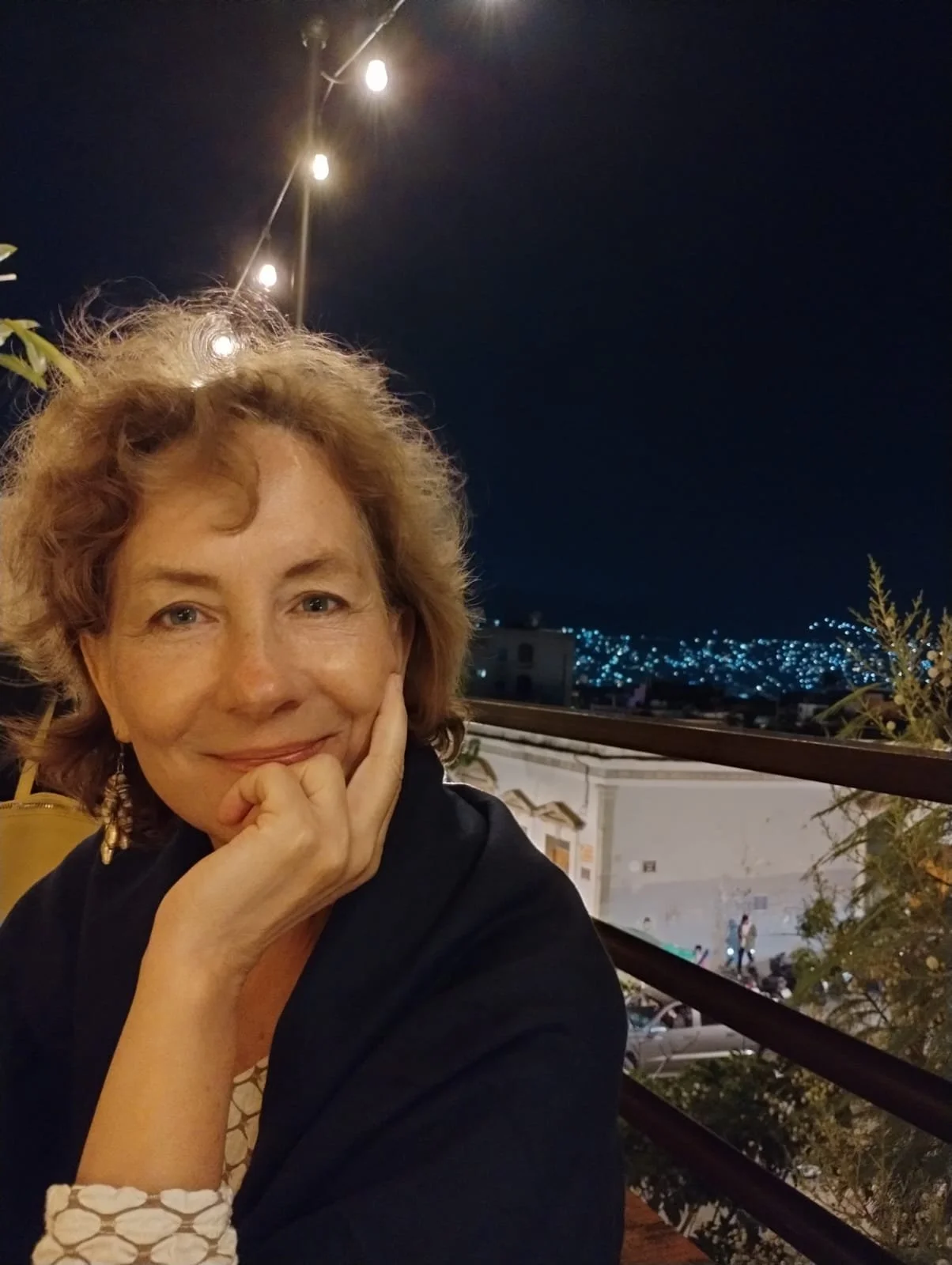
Corinne O’Shaughnessy is a retired New York City public school teacher. Her essays have appeared in the FeminineCollective.com, Oldster.substack.com, dorothyparkersashes.com, TwoHawksQuarterly.com, TheManifestStation.com, sadgirlsdiaries.com and this publication, among others. She has also previously participated in live readings with WritersRead.org, including their Ten Best of the Year event in 2023. Her short story Secret Spot was nominated for a Best of the Net in 2022 by BookofMatchesLit.com. She divides her time between the Bronx and Oaxaca, Mexico.