
Mother

Mom
in Texas
you hang a picture over your bed
of a silhouette lost like a wrinkle
in the folds of the desert
you understand
at nineteen and an immigrant
one-way plane ticket from Hong Kong
from the close quarters of family and friends
one grain in a sea of sand
The manager at McDonald’s
wishes he didn’t hire you
you struggle to catch orders
words slippery and fast
might as well
catch fish with bare hands
and your tongue too clumsy
to perform the acrobat
of the t-h in
Thank you come again

I am the keeper of the dreams and the memories, the matrix where the generations converge, the record-book held between familial bookends. I am responsible for passing her life on to him that she may continue to live and that he may understand the consequences of history and culture.

It’s Tuesday 23rd January 2001 and I don’t want to go to school. Today is a different day from the ones that have gone before. Every day since Saturday has been a different day from the ones that have gone before.

I heard the words, but they had never really registered. “Remember, no sleep for two year!” my boss warned when I shared the news of my second pregnancy with him.

Some people ask how I became a world traveler. I guess I got it from my mother. She never told us to be curious or seek out new places, but she made anything possible.
I was the youngest of six kids. My dad left to marry our neighbor five doors down when I was in second grade, so though he was nearby, he wasn’t part of my everyday life. He belonged to my best friend now.

Kids have a way of helping you see things clearly. Maybe because they consume so much of your time and energy until all that remains are the essentials? I don’t know how it works, but I know that shortly after the birth of my son, my old dream of becoming a writer suddenly became important to me.

Dear Mom,
I'm enjoying a cigarette on my rooftop. I'm sorry that, as an all knowing thirteen-year-old, I told you how to live. It's funny how much changes in ten years. The older I get the more I understand your stress and anxiety. I remember watching you and thinking, "Why can't you just be strong for me?"

I do not know what it is like to be a mother. I am not sure if I ever want to. But I know that I could never be who I am if it was not for the mothers before me. My Mother’s Mother was one of the toughest and prickly people you could even encounter. However, she loved her children and her grandkids more than anything. She may not have been sweet but she made sweet treats. She may not have always been prim and proper but she told you the truth and always stood up for herself. Her life was rough but through it all she found love and gave love and that is what truly mattered.

Dear Mom,
One of our mini stories together has been playing through my mind a lot recently, reminding me of the beauty and wisdom you weave into my life each and every day.

For the longest time in my life, I thought people could only be all good or all bad. Slowly the two moms I had and lost taught me value in seeing how people are imperfect creatures filled with good and bad.
In nursing college
the teacher sits you down
and says
Honey
maybe this isn’t for you
while you cry
But like Indiana Jones
you won’t quit and go home
you run for the prize
come fire and scorpions
failed tests and long medical terms
and people who snicker
when you don’t comprehend
their foreign words
you run for the prize
your diploma
you run to master
the t-h in
that’s right
watch me
catch fish with
bare hands
-Katina Wong Laib
This product gives you access to all four weeks of the workshop. Purchase one or more drop-in sessions here.
Build a habit in 20 sessions. In this 4 week workshop that meets Mondays through Fridays from 8:00-9:00 AM CST, we will focus on generating new writing—making headway on a current project, reviving an old project that’s been gathering dust, or writing based off of the daily prompts Leigh provides.
The first 45 minutes of class are a gentle, camera-off, silent writing session. The remaining 15 minutes are an opportunity to share excerpts of our work, reflect on progress made, and set intentions for the following day. Then we will read a passage together on the writing life and close each class with a new learning about habit formation. By the end of this course we’ll have a morning writing habit that is each our own to continue and build upon.
This listing is for an individual class. To purchase access for the full 4-week workshop, click here.
Build a habit in 20 sessions. In this 4 week workshop that meets Mondays through Fridays from 8:00-9:00 AM CST, we will focus on generating new writing—making headway on a current project, reviving an old project that’s been gathering dust, or writing based off of the daily prompts Leigh provides.
The first 45 minutes of class is a gentle, camera-off, silent writing session. The remaining 15 minutes are an opportunity to share excerpts of our work, reflect on progress made, and set intentions for the following day. Then we will read a passage together on the writing life and close each class with a new learning about habit formation. By the end of this course we’ll have a morning writing habit that is each our own to continue and build upon.
Many writers feel drawn to write about their lives but struggle with uncertainty: Why this story? Why now? And who is it really for? This workshop is designed to help writers move beyond doubt and toward clarity by focusing on the deeper meaning and purpose beneath their story.
In this interactive, craft-forward session, participants will be introduced to the Memoir Compass, a practical framework that helps writers articulate their motivation (why they are writing), mission (who the story serves), and message (what meaning or insight the story carries). Through guided reflection and writing exercises, participants will begin shaping a personal narrative rooted in intention rather than overwhelm.
This workshop is ideal for writers interested in memoir or personal narrative, as well as fiction writers drawing from lived experience, who want to move forward with greater confidence, focus, and direction.
Some of the most compelling creative nonfiction begins with the feelings we are tempted to avoid: anger, resentment, shame, fear, or the sense that we have an axe to grind. In this six-week workshop, writers will explore how to follow that emotional heat toward deeper, more honest work—without sacrificing compassion, complexity, or craft. Through close readings, writing exercises, discussion, and constructive feedback, we’ll consider how to transform strong feelings into writing that reaches beyond catharsis and connects with readers.
IT’S NO SECRET THAT FEEDBACK IS AN IMPORTANT PART OF THE WRITING PROCESS.
In fact, we argue that it might be the most important part of the process.
But it’s hard to find a writing community. It’s hard to find the people who are willing to take the time and the effort to read your work and give the feedback you really, truly deserves.
That’s where HerStry Critique Groups come in!
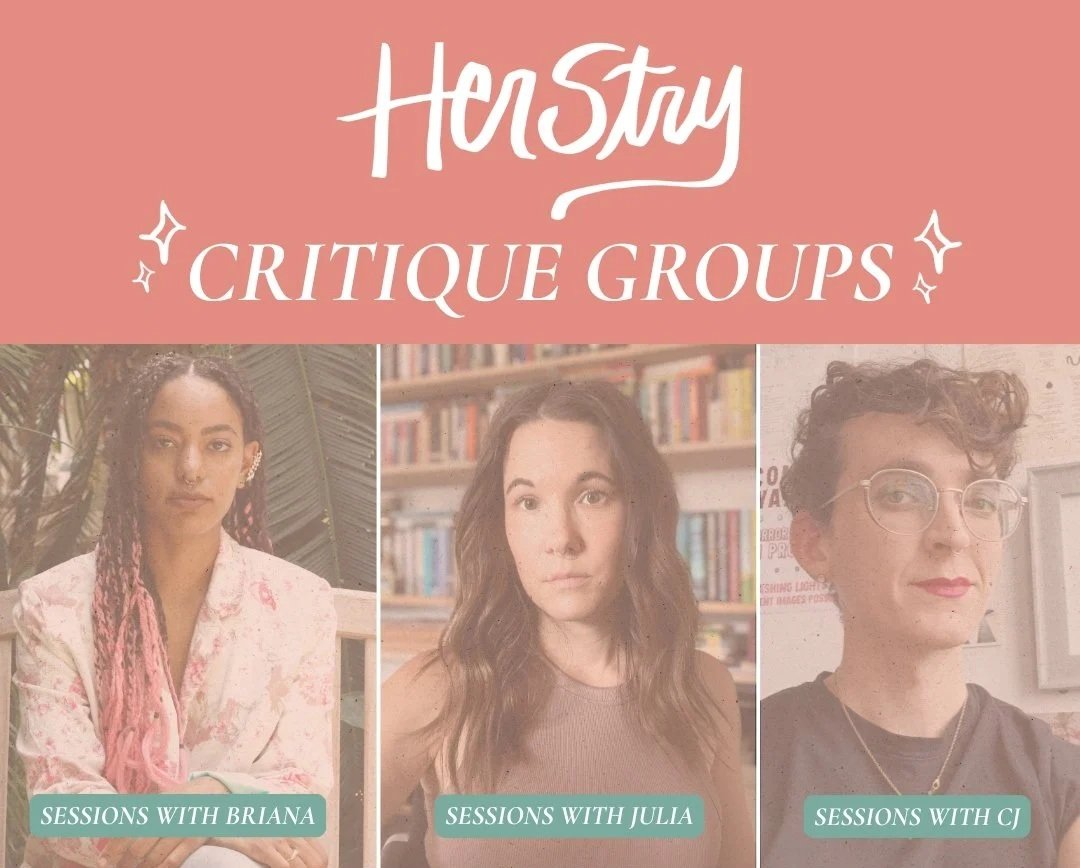
HerStry Critique Groups are small groups of 6 women who gather online for 6 weeks to share their writing, give constructive feedback and gain skills as writers.
Weekly online sessions last approximately ninety minutes, with three women sharing their work each week. Writers of all genres and levels are welcome and you may share both works of fiction and nonfiction.
Sessions take place on Mondays 7PM CT, Tuesdays 11AM CT, Fridays 11AM CT
WHAT’S INCLUDED IN THE HERSTRY CRITIQUE GROUPS?
Six 90 minute live workshop sessions
Three 20 minutes sessions in the “hot seat” to get you work critiqued
Written and verbal feedback from your fellow workshop participants
A weekly in depth edit and critique of your work from the group leader after each session
Weekly writing goals and accountability check ins
Full video recordings of each session to keep for your records
Say goodbye to the lonely, stuck in your head writing life!

LET’S WRITE!
From conception to submission. Let’s make summer sizzle with stories.
Writing a short story doesn’t happen in one session. It takes multiple drafts to get it exactly right, to create characters that come to life for the reader and a world they can’t stop thinking about. In this seven week course we will work on a single short story from conception to submission ready. The seven week session will include generative brainstorming sessions, short story craft talks, multiple workshops for feedback from fellow writers, and detailed line by line feedback and edits from your instructor. Plus, we’ll talk about submission venues, cover letters, and when to know if your story is ‘finished.’
IT’S NO SECRET THAT FEEDBACK IS AN IMPORTANT PART OF THE WRITING PROCESS.
In fact, we argue that it might be the most important part of the process.
But it’s hard to find a writing community. It’s hard to find the people who are willing to take the time and the effort to read your work and give the feedback you really, truly deserves.
That’s where HerStry Critique Groups come in!
HerStry Critique Groups are small groups of 6 women who gather online for 6 weeks to share their writing, give constructive feedback and gain skills as writers.
Weekly online sessions last approximately ninety minutes, with three women sharing their work each week. Writers of all genres and levels are welcome and you may share both works of fiction and nonfiction.
Sessions take place on Mondays 7PM CT, Tuesdays 11AM CT, Fridays 11AM CT
WHAT’S INCLUDED IN THE HERSTRY CRITIQUE GROUPS?
Six 90 minute live workshop sessions
Three 20 minutes sessions in the “hot seat” to get you work critiqued
Written and verbal feedback from your fellow workshop participants
A weekly in depth edit and critique of your work from the group leader after each session
Weekly writing goals and accountability check ins
Full video recordings of each session to keep for your records
Say goodbye to the lonely, stuck in your head writing life!

October 7, 14, 21, 28, November 4 and 18 CT
There is no class on November 11.
WRITING THE SEX SCENE.
Writing a sex scene can be delirious fun, a harrowing challenge, a literary milestone—possibly the most important part of building your short story or book. In our six weeks together, you’ll experience just about every possible emotion as you explore the erotic in different modes: comic, tender, harrowing, soul-shattering … because it really is all about the characters’ feelings, not just the mechanics. So we’ll talk about tone. Vocabulary. Metaphor. Sensory detail. How to get big emotions on the page … and when to pull back and let the reader’s imagination go to work.
This is a course for writers who want to explore the intersection between the novel and short stories, and would like to weave their short stories into a story cycle (or collection of "linked stories" or "composite novel"). This is also a class about the interaction of form and content, and how one influences the other. We will read works of interlinked stories by writers from diverse cultural and ethnic backgrounds, focusing on modern classics and contemporary practitioners of these hybrid forms. Weekly discussions will center on elements of craft, such as the expansion and compression of time, setting as an organizing and connecting principle, character development within and between stories, structure and plot for interconnected stories, and responding to literary influences in the same genre.
This six-week course guides writers through the literary submission process, offering insider insight and practical tools to help you get your work into the world. We’ll demystify everything from reading submission calls to writing cover letters and choosing the right journals. Along the way, we’ll workshop short bios, develop submission trackers, and build personalized plans that align with your voice and goals.
By the end of the course, you’ll walk away with a polished piece ready to send, a tailored submission list, and the confidence to navigate the lit mag world with clarity and purpose.
Ideal for writers of literary fiction, poetry, personal essay, memoir, and hybrid forms.
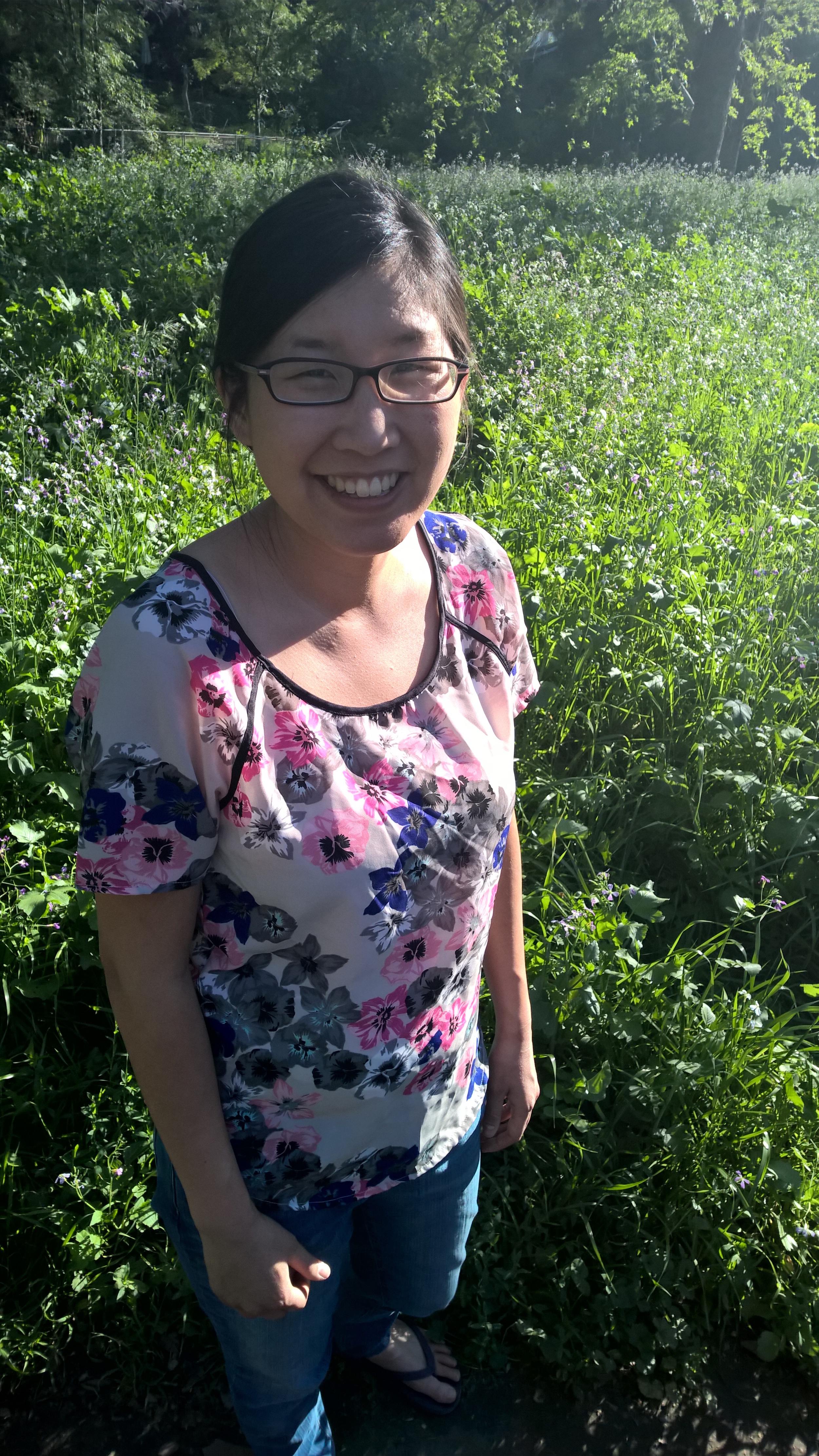
Katina Laib, a native of California, has always had a fascination with words, particularly through the medium of poetry. She has written poems and short stories since elementary school. Her writing is shaped particularly by her training through Poetry for the People, a program at the University of California, Berkeley, that believes powerful writing has the ability to heal, bridge differences, build communities, and usher in justice. Katina is also passionate about the use of language as a marriage and family therapist, where she helps her clients tell their stories in new ways. She lives with her husband and two cats in Orange County, California.
Home birth sounds so
Homey! Sweet! Safe from fear!
What a welcome, to bouncing baby
Who will arrive through legs, in arms, home