
I AM a Girl

Don’t you want that baby doll?
She’s pretty and you could dress her and feed her.
How else will you learn to be a good mommy?
Girls wear dresses, not pants. Those are for boys.
You’re not a little boy.
You look so pretty in that pink dress. Pink is a good color for you.
Pretty girls like pink.
Boys play soccer and with cars and in the dirt. Girls who do that are different.
You’re a tomboy. But you’re not a little boy.
Girls don’t play the fiddle here. You can learn to play violin. And wear a dress at our concerts.
No, boys wear pants.
You’re a little girl.
How about you play the clarinet? Girls play clarinets or the flute.
Girls don’t play drums.
You’re a little girl.

Praying during the first grief-soaked month following my father’s death felt rote to me. Awkward. I had taken on the obligation of saying the Mourner’s Kaddish every day for at least a month before realizing I had forgotten how to pray. A professor in college who gave me a C on a paper about James Joyce’s Ulysses said I was like a blind woman trying to describe a painting in front of her. That’s how it felt saying the Kaddish.

The last time I went to the church of my childhood, I wore my collar—my hot, plastic, clerical collar. I felt obvious and tender in it, like a burgeoning zit, like everyone would stare. And yet, I wanted them to stare, I wanted them to look at me and be amazed.

We held our hands in prayer. “Te lo pido, señor.” That week, it was my turn to visit Marco at the Elizabeth Detention Center, a contract detention facility in New Jersey used by Immigrations and Customs Enforcement to detain immigrants determined to be “suspicious” or “illegal.”

I am seven years old. It’s time for communion in my United Methodist Church in a small town in mid-Michigan. After watching communion by intinction happen for so many years from the sidelines, I am excited when my mom tells me it is okay for me to line up in the center aisle with her and slowly shuffle forward, waiting for my time to tear a piece of bread off the soft, white loaf and dip it in the grape juice.

The coconut palm in the field behind my house worships the wind. Its feather duster head sweeps low, bows to the earth like a holy roller in ecstasy, and then snaps back skyward—defiant—in an elastic, resurrecting leap that blasts the law of gravity.

Last year - I came out of a chaplaincy year that wrecked my idea of what I thought I wanted for my ministry.
But what do they say – make plans and God laughs.
God laughs and I get whiplash.

I am Clergy. My name isn’t on a roster for it anywhere; there’s no organizing body that ordained me and all my fellow clergy; I didn’t attend a seminary school. Still, I am Clergy.

We’d never had a woman pastor before.
When the United Methodist Church in my small, rural, mostly Mennonite town found out that the Bishop assigned us a female pastor, the conversation around town was in full force.

Don’t you want that baby doll?
She’s pretty and you could dress her and feed her.
How else will you learn to be a good mommy?
Girls wear dresses, not pants. Those are for boys.
You’re not a little boy.
You run fast for a girl!
If you sing in this vocal music class you will perform in a dress. If you don’t show up your grade will be affected.
You’re a girl.
Head trainers are men. You’re smart. You can teach these new students the techniques.
You’ll make a good assistant some day.
You’re a girl.
Women can play the piano, sing in the choir, tend children in the nursery, or teach Sunday school.
You should dress up sometimes. Wear a dress.
This is how we wear makeup and prepare ourselves for our husbands.
This is how we become good mommies and good wives.
Pink is a girl color. You should wear it.
You’re a girl.
I want your advice and your thoughts on things. But I may use them as my own ideas.
You’re smart and you have good skills, skills that cannot be taught.
But don’t focus on those things, or say blanket statements like that, or challenge patriarchy.
Stay in your place, and mind your voice.
You’re a girl.
You’re studying Divinity? Like seminary? Where pastors are trained?
What does that look like? Can women really preach?
I AM a pastor.
And I AM a girl.
-Jeani Rice-Cranford
This product gives you access to all four weeks of the workshop. Purchase one or more drop-in sessions here.
Build a habit in 20 sessions. In this 4 week workshop that meets Mondays through Fridays from 8:00-9:00 AM CST, we will focus on generating new writing—making headway on a current project, reviving an old project that’s been gathering dust, or writing based off of the daily prompts Leigh provides.
The first 45 minutes of class are a gentle, camera-off, silent writing session. The remaining 15 minutes are an opportunity to share excerpts of our work, reflect on progress made, and set intentions for the following day. Then we will read a passage together on the writing life and close each class with a new learning about habit formation. By the end of this course we’ll have a morning writing habit that is each our own to continue and build upon.
This listing is for an individual class. To purchase access for the full 4-week workshop, click here.
Build a habit in 20 sessions. In this 4 week workshop that meets Mondays through Fridays from 8:00-9:00 AM CST, we will focus on generating new writing—making headway on a current project, reviving an old project that’s been gathering dust, or writing based off of the daily prompts Leigh provides.
The first 45 minutes of class is a gentle, camera-off, silent writing session. The remaining 15 minutes are an opportunity to share excerpts of our work, reflect on progress made, and set intentions for the following day. Then we will read a passage together on the writing life and close each class with a new learning about habit formation. By the end of this course we’ll have a morning writing habit that is each our own to continue and build upon.
Many writers feel drawn to write about their lives but struggle with uncertainty: Why this story? Why now? And who is it really for? This workshop is designed to help writers move beyond doubt and toward clarity by focusing on the deeper meaning and purpose beneath their story.
In this interactive, craft-forward session, participants will be introduced to the Memoir Compass, a practical framework that helps writers articulate their motivation (why they are writing), mission (who the story serves), and message (what meaning or insight the story carries). Through guided reflection and writing exercises, participants will begin shaping a personal narrative rooted in intention rather than overwhelm.
This workshop is ideal for writers interested in memoir or personal narrative, as well as fiction writers drawing from lived experience, who want to move forward with greater confidence, focus, and direction.
Some of the most compelling creative nonfiction begins with the feelings we are tempted to avoid: anger, resentment, shame, fear, or the sense that we have an axe to grind. In this six-week workshop, writers will explore how to follow that emotional heat toward deeper, more honest work—without sacrificing compassion, complexity, or craft. Through close readings, writing exercises, discussion, and constructive feedback, we’ll consider how to transform strong feelings into writing that reaches beyond catharsis and connects with readers.
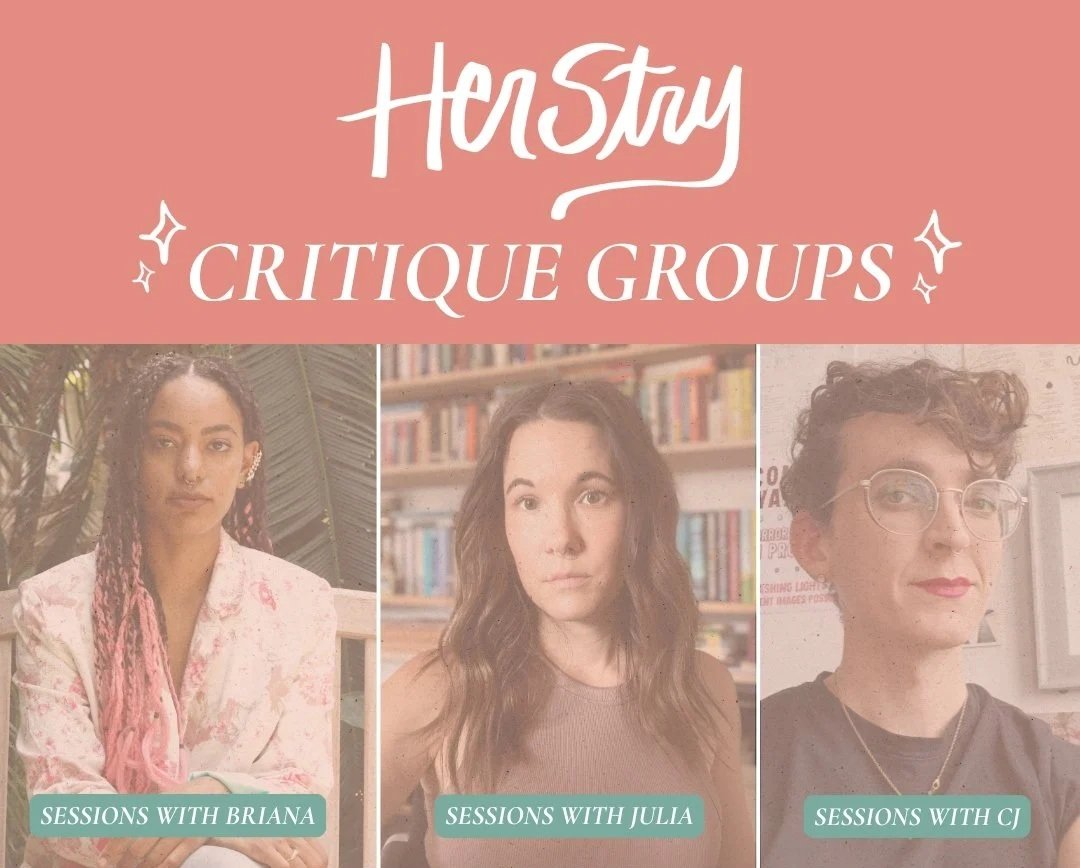
IT’S NO SECRET THAT FEEDBACK IS AN IMPORTANT PART OF THE WRITING PROCESS.
In fact, we argue that it might be the most important part of the process.
But it’s hard to find a writing community. It’s hard to find the people who are willing to take the time and the effort to read your work and give the feedback you really, truly deserves.
That’s where HerStry Critique Groups come in!
HerStry Critique Groups are small groups of 6 women who gather online for 6 weeks to share their writing, give constructive feedback and gain skills as writers.
Weekly online sessions last approximately ninety minutes, with three women sharing their work each week. Writers of all genres and levels are welcome and you may share both works of fiction and nonfiction.
Sessions take place on Mondays 7PM CT, Tuesdays 11AM CT, Fridays 11AM CT
WHAT’S INCLUDED IN THE HERSTRY CRITIQUE GROUPS?
Six 90 minute live workshop sessions
Three 20 minutes sessions in the “hot seat” to get you work critiqued
Written and verbal feedback from your fellow workshop participants
A weekly in depth edit and critique of your work from the group leader after each session
Weekly writing goals and accountability check ins
Full video recordings of each session to keep for your records
Say goodbye to the lonely, stuck in your head writing life!

LET’S WRITE!
From conception to submission. Let’s make summer sizzle with stories.
Writing a short story doesn’t happen in one session. It takes multiple drafts to get it exactly right, to create characters that come to life for the reader and a world they can’t stop thinking about. In this seven week course we will work on a single short story from conception to submission ready. The seven week session will include generative brainstorming sessions, short story craft talks, multiple workshops for feedback from fellow writers, and detailed line by line feedback and edits from your instructor. Plus, we’ll talk about submission venues, cover letters, and when to know if your story is ‘finished.’
IT’S NO SECRET THAT FEEDBACK IS AN IMPORTANT PART OF THE WRITING PROCESS.
In fact, we argue that it might be the most important part of the process.
But it’s hard to find a writing community. It’s hard to find the people who are willing to take the time and the effort to read your work and give the feedback you really, truly deserves.
That’s where HerStry Critique Groups come in!
HerStry Critique Groups are small groups of 6 women who gather online for 6 weeks to share their writing, give constructive feedback and gain skills as writers.
Weekly online sessions last approximately ninety minutes, with three women sharing their work each week. Writers of all genres and levels are welcome and you may share both works of fiction and nonfiction.
Sessions take place on Mondays 7PM CT, Tuesdays 11AM CT, Fridays 11AM CT
WHAT’S INCLUDED IN THE HERSTRY CRITIQUE GROUPS?
Six 90 minute live workshop sessions
Three 20 minutes sessions in the “hot seat” to get you work critiqued
Written and verbal feedback from your fellow workshop participants
A weekly in depth edit and critique of your work from the group leader after each session
Weekly writing goals and accountability check ins
Full video recordings of each session to keep for your records
Say goodbye to the lonely, stuck in your head writing life!
October 7, 14, 21, 28, November 4 and 18 CT
There is no class on November 11.
WRITING THE SEX SCENE.
Writing a sex scene can be delirious fun, a harrowing challenge, a literary milestone—possibly the most important part of building your short story or book. In our six weeks together, you’ll experience just about every possible emotion as you explore the erotic in different modes: comic, tender, harrowing, soul-shattering … because it really is all about the characters’ feelings, not just the mechanics. So we’ll talk about tone. Vocabulary. Metaphor. Sensory detail. How to get big emotions on the page … and when to pull back and let the reader’s imagination go to work.
This is a course for writers who want to explore the intersection between the novel and short stories, and would like to weave their short stories into a story cycle (or collection of "linked stories" or "composite novel"). This is also a class about the interaction of form and content, and how one influences the other. We will read works of interlinked stories by writers from diverse cultural and ethnic backgrounds, focusing on modern classics and contemporary practitioners of these hybrid forms. Weekly discussions will center on elements of craft, such as the expansion and compression of time, setting as an organizing and connecting principle, character development within and between stories, structure and plot for interconnected stories, and responding to literary influences in the same genre.
This six-week course guides writers through the literary submission process, offering insider insight and practical tools to help you get your work into the world. We’ll demystify everything from reading submission calls to writing cover letters and choosing the right journals. Along the way, we’ll workshop short bios, develop submission trackers, and build personalized plans that align with your voice and goals.
By the end of the course, you’ll walk away with a polished piece ready to send, a tailored submission list, and the confidence to navigate the lit mag world with clarity and purpose.
Ideal for writers of literary fiction, poetry, personal essay, memoir, and hybrid forms.

Jeani Rice-Cranford recently graduated from Vanderbilt Divinity School with a Master’s degree in Divinity. During her time at Vanderbilt, she interned as a chaplain with Operation Stand Down Tennessee—a nonprofit organization specializing in helping veterans connect with community, educational, and employment resources throughout middle Tennessee—and as a pastoral intern with Holy Trinity Community Church in Nashville—a sister church in the United Church of Christ.
Jeani is currently discerning the vocational aspect of her calling to ministry and enjoys facilitating a bi-monthly conversation regarding the ways in which we can become more healthy when Responding to Change, as well as participating in writing projects related to theology and the practices of faith—seeking justice, loving mercy, and walking humbly with our God that we might love God with all that we are, and love our neighbors as we love ourselves.
I came home to wisps of white paper blowing through the screened-in porch like feathers in a chicken coop. Rosie, the rescue puppy, was sitting on haunches with head bowed and tail wagging sheepishly, white exclamation points in the black spots of her scruffy fur. The trail of paper led from the porch, through the dog door, to the living room floor, to the black leather cover of my grandmother’s Bible, her name in gold on the lower corner.