
Are you are uncomfortable by what you see?
I would not be surprised.
We're trained to judge a body by what it is,
and what it is not.

Every flaw has been painted into my mirror,
drilled into my brain from the first time
I saw my Mother mix Slim-Fast
into a cup of fat-free milk.
The first time I heard she’s happier
now that her love-handles are gone.
Every ad is a microscope to this body’s flaws.
Every plan to lose a dress size in two weeks
Every new squat, press, and lunge;
Peel off those inches.
Fit into that bikini by summer.
Take up less space.
You are more comfortable
the smaller I become,
the smoother I become—
that much easier to slip from view.
I know you are uncomfortable.
My body, this swimsuit,
a burden to your eyes.
How else to explain how you can’t
lift them to meet my own.
My body is a sin—
I know this, feel it every day.
I send my wallet up as a prayer
to the gods of Sephora and Planet Fitness.
I lift, press, color, and pluck
until I'm forgiven for getting old.
What a day it would be to have you look at me
without me hiding my muffin top.
Oh, the relief it would be if I could stop worrying
about the dimples in my thighs.
What it would be to have you look at me
without me wondering if you notice
my frown lines and hooded eyes.
I will wear this bikini today.
Wear it without layering it
in shirts and shame.
I can’t carry the weight
of your judgement, anymore.
My body will touch sunlight.
-Alexis-Rueal
Wednesdays at 6pm CST, March 31 - June 2, 2027
How do we make sense of the terrifying and unknown? For both ancient times and the modern era, fairytales, myths, and legends have provided insights into the human mind and community at large, but at the center of those stories are the experiences and truths of women. In this special topics craft course, we will explore contemporary retellings of magic and myth across writing genres through the lens of womanhood. Required readings in the course will feature work by Helen Oyeyemi, Sabrina Orah Mark, and others. Students will read and write across the genres in writing prompts, and the class will culminate in a workshop.
The hermit crab essay is a term originally coined by Brenda Miller and Suzanne Paola in their craft book Tell It Slant: Creating, Refining, and Publishing Creative Nonfiction. Like its namesake, the hermit crab essay borrows an existing container, such as a list, set of directions, tarot card reading, or real estate listing, and makes it its own.
In this workshop, we’ll explore how different authors use the Hermit Crab Essay as a creative vehicle for approaching topics that may feel too difficult, vulnerable, or traumatic to write about directly. I’ll share writing exercises, practical tools, and techniques that you can take with you to experiment with this form and begin crafting your own next essay.
The success of Gillian Flynn’s Gone Girl (2012) heralded a new era of domestic suspense. Most of the novels that came to define this genre featured white women narrators behaving badly. While this convention invokes the precedent of the pathologization of hysterical women, we must also consider how this convention relies on contemporary white privilege. How do Caro Claire Burke’s Yesteryear (2026), Alice Feeney’s My Husband’s Wife (2026), and Meagan Church’s The Mad Wife (2025) use unreliable narration to suggest that madness is a privileged state?
Women characters are still too often judged by one question: Is she likeable? That question can do a lot of damage on the page. Anger gets softened. Ambition needs an explanation. Bad decisions need a sympathetic reason behind them. A woman can be selfish, difficult, ruthless, jealous, furious, or want something she probably shouldn't, but writers often start sanding those edges down because they're afraid the reader won't like her. But liking a character and wanting to keep reading about her are two very different things. Stop Making Her Likeable is a 90-minute workshop about what actually keeps a reader invested in a complicated woman. We'll look at why readers can become completely absorbed by characters they don't approve of, what makes difficult behaviour fascinating rather than simply frustrating, and how motivation, contradiction, desire, and agency affect the way a reader responds to her. We'll also look at our own pages. Where are we explaining a woman because we're afraid she'll be judged? Where are we making her apologize for wanting something? Where have we given her a tragic reason for behaviour that we might simply allow from a male character? The goal isn't to teach writers how to create an “unlikeable female character.” It's to stop treating likeability as the price a woman has to pay to be worth reading about.
In this course, author Piper L. White will discuss feminism through the use of fairytales and how to take these beloved childhood stories and twist them into our modern writing by delving deep into the psyche of women-identifying people and their everyday horrors to craft their own prose pieces.
This product gives you access to all four weeks of the workshop. Purchase one or more drop-in sessions here.
Build a habit in 20 sessions. In this 4 week workshop that meets Mondays through Fridays from 8:00-9:00 AM CST, we will focus on generating new writing—making headway on a current project, reviving an old project that’s been gathering dust, or writing based off of the daily prompts Leigh provides.
The first 45 minutes of class are a gentle, camera-off, silent writing session. The remaining 15 minutes are an opportunity to share excerpts of our work, reflect on progress made, and set intentions for the following day. Then we will read a passage together on the writing life and close each class with a new learning about habit formation. By the end of this course we’ll have a morning writing habit that is each our own to continue and build upon.
This listing is for an individual class. To purchase access for the full 4-week workshop, click here.
Build a habit in 20 sessions. In this 4 week workshop that meets Mondays through Fridays from 8:00-9:00 AM CST, we will focus on generating new writing—making headway on a current project, reviving an old project that’s been gathering dust, or writing based off of the daily prompts Leigh provides.
The first 45 minutes of class is a gentle, camera-off, silent writing session. The remaining 15 minutes are an opportunity to share excerpts of our work, reflect on progress made, and set intentions for the following day. Then we will read a passage together on the writing life and close each class with a new learning about habit formation. By the end of this course we’ll have a morning writing habit that is each our own to continue and build upon.
Some of the most compelling creative nonfiction begins with the feelings we are tempted to avoid: anger, resentment, shame, fear, or the sense that we have an axe to grind. In this six-week workshop, writers will explore how to follow that emotional heat toward deeper, more honest work—without sacrificing compassion, complexity, or craft. Through close readings, writing exercises, discussion, and constructive feedback, we’ll consider how to transform strong feelings into writing that reaches beyond catharsis and connects with readers.
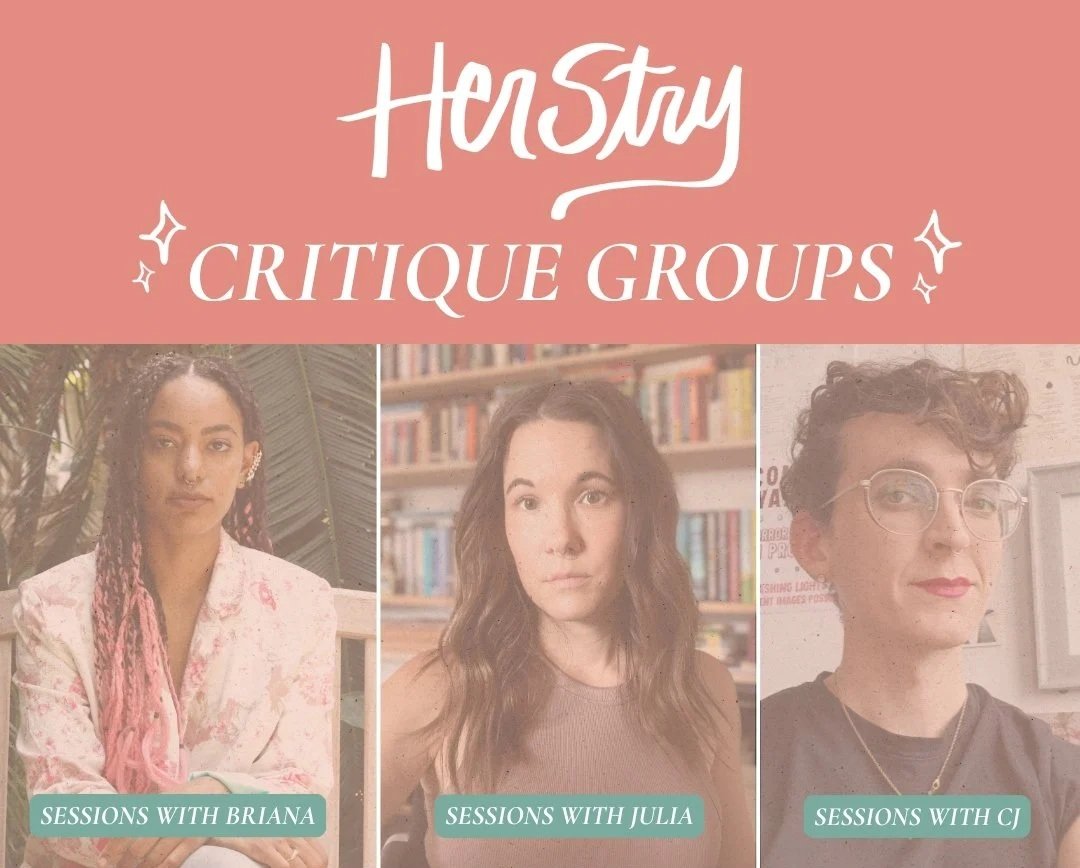
IT’S NO SECRET THAT FEEDBACK IS AN IMPORTANT PART OF THE WRITING PROCESS.
In fact, we argue that it might be the most important part of the process.
But it’s hard to find a writing community. It’s hard to find the people who are willing to take the time and the effort to read your work and give the feedback you really, truly deserves.
That’s where HerStry Critique Groups come in!
HerStry Critique Groups are small groups of 6 women who gather online for 6 weeks to share their writing, give constructive feedback and gain skills as writers.
Weekly online sessions last approximately ninety minutes, with three women sharing their work each week. Writers of all genres and levels are welcome and you may share both works of fiction and nonfiction.
Sessions take place on Mondays 7PM CT, Tuesdays 11AM CT, Fridays 11AM CT
WHAT’S INCLUDED IN THE HERSTRY CRITIQUE GROUPS?
Six 90 minute live workshop sessions
Three 20 minutes sessions in the “hot seat” to get you work critiqued
Written and verbal feedback from your fellow workshop participants
A weekly in depth edit and critique of your work from the group leader after each session
Weekly writing goals and accountability check ins
Full video recordings of each session to keep for your records
Say goodbye to the lonely, stuck in your head writing life!

Alexis-Rueal is a Columbus, Ohio poet whose work has appeared in online and print journals throughout the US and Europe. She enjoys performing in venues and festivals throughout Ohio and Kentucky, and she was a member of the Women of Appalachia: Women Speak project in 2016-17. Her first full-length collection, I Speak Hick, was published by Writing Knights Press in 2016.
Want to know what makes agents request pages? It all starts with a captivating query letter, and you can bet giraffe there’s a formula agents look for. Join literary agent and founder of GiraffeLight Media Agency, Stephanie Katz, as she talks how to structure query letters that will get agents’ attention, the key Green Flags agents look for and the Icks that turn them off, the all important Comp Titles that authors unknowingly live and die by, and how so many authors are using Comp Titles wrong. The Query Letter is your industry handshake, and Stephanie will help teach you how to make it strong.