
It's been a year since I haven't had breasts, and I think I’m pretty well adjusted. At first, I thought I was going to have new breasts made from fat taken off somewhere else on my body. It turns out I lack “the right kind of fat,” so, at the last moment, I opted to forgo reconstruction.
To conjure a picture of what my torso looks like, flat as a board and flat as a pancake don't apply. My chest is not flat. It's two concave spots on either side of a protruding sternum. It’s divots and crisscrosses of scars—some thick, some thin. The weirdest part are the little flaps that were left— “pockets, in case you want implants.”
The local plastic surgeon apparently doesn't believe that no means no.
My ribs stick out like hills above valleys. Last month, my endocrinologist asked if I’d always had this peculiar deformity. I didn’t know that’s what it’s called, but sometimes I tell people to touch it so they can see that it's bone and not tissue. They are always surprised which lets me know that everyone who sees me probably thinks it’s flesh, like the protruding abdomens common to heavy drinkers. I don't drink. My liver has to be babied at all times.

When the nurse called and said, “Your biopsy results show malignant ductal carcinoma in situ,” I was shocked. Did she say, “carcinoma?”
“What?” I sat down. “What do you mean, ‘malignant?’”
She said a few more words and I interrupted, “Wait a minute. Are you saying that I have CANCER?”

At first, they were nothing but trouble.
“I want her to wear a shirt from now on,” my father barked at my mother. He refused to address me now that I had the smallest hint of breast development.
A short time later, as my tops clung to my chest and my flat torso became round and foreign, I felt weird and ugly.

The Charles River Esplanade, a green and flowering oasis in the heart of Boston, is a popular place for cyclists, picnickers, parents pushing strollers, and college kids looking to rent kayaks and sailboats. But on a September Sunday I spent there, the majority of park visitors had a different activity in mind: a 5-mile fundraising walk while wearing lots of pink.

It's been a year since I haven't had breasts, and I think I’m pretty well adjusted. At first, I thought that I was going to have new breasts made from fat taken off somewhere else on my body, but it turns out that I lack “the right kind of fat,” so, at the last moment, I opted to forgo reconstruction.

“Why me” never crosses your mind. Maybe you feel it’s inevitable; after all, your best friend and first boyfriend both died from cancer—not breast like you, but cancer nonetheless. And your favorite grandfather and most of his brothers and sisters—except the sister who died in the influenza epidemic—died of cancer.

I can't even take a Tylenol, much less have a cocktail.
My mother had breast cancer when I was a little girl. It was present in several lymph nodes. Her chemo at Stanford seemed to go on for years. She’s in her eighties now, having survived stage three colon cancer in her sixties. Her identical twin sister chose a lumpectomy and no treatment but it came back five years later. She passed away the morning after my wedding. My brother died young from melanoma. All of this indicated we might have the BRCA gene mutation in our family. Sure enough, we do. I have to remind myself that being able to become a previvor—when one’s chances of not getting cancer are only twelve percent—seems pretty fantastic in the scheme of things. It’s a miracle of sorts.
So, below my weird rib protrusion, I have quite a belly, but it’s a side effect of the high dosage steroids that have kept me functioning with my health issues. “It's caused something called Cushing's Syndrome,” says the doctor at Stanford. People who know what that is sometimes ask if I have it, by the roundness of my face and, probably, the hump on my back which I don't really see unless I look.
This belly and chest remind me of a Buddha figurine. And, weirdly, that makes me smile like one. I look down at myself and there's something baby-like, not just in the concave chest and stuck-out belly, but in the way that it all flops together without any ability to tuck it in self-consciously.
I rather like this new me.
-Beri Balistreri
The hermit crab essay is a term originally coined by Brenda Miller and Suzanne Paola in their craft book Tell It Slant: Creating, Refining, and Publishing Creative Nonfiction. Like its namesake, the hermit crab essay borrows an existing container, such as a list, set of directions, tarot card reading, or real estate listing, and makes it its own.
In this workshop, we’ll explore how different authors use the Hermit Crab Essay as a creative vehicle for approaching topics that may feel too difficult, vulnerable, or traumatic to write about directly. I’ll share writing exercises, practical tools, and techniques that you can take with you to experiment with this form and begin crafting your own next essay.
The success of Gillian Flynn’s Gone Girl (2012) heralded a new era of domestic suspense. Most of the novels that came to define this genre featured white women narrators behaving badly. While this convention invokes the precedent of the pathologization of hysterical women, we must also consider how this convention relies on contemporary white privilege. How do Caro Claire Burke’s Yesteryear (2026), Alice Feeney’s My Husband’s Wife (2026), and Meagan Church’s The Mad Wife (2025) use unreliable narration to suggest that madness is a privileged state?
Women characters are still too often judged by one question: Is she likeable? That question can do a lot of damage on the page. Anger gets softened. Ambition needs an explanation. Bad decisions need a sympathetic reason behind them. A woman can be selfish, difficult, ruthless, jealous, furious, or want something she probably shouldn't, but writers often start sanding those edges down because they're afraid the reader won't like her. But liking a character and wanting to keep reading about her are two very different things. Stop Making Her Likeable is a 90-minute workshop about what actually keeps a reader invested in a complicated woman. We'll look at why readers can become completely absorbed by characters they don't approve of, what makes difficult behaviour fascinating rather than simply frustrating, and how motivation, contradiction, desire, and agency affect the way a reader responds to her. We'll also look at our own pages. Where are we explaining a woman because we're afraid she'll be judged? Where are we making her apologize for wanting something? Where have we given her a tragic reason for behaviour that we might simply allow from a male character? The goal isn't to teach writers how to create an “unlikeable female character.” It's to stop treating likeability as the price a woman has to pay to be worth reading about.
In this course, author Piper L. White will discuss feminism through the use of fairytales and how to take these beloved childhood stories and twist them into our modern writing by delving deep into the psyche of women-identifying people and their everyday horrors to craft their own prose pieces.
This product gives you access to all four weeks of the workshop. Purchase one or more drop-in sessions here.
Build a habit in 20 sessions. In this 4 week workshop that meets Mondays through Fridays from 8:00-9:00 AM CST, we will focus on generating new writing—making headway on a current project, reviving an old project that’s been gathering dust, or writing based off of the daily prompts Leigh provides.
The first 45 minutes of class are a gentle, camera-off, silent writing session. The remaining 15 minutes are an opportunity to share excerpts of our work, reflect on progress made, and set intentions for the following day. Then we will read a passage together on the writing life and close each class with a new learning about habit formation. By the end of this course we’ll have a morning writing habit that is each our own to continue and build upon.
This listing is for an individual class. To purchase access for the full 4-week workshop, click here.
Build a habit in 20 sessions. In this 4 week workshop that meets Mondays through Fridays from 8:00-9:00 AM CST, we will focus on generating new writing—making headway on a current project, reviving an old project that’s been gathering dust, or writing based off of the daily prompts Leigh provides.
The first 45 minutes of class is a gentle, camera-off, silent writing session. The remaining 15 minutes are an opportunity to share excerpts of our work, reflect on progress made, and set intentions for the following day. Then we will read a passage together on the writing life and close each class with a new learning about habit formation. By the end of this course we’ll have a morning writing habit that is each our own to continue and build upon.
Many writers feel drawn to write about their lives but struggle with uncertainty: Why this story? Why now? And who is it really for? This workshop is designed to help writers move beyond doubt and toward clarity by focusing on the deeper meaning and purpose beneath their story.
In this interactive, craft-forward session, participants will be introduced to the Memoir Compass, a practical framework that helps writers articulate their motivation (why they are writing), mission (who the story serves), and message (what meaning or insight the story carries). Through guided reflection and writing exercises, participants will begin shaping a personal narrative rooted in intention rather than overwhelm.
This workshop is ideal for writers interested in memoir or personal narrative, as well as fiction writers drawing from lived experience, who want to move forward with greater confidence, focus, and direction.
Some of the most compelling creative nonfiction begins with the feelings we are tempted to avoid: anger, resentment, shame, fear, or the sense that we have an axe to grind. In this six-week workshop, writers will explore how to follow that emotional heat toward deeper, more honest work—without sacrificing compassion, complexity, or craft. Through close readings, writing exercises, discussion, and constructive feedback, we’ll consider how to transform strong feelings into writing that reaches beyond catharsis and connects with readers.
IT’S NO SECRET THAT FEEDBACK IS AN IMPORTANT PART OF THE WRITING PROCESS.
In fact, we argue that it might be the most important part of the process.
But it’s hard to find a writing community. It’s hard to find the people who are willing to take the time and the effort to read your work and give the feedback you really, truly deserves.
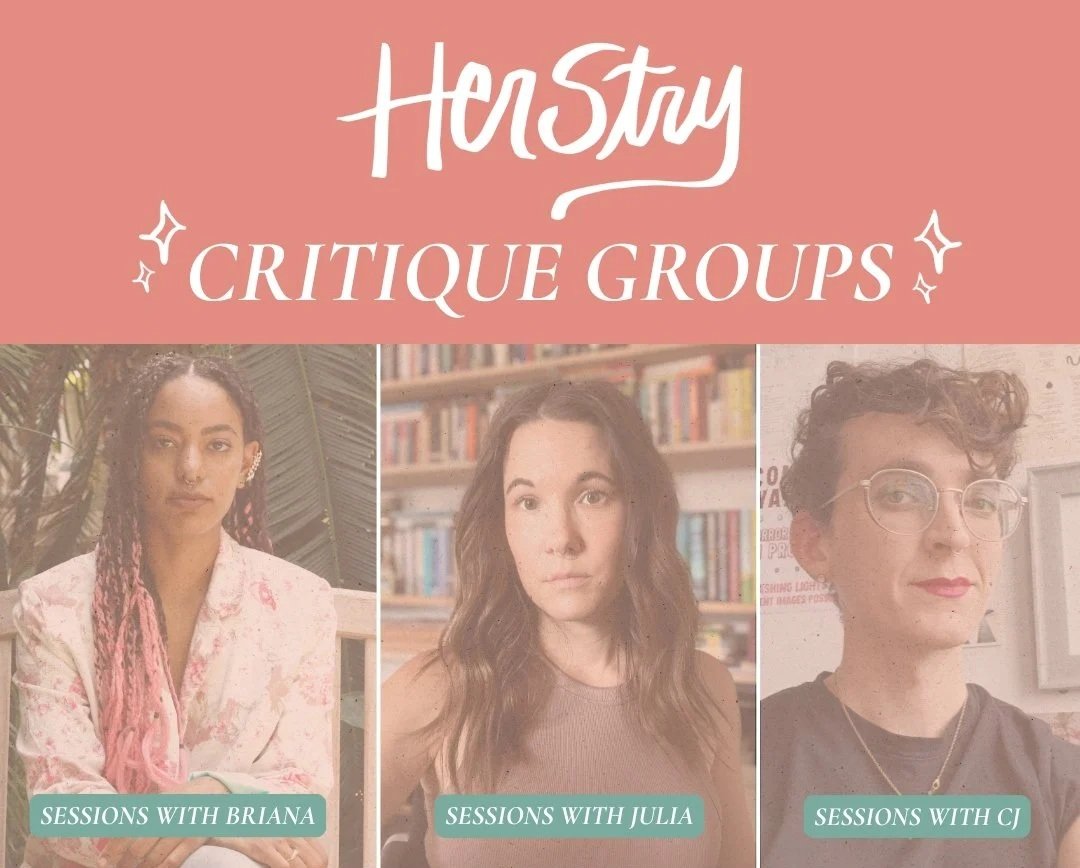
That’s where HerStry Critique Groups come in!
HerStry Critique Groups are small groups of 6 women who gather online for 6 weeks to share their writing, give constructive feedback and gain skills as writers.
Weekly online sessions last approximately ninety minutes, with three women sharing their work each week. Writers of all genres and levels are welcome and you may share both works of fiction and nonfiction.
Sessions take place on Mondays 7PM CT, Tuesdays 11AM CT, Fridays 11AM CT
WHAT’S INCLUDED IN THE HERSTRY CRITIQUE GROUPS?
Six 90 minute live workshop sessions
Three 20 minutes sessions in the “hot seat” to get you work critiqued
Written and verbal feedback from your fellow workshop participants
A weekly in depth edit and critique of your work from the group leader after each session
Weekly writing goals and accountability check ins
Full video recordings of each session to keep for your records
Say goodbye to the lonely, stuck in your head writing life!
LET’S WRITE!
From conception to submission. Let’s make summer sizzle with stories.
Writing a short story doesn’t happen in one session. It takes multiple drafts to get it exactly right, to create characters that come to life for the reader and a world they can’t stop thinking about. In this seven week course we will work on a single short story from conception to submission ready. The seven week session will include generative brainstorming sessions, short story craft talks, multiple workshops for feedback from fellow writers, and detailed line by line feedback and edits from your instructor. Plus, we’ll talk about submission venues, cover letters, and when to know if your story is ‘finished.’

Beri's writing appears in journals from the August 2019 issue of 'Cleaning Up Glitter' to the feminist 'Encodings' and Andrei Codrescu's 'Exquisite Corpse.' She received Literatea's 2019 Golden Pineapple Award for her creative nonfiction essay. Her plays have been produced in Monterey and San Francisco. Her creative MA is from San Francisco State and her MSW is from USC. Her novel 'Woman Murdered' is a domestic suspense available on Amazon and at select bookstores.
I have loved my girls ever since I got them, maybe because I don’t have beautiful legs or a JLo butt. I’d like to declare my feelings of femininity come solely from my character, but I am not that evolved. When my girls arrived around the age of thirteen, they felt wonderfully womanly. I’ve loved them ever since.