
It never happened at Isaly’s ice cream joint, the first place I waitressed.
Waitressing is probably not the right word for what I did. It was more like order-taking, burger-flipping, shake-making, and plopping-on-the-counter-for-the-customer work. That demanding all-in-one food industry post that so many have as their first or second or forever job.
Interactions with customers at Isaly’s ice cream were brief and direct, an absolute necessity as I juggled the buns and burgers and scoops and sodas in one never-ending coordinated motion.
I must’ve had a uniform, but I only remember the apron, with pockets for the order pad and any coins customers might leave me. There was no pretense of socializing. I spent as much time scrubbing the grill at the end of the shift, getting it as close to glistening as the scores of hamburger patties allowed, as I did making small talk with those bent over malts or root beer floats.
So I wasn’t prepared for the socializing required in my first real waitressing job in a French restaurant in Boston. I was a newly minted college grad whose academic credentials, combined with her gender, meant that waitressing was inevitable.
There was some kind of required attire at that toney place, but the details are seared from my memory. What I do recall was the requisite mask, essential every moment on duty, but not provided by the employer: a wide, unfailing, and one hundred percent-approving smile. A smile that did not move, no matter how impatient, rude, or inappropriate the customer’s behavior.

It was almost three years ago when I went over to his house. He was a sophomore in college that already lived off campus and that was kind of cool. He was into anime and when I had been the desk manager at the dorm he had lived in the year before that was how we became friends. Kind of.

Childhood games, such as “boys catch the girls,” taught us how to behave and what to feel about ourselves. It taught us that we are not important unless we are pursued.


It was over a year later that I realized what had happened. It may sound strange to you that I didn’t know it had. Wouldn’t you know if that kind of thing had happened to you? I wasn’t unconscious or inebriated. I remembered that evening, those moments in that room, but I didn’t realize it had happened. Because it wasn’t the kind of thing I was taught about in health class. Instead, I was taught about herpes and genital warts and obesity.

Train station toilets and hospital rooms, especially bed seven, smell the same. Like chlorine and baking soda and coercion and cold. I’m seventeen and I wear my school uniform. No - she wears her school uniform, three layers of khaki and stockings. He wears a suit and carries an umbrella.

Over a decade ago, I had a best guy friend with whom I shared a great deal of my life. He was the picture perfect, textbook “nice guy.” Unfortunately, as is common, when someone seems nearly too good to be true, they often are. This guy was my best friend. And I his. I had always suspected that he wanted more than my friendship, but I wasn’t interested in taking our relationship to that place. I thought this was something that he would respect. I was wrong.


On an August day in 1988 I walked home from my summer job at the Farish Street YMCA. I was fifteen and a freshman in the Lanier High School band. Dressed in shorts and a t-shirt I moved along the sidewalk of Monument Street quick and unresponsive to the honking horns and catcalls from the fluid noon traffic. A man in torn blue jeans walked towards me with a brown bag in hand. He brought the bag to his lips then howled when he returned it to his side. He looked at me then said,” GOOD STUFF!”
It started with the verbal. Familiarity from male customers, whose repeated names for me were deemed flattering, playful, and-above all-innocent.
“Honey,” “Sweetie,” “Good-lookin’, ” “Cutie pie.”
This was blizzard-bound, baked-bean, Redsocks Boston. Boston, where redlining insured racial segregation, and Catholic cultural mores taught men to see women as handmaids. A far cry from the welcoming South I would later embrace, where New Orleans greetings include terms of endearment, no matter the ages or genders.

When the French restaurant customers began the stream of what were, in essence, three-piece-suit catcalls, I was startled. I did a quick check to make sure my mask was on straight. That was no small challenge, as I felt like someone had just grabbed my heart and given it a hard pinch.
I went back to the kitchen to place orders, breathing deeply to calm myself down.
It’s not a big deal. I should ignore it were the mantras I repeated.
One night, a large party’s orders included several rounds of drinks, and as the evening went on, it was not only lips that were loosened. By the time the menu got to dessert, one customer decided that rather than pick from the cart of delicacies I parked at his side, he would have me.
Suddenly an inordinately large and fleshy hand made its way in slow motion down my rump.
It was one of those moments where the combined response of body and soul is to freeze in disbelief, as the mind attempts to make sense of an action that is unexpected, unwanted, and violent all at once.
My mask fell to the floor.
“What the-! Get off me!” I yelled and ran to kitchen.
“That man… assaulted me!” I cried as I grabbed my things. “I quit!”
I marched out of the French restaurant enraged.
As I marched, I tossed my head high and voiced a new mantra.
May we never meet again.
-Mariana Mcdonald
This product gives you access to all four weeks of the workshop. Purchase one or more drop-in sessions here.
Build a habit in 20 sessions. In this 4 week workshop that meets Mondays through Fridays from 8:00-9:00 AM CST, we will focus on generating new writing—making headway on a current project, reviving an old project that’s been gathering dust, or writing based off of the daily prompts Leigh provides.
The first 45 minutes of class are a gentle, camera-off, silent writing session. The remaining 15 minutes are an opportunity to share excerpts of our work, reflect on progress made, and set intentions for the following day. Then we will read a passage together on the writing life and close each class with a new learning about habit formation. By the end of this course we’ll have a morning writing habit that is each our own to continue and build upon.
This listing is for an individual class. To purchase access for the full 4-week workshop, click here.
Build a habit in 20 sessions. In this 4 week workshop that meets Mondays through Fridays from 8:00-9:00 AM CST, we will focus on generating new writing—making headway on a current project, reviving an old project that’s been gathering dust, or writing based off of the daily prompts Leigh provides.
The first 45 minutes of class is a gentle, camera-off, silent writing session. The remaining 15 minutes are an opportunity to share excerpts of our work, reflect on progress made, and set intentions for the following day. Then we will read a passage together on the writing life and close each class with a new learning about habit formation. By the end of this course we’ll have a morning writing habit that is each our own to continue and build upon.
Many writers feel drawn to write about their lives but struggle with uncertainty: Why this story? Why now? And who is it really for? This workshop is designed to help writers move beyond doubt and toward clarity by focusing on the deeper meaning and purpose beneath their story.
In this interactive, craft-forward session, participants will be introduced to the Memoir Compass, a practical framework that helps writers articulate their motivation (why they are writing), mission (who the story serves), and message (what meaning or insight the story carries). Through guided reflection and writing exercises, participants will begin shaping a personal narrative rooted in intention rather than overwhelm.
This workshop is ideal for writers interested in memoir or personal narrative, as well as fiction writers drawing from lived experience, who want to move forward with greater confidence, focus, and direction.
Some of the most compelling creative nonfiction begins with the feelings we are tempted to avoid: anger, resentment, shame, fear, or the sense that we have an axe to grind. In this six-week workshop, writers will explore how to follow that emotional heat toward deeper, more honest work—without sacrificing compassion, complexity, or craft. Through close readings, writing exercises, discussion, and constructive feedback, we’ll consider how to transform strong feelings into writing that reaches beyond catharsis and connects with readers.
IT’S NO SECRET THAT FEEDBACK IS AN IMPORTANT PART OF THE WRITING PROCESS.
In fact, we argue that it might be the most important part of the process.
But it’s hard to find a writing community. It’s hard to find the people who are willing to take the time and the effort to read your work and give the feedback you really, truly deserves.
That’s where HerStry Critique Groups come in!
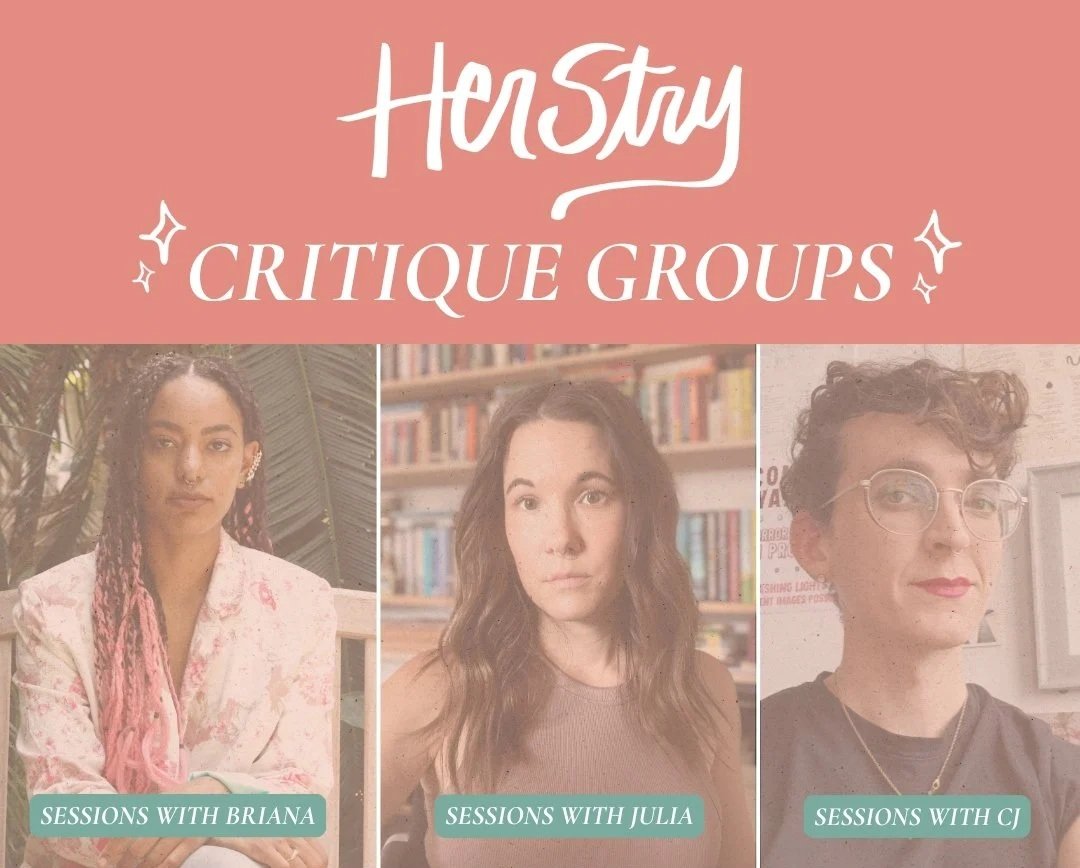
HerStry Critique Groups are small groups of 6 women who gather online for 6 weeks to share their writing, give constructive feedback and gain skills as writers.
Weekly online sessions last approximately ninety minutes, with three women sharing their work each week. Writers of all genres and levels are welcome and you may share both works of fiction and nonfiction.
Sessions take place on Mondays 7PM CT, Tuesdays 11AM CT, Fridays 11AM CT
WHAT’S INCLUDED IN THE HERSTRY CRITIQUE GROUPS?
Six 90 minute live workshop sessions
Three 20 minutes sessions in the “hot seat” to get you work critiqued
Written and verbal feedback from your fellow workshop participants
A weekly in depth edit and critique of your work from the group leader after each session
Weekly writing goals and accountability check ins
Full video recordings of each session to keep for your records
Say goodbye to the lonely, stuck in your head writing life!
LET’S WRITE!
From conception to submission. Let’s make summer sizzle with stories.
Writing a short story doesn’t happen in one session. It takes multiple drafts to get it exactly right, to create characters that come to life for the reader and a world they can’t stop thinking about. In this seven week course we will work on a single short story from conception to submission ready. The seven week session will include generative brainstorming sessions, short story craft talks, multiple workshops for feedback from fellow writers, and detailed line by line feedback and edits from your instructor. Plus, we’ll talk about submission venues, cover letters, and when to know if your story is ‘finished.’
IT’S NO SECRET THAT FEEDBACK IS AN IMPORTANT PART OF THE WRITING PROCESS.
In fact, we argue that it might be the most important part of the process.
But it’s hard to find a writing community. It’s hard to find the people who are willing to take the time and the effort to read your work and give the feedback you really, truly deserves.
That’s where HerStry Critique Groups come in!
HerStry Critique Groups are small groups of 6 women who gather online for 6 weeks to share their writing, give constructive feedback and gain skills as writers.
Weekly online sessions last approximately ninety minutes, with three women sharing their work each week. Writers of all genres and levels are welcome and you may share both works of fiction and nonfiction.
Sessions take place on Mondays 7PM CT, Tuesdays 11AM CT, Fridays 11AM CT
WHAT’S INCLUDED IN THE HERSTRY CRITIQUE GROUPS?
Six 90 minute live workshop sessions
Three 20 minutes sessions in the “hot seat” to get you work critiqued
Written and verbal feedback from your fellow workshop participants
A weekly in depth edit and critique of your work from the group leader after each session
Weekly writing goals and accountability check ins
Full video recordings of each session to keep for your records
Say goodbye to the lonely, stuck in your head writing life!
October 7, 14, 21, 28, November 4 and 18 CT
There is no class on November 11.
WRITING THE SEX SCENE.
Writing a sex scene can be delirious fun, a harrowing challenge, a literary milestone—possibly the most important part of building your short story or book. In our six weeks together, you’ll experience just about every possible emotion as you explore the erotic in different modes: comic, tender, harrowing, soul-shattering … because it really is all about the characters’ feelings, not just the mechanics. So we’ll talk about tone. Vocabulary. Metaphor. Sensory detail. How to get big emotions on the page … and when to pull back and let the reader’s imagination go to work.
This is a course for writers who want to explore the intersection between the novel and short stories, and would like to weave their short stories into a story cycle (or collection of "linked stories" or "composite novel"). This is also a class about the interaction of form and content, and how one influences the other. We will read works of interlinked stories by writers from diverse cultural and ethnic backgrounds, focusing on modern classics and contemporary practitioners of these hybrid forms. Weekly discussions will center on elements of craft, such as the expansion and compression of time, setting as an organizing and connecting principle, character development within and between stories, structure and plot for interconnected stories, and responding to literary influences in the same genre.
This six-week course guides writers through the literary submission process, offering insider insight and practical tools to help you get your work into the world. We’ll demystify everything from reading submission calls to writing cover letters and choosing the right journals. Along the way, we’ll workshop short bios, develop submission trackers, and build personalized plans that align with your voice and goals.
By the end of the course, you’ll walk away with a polished piece ready to send, a tailored submission list, and the confidence to navigate the lit mag world with clarity and purpose.
Ideal for writers of literary fiction, poetry, personal essay, memoir, and hybrid forms.

Mariana Mcdonald is a bicultural poet, fiction writer, journalist and editor. Her work has appeared widely, including poetry in Crab Orchard Review, Lunch Ticket, and Poesía en Vuelo, fiction in So to Speak and Cobalt, creative nonfiction in Longridge Review, and nonfiction in In Motion. She edited the 2017 International Latino Book Award-winning bilingual memoir Cartas a Karinaby Oscar López Rivera. She is active in social justice movements and the writing community.
It never happened at Isaly’s ice cream joint, the first place I waitressed.
Well, waitressing is probably not the right word for what I did. It was more like order-taking, burger-flipping, shake-making, and plopping-on-the-counter-for-the-customer work. That demanding all-in-one food industry post that so many have as their first or second or forever job.