
She grabbed the goose by the beak, straddled it between her thighs, plucked the feathers from its neck, slit it, bled it into quietude, and continued to pluck the rest of the feathers. That night we had czernina and drumsticks.
There was a sweet side to Gran; she poured it into her cakes drowned in vodka and homemade jam. Her cellar contained riches of golden Rainier cherries, gooseberries, and currants. I would fly down the whitewashed concrete steps into the cellar and glide across the dusty floor toward the small window where dust specks danced to their secret melody, entertaining rows of jam. I could have stayed there for hours if it wasn’t for the goose ghost stalking my steps.
Although she filled my childhood with fresh bakes, crochet doilies, handmade dresses, and later, cherry liquor, my gran’s journey has been far from a fairytale.
She never complained about the lack of recognition for assisting wounded WWII soldiers. It’s what was expected. She didn’t blink an eye when she had to sacrifice her education to work as a housemaid. It’s what was expected. She didn’t grumble when she had to manage a distillery in between birthing a couple of children, single-handedly tending to a farm and backyard garden. It’s what was expected. She watched silently as her son moved almost nine thousand miles away, across oceans and lands with her only grandchildren.

I inherited three things from my paternal grandmother: my middle name, an engagement ring, and the desire to be a writer. I didn’t know that Gram’s ambitions to be a writer matched mine until I was sixteen, when I read an essay she wrote titled “Why I Am What I Am.” In it, she writes, “I have a very decided ambition to become an authoress. I have always loved to write…I have a vivid imagination, which was probably kindled by the necessity of my finding something within myself to amuse myself, for I had very few friends my age.” As the youngest person in both my extended family and my neighborhood by nearly a decade, I knew what she meant.

Rose, I saw a picture of you today. The first one, I think, I’ve ever seen. Your face was kind, like my Gran’s. For some reason this surprised me. But you must have been kind. Your daughter is kindness personified. The photo was sent by Amanda, your granddaughter, my aunt. I’d fired off an email this morning, and by lunchtime there you were, sitting in my downloads. I tried to zoom in on your face, but you pixelated on my phone screen. You were sixty-three, sitting in the garden with Great-Grandpa on Amanda’s eighth birthday. My mother, a chubby toddler, sits on Great-Grandpa’s lap. Sixty-three is the age my parents are now, but you look much older than them. Maybe it’s your clothes, your hairstyle, or the black and white camera. Maybe it’s the war, the guilt and grief that you carried away from it.

Daytime soap operas held all the answers.
In fifth grade, my friend Connie introduced me to daytime soap operas so I could learn about things of which I had no firsthand knowledge, things that Connie already understood—love triangles, how to successfully ruin the social and business reputations of others, dead people coming back to life as their previously unknown evil twin.

I didn’t learn to read until I was eight years old, a full month into second grade. It’s not something that entirely made sense, since I had learned how to spell simple words in the previous year, and I could speak English with the same ease as Spanish since the end of kindergarten. Reading, however, was something that had slipped past until the day my teacher took me aside, bewildered by my scattershot collection of knowledge.

The joke about Bath, Michigan, where my grandparents lived, was that it was fifteen miles and fifty years outside of Lansing, the capital city. A wooden sign painted “Welcome to the Community of Bath, Michigan” with the moniker of a Boy Scout Troop from the early 1970s was the first indicator that one was leaving urban civilization.

My grandmother’s teeth have been the lively topic of family jokes for many years. This is not cruel, but rather a kind of family shorthand, coded with her legacy of the need for levity during adversity. Even today, mention of my grandmother’s teeth prompts laughter and joy.

For months after my abuelita died, I slept with the covers tucked around my six-year-old face. The breeze that blew in from the Caribbean, cooling along the way as it traveled across the mountains, through the concrete city of Caracas, past the iron bars of my bedroom window, entering my mouth, my nose, my ears, felt like something my grandmother had sent from above, just for me.

Grandma Helen was my fancy grandmother. Born in 1909, she was the firstborn child of Julius and Mary Nelson’s five children. Her tall, blue-eyed father liked to tell her that her birth brought him luck. After Grandma arrived, Julius went from selling newspapers on the Lower East Side to learning the trade in his wife’s family’s coat business.

I am standing in front of the microwave with its door open, ready to insert the bag of popcorn I’ll have for dinner. As I reach for the bag, I hear the lush opening notes of “The Blue Danube Waltz” by Johann Strauss. My body freezes, immobilized as if zapped by some 1950s, paralyzing ray gun. Before I can turn around to see if it’s an ad on TV, my eyes puddle up.

When she finally retired, the underworld claimed her husband and left her alone. Time slowed down. She filled her house with plants—ferns, spider plants, violets, chrysanthemums, and golden pothos. Every corner was taken up by palms of various shapes and sizes. Perhaps they were the perfect company—calm and giving, within her reach and control.
My gran's sacrifices haven’t been in vain. I may struggle to keep a fern alive and have two left hands when holding a crochet hook, but her will and determination push me to try harder. Her selflessness makes me want to be the best version of myself, to make her efforts worthwhile.
I look back on a photo from her youth. She’s about the same age as me, sitting atop a motorbike with her black hair resting on her shoulders and wearing a confident smile. She’s about to embark on a journey of motherhood. She will hear about a man landing on the moon. She will learn about the internet, wireless devices, coffee machines, and ThermoMixers. She will be amused when her prized rooster chases down her granddaughter, solidifying a fear of chickens forevermore. I am proud of who she is and who she’s yet to become. I hope I can tackle my changing world with an open mind and forgiving heart, as she has.
-Ola Kwintowski
This product gives you access to all four weeks of the workshop. Purchase one or more drop-in sessions here.
Build a habit in 20 sessions. In this 4 week workshop that meets Mondays through Fridays from 8:00-9:00 AM CST, we will focus on generating new writing—making headway on a current project, reviving an old project that’s been gathering dust, or writing based off of the daily prompts Leigh provides.
The first 45 minutes of class are a gentle, camera-off, silent writing session. The remaining 15 minutes are an opportunity to share excerpts of our work, reflect on progress made, and set intentions for the following day. Then we will read a passage together on the writing life and close each class with a new learning about habit formation. By the end of this course we’ll have a morning writing habit that is each our own to continue and build upon.
This listing is for an individual class. To purchase access for the full 4-week workshop, click here.
Build a habit in 20 sessions. In this 4 week workshop that meets Mondays through Fridays from 8:00-9:00 AM CST, we will focus on generating new writing—making headway on a current project, reviving an old project that’s been gathering dust, or writing based off of the daily prompts Leigh provides.
The first 45 minutes of class is a gentle, camera-off, silent writing session. The remaining 15 minutes are an opportunity to share excerpts of our work, reflect on progress made, and set intentions for the following day. Then we will read a passage together on the writing life and close each class with a new learning about habit formation. By the end of this course we’ll have a morning writing habit that is each our own to continue and build upon.
Many writers feel drawn to write about their lives but struggle with uncertainty: Why this story? Why now? And who is it really for? This workshop is designed to help writers move beyond doubt and toward clarity by focusing on the deeper meaning and purpose beneath their story.
In this interactive, craft-forward session, participants will be introduced to the Memoir Compass, a practical framework that helps writers articulate their motivation (why they are writing), mission (who the story serves), and message (what meaning or insight the story carries). Through guided reflection and writing exercises, participants will begin shaping a personal narrative rooted in intention rather than overwhelm.
This workshop is ideal for writers interested in memoir or personal narrative, as well as fiction writers drawing from lived experience, who want to move forward with greater confidence, focus, and direction.
Some of the most compelling creative nonfiction begins with the feelings we are tempted to avoid: anger, resentment, shame, fear, or the sense that we have an axe to grind. In this six-week workshop, writers will explore how to follow that emotional heat toward deeper, more honest work—without sacrificing compassion, complexity, or craft. Through close readings, writing exercises, discussion, and constructive feedback, we’ll consider how to transform strong feelings into writing that reaches beyond catharsis and connects with readers.
IT’S NO SECRET THAT FEEDBACK IS AN IMPORTANT PART OF THE WRITING PROCESS.
In fact, we argue that it might be the most important part of the process.
But it’s hard to find a writing community. It’s hard to find the people who are willing to take the time and the effort to read your work and give the feedback you really, truly deserves.
That’s where HerStry Critique Groups come in!
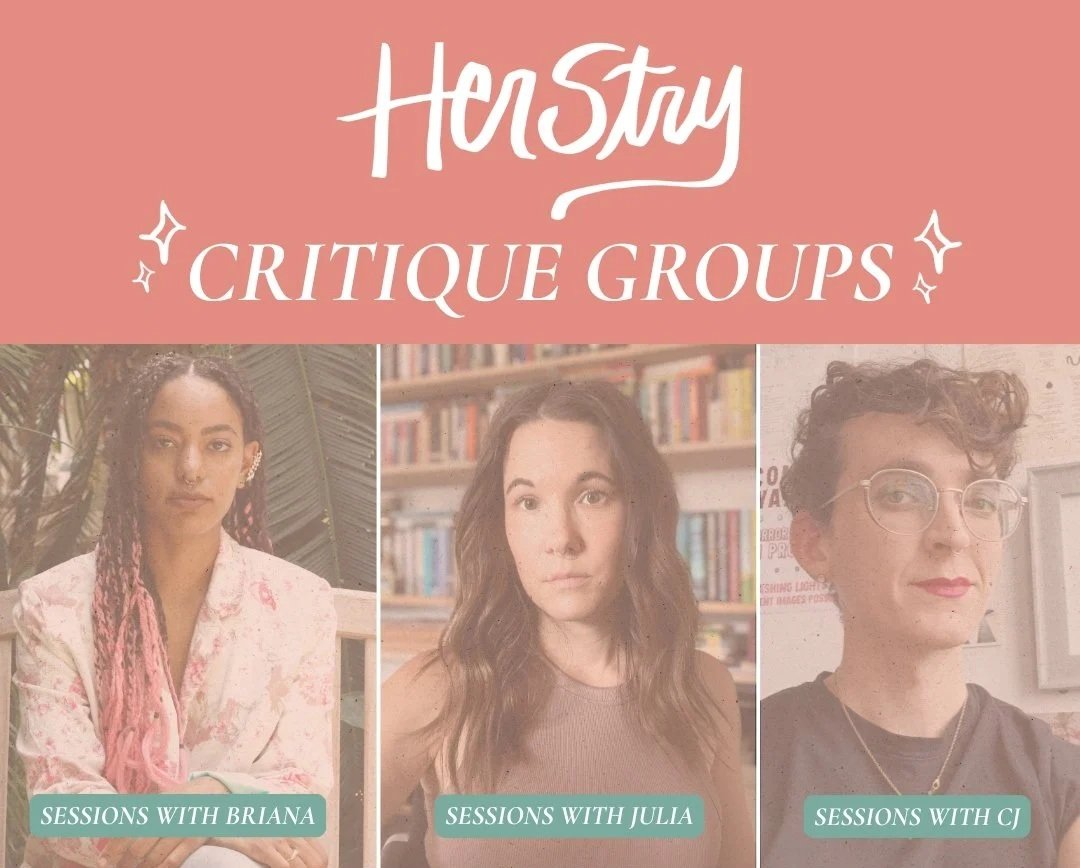
HerStry Critique Groups are small groups of 6 women who gather online for 6 weeks to share their writing, give constructive feedback and gain skills as writers.
Weekly online sessions last approximately ninety minutes, with three women sharing their work each week. Writers of all genres and levels are welcome and you may share both works of fiction and nonfiction.
Sessions take place on Mondays 7PM CT, Tuesdays 11AM CT, Fridays 11AM CT
WHAT’S INCLUDED IN THE HERSTRY CRITIQUE GROUPS?
Six 90 minute live workshop sessions
Three 20 minutes sessions in the “hot seat” to get you work critiqued
Written and verbal feedback from your fellow workshop participants
A weekly in depth edit and critique of your work from the group leader after each session
Weekly writing goals and accountability check ins
Full video recordings of each session to keep for your records
Say goodbye to the lonely, stuck in your head writing life!
LET’S WRITE!
From conception to submission. Let’s make summer sizzle with stories.
Writing a short story doesn’t happen in one session. It takes multiple drafts to get it exactly right, to create characters that come to life for the reader and a world they can’t stop thinking about. In this seven week course we will work on a single short story from conception to submission ready. The seven week session will include generative brainstorming sessions, short story craft talks, multiple workshops for feedback from fellow writers, and detailed line by line feedback and edits from your instructor. Plus, we’ll talk about submission venues, cover letters, and when to know if your story is ‘finished.’
IT’S NO SECRET THAT FEEDBACK IS AN IMPORTANT PART OF THE WRITING PROCESS.
In fact, we argue that it might be the most important part of the process.
But it’s hard to find a writing community. It’s hard to find the people who are willing to take the time and the effort to read your work and give the feedback you really, truly deserves.
That’s where HerStry Critique Groups come in!
HerStry Critique Groups are small groups of 6 women who gather online for 6 weeks to share their writing, give constructive feedback and gain skills as writers.
Weekly online sessions last approximately ninety minutes, with three women sharing their work each week. Writers of all genres and levels are welcome and you may share both works of fiction and nonfiction.
Sessions take place on Mondays 7PM CT, Tuesdays 11AM CT, Fridays 11AM CT
WHAT’S INCLUDED IN THE HERSTRY CRITIQUE GROUPS?
Six 90 minute live workshop sessions
Three 20 minutes sessions in the “hot seat” to get you work critiqued
Written and verbal feedback from your fellow workshop participants
A weekly in depth edit and critique of your work from the group leader after each session
Weekly writing goals and accountability check ins
Full video recordings of each session to keep for your records
Say goodbye to the lonely, stuck in your head writing life!
October 7, 14, 21, 28, November 4 and 18 CT
There is no class on November 11.
WRITING THE SEX SCENE.
Writing a sex scene can be delirious fun, a harrowing challenge, a literary milestone—possibly the most important part of building your short story or book. In our six weeks together, you’ll experience just about every possible emotion as you explore the erotic in different modes: comic, tender, harrowing, soul-shattering … because it really is all about the characters’ feelings, not just the mechanics. So we’ll talk about tone. Vocabulary. Metaphor. Sensory detail. How to get big emotions on the page … and when to pull back and let the reader’s imagination go to work.
This is a course for writers who want to explore the intersection between the novel and short stories, and would like to weave their short stories into a story cycle (or collection of "linked stories" or "composite novel"). This is also a class about the interaction of form and content, and how one influences the other. We will read works of interlinked stories by writers from diverse cultural and ethnic backgrounds, focusing on modern classics and contemporary practitioners of these hybrid forms. Weekly discussions will center on elements of craft, such as the expansion and compression of time, setting as an organizing and connecting principle, character development within and between stories, structure and plot for interconnected stories, and responding to literary influences in the same genre.
This six-week course guides writers through the literary submission process, offering insider insight and practical tools to help you get your work into the world. We’ll demystify everything from reading submission calls to writing cover letters and choosing the right journals. Along the way, we’ll workshop short bios, develop submission trackers, and build personalized plans that align with your voice and goals.
By the end of the course, you’ll walk away with a polished piece ready to send, a tailored submission list, and the confidence to navigate the lit mag world with clarity and purpose.
Ideal for writers of literary fiction, poetry, personal essay, memoir, and hybrid forms.

Ola enjoys writing short stories and taking her readers to the depths of her imagination. Her background in psychology and photography has inspired her writing, as she can delve into landscapes and characters’ minds with words and imagery to bring them to life and into the world. She is currently completing a writing degree at the Sunshine Coast in Australia, enjoying the surf in between novels and writing.
“Shoot your vagina up to the ceiling” one male doctor helpfully suggested as your head inched forward and back into my body again. Limp I stared into the bright white hospital light above me where I saw a vision of my own blood and guts floating on the ceiling. I learned later that this particular delivery room was famous for having a tinted convex light that reflected the labor in detail if you knew to look.