
Blessed
Blessed are those who receive a text of their adult daughter’s new tattoo at 3 a.m.;
for they will have a sleep-drunk spouse who will stir and mutter, “What the fuck?”
Blessed are those who hit the snooze button;
for they shall receive nine more minutes of sleep, unless they accidentally hit the stop button and awake in a panic an hour later.
Blessed are those who sleep on their faces;
for the deep crease running from eyebrow to lip will flatten out by their 10 a.m. meeting.
Blessed are those who pray in the shower;
for eventually the water will get hot.
Blessed are allergy pills, face cream, concealer, ibuprofen.
Blessed are those who glimpse their father’s eyes in their own as they brush their teeth;
for he will feel more present now than when he was alive.

I’ve always been a good patient—keep my jaw open even when it aches for the dentist, never flinch from the needle of a vaccine, and have thick, easy-to-find veins for blood draws. Maybe I learned it in high school on the soccer field; complain, and be benched. Maybe I carried it in my DNA, passed down from stoic Norwegian farmers; suffering is inevitable, better to keep your mouth shut and your eyes towards God.
My mother remembers one less, but I remember seven. Seven places I called home outside of Nanny’s trailer. Each move had its own life and timeline complete with characters and climate, seemingly separate from the world happening at Nanny’s. Seven times I packed my “101 Dalmatians” suitcase and cardboard boxes of pictures. I gained a little more makeup for each move: a new sheen lip gloss, glitter nail polish with chunky stars, Hot Topic eyeshadow, the limited edition Gerard Way palette that glowed bright red. Puberty marked by moves.
Blessed are those who squeeze into their bra, snap off their bra, change shirts three times, zip up their boots, kick off their boots, then slip into flats;
for eventually they will feel presentable.
Blessed are those who should’ve worn their lumpy down coat, who regret choosing pretty over practical with each gust of wind;
for soon they will lace their fingers around a warm mug of coffee.
Blessed are those who oversleep and skip breakfast;
for today the cafeteria is serving fried chicken and mashed potatoes.

Blessed are those addicted to coffee and Camels;
for their blood levels will be perfectly balanced when they pitch an idea at their afternoon meeting.
Blessed are those who blow the doors off of other commuters on the highway;
for they will reach the red light three seconds faster.
Blessed are those who worry their spouse has made an insensitive remark about their daughter’s tattoo and unleashed a deluge of tears they’ll feel compelled to soothe the moment they walk through the door;
for they are too tired to soothe them, and dinner is not going to get on the table by itself.
Blessed are those who load the dishwasher without being asked.
No, seriously. They are really, really blessed.
Blessed are those who play games on their phone and watch murder shows on TV while their internal voice barks at them to do something productive;
for they will meet their deadlines and keep their promises anyway.
Blessed is the mattress that sighs beneath the work-spent body;
for the body will feel completely understood.
Blessed are those who set their alarms, convinced they will wake up on time tomorrow;
for they will not, and the day will unfold just fine.
-Laura Rose
This product gives you access to all four weeks of the workshop. Purchase one or more drop-in sessions here.
Build a habit in 20 sessions. In this 4 week workshop that meets Mondays through Fridays from 8:00-9:00 AM CST, we will focus on generating new writing—making headway on a current project, reviving an old project that’s been gathering dust, or writing based off of the daily prompts Leigh provides.
The first 45 minutes of class are a gentle, camera-off, silent writing session. The remaining 15 minutes are an opportunity to share excerpts of our work, reflect on progress made, and set intentions for the following day. Then we will read a passage together on the writing life and close each class with a new learning about habit formation. By the end of this course we’ll have a morning writing habit that is each our own to continue and build upon.
This listing is for an individual class. To purchase access for the full 4-week workshop, click here.
Build a habit in 20 sessions. In this 4 week workshop that meets Mondays through Fridays from 8:00-9:00 AM CST, we will focus on generating new writing—making headway on a current project, reviving an old project that’s been gathering dust, or writing based off of the daily prompts Leigh provides.
The first 45 minutes of class is a gentle, camera-off, silent writing session. The remaining 15 minutes are an opportunity to share excerpts of our work, reflect on progress made, and set intentions for the following day. Then we will read a passage together on the writing life and close each class with a new learning about habit formation. By the end of this course we’ll have a morning writing habit that is each our own to continue and build upon.
Many writers feel drawn to write about their lives but struggle with uncertainty: Why this story? Why now? And who is it really for? This workshop is designed to help writers move beyond doubt and toward clarity by focusing on the deeper meaning and purpose beneath their story.
In this interactive, craft-forward session, participants will be introduced to the Memoir Compass, a practical framework that helps writers articulate their motivation (why they are writing), mission (who the story serves), and message (what meaning or insight the story carries). Through guided reflection and writing exercises, participants will begin shaping a personal narrative rooted in intention rather than overwhelm.
This workshop is ideal for writers interested in memoir or personal narrative, as well as fiction writers drawing from lived experience, who want to move forward with greater confidence, focus, and direction.
Some of the most compelling creative nonfiction begins with the feelings we are tempted to avoid: anger, resentment, shame, fear, or the sense that we have an axe to grind. In this six-week workshop, writers will explore how to follow that emotional heat toward deeper, more honest work—without sacrificing compassion, complexity, or craft. Through close readings, writing exercises, discussion, and constructive feedback, we’ll consider how to transform strong feelings into writing that reaches beyond catharsis and connects with readers.
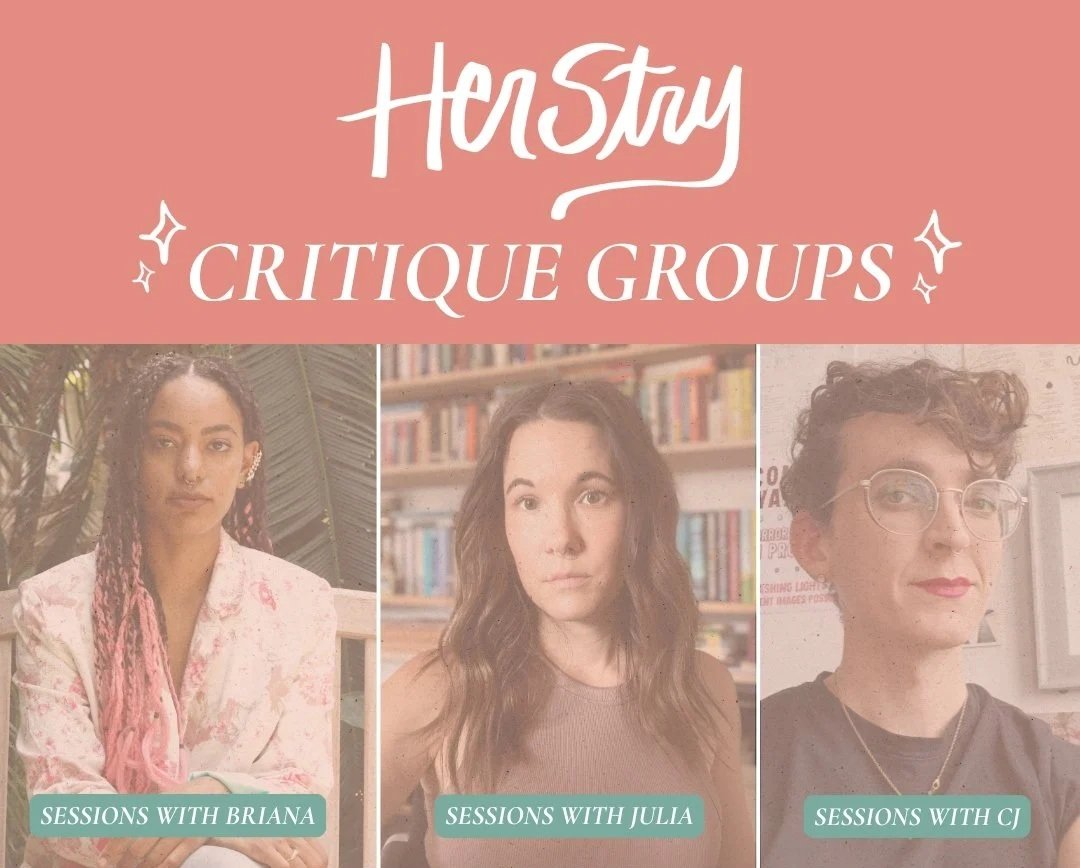
IT’S NO SECRET THAT FEEDBACK IS AN IMPORTANT PART OF THE WRITING PROCESS.
In fact, we argue that it might be the most important part of the process.
But it’s hard to find a writing community. It’s hard to find the people who are willing to take the time and the effort to read your work and give the feedback you really, truly deserves.
That’s where HerStry Critique Groups come in!
HerStry Critique Groups are small groups of 6 women who gather online for 6 weeks to share their writing, give constructive feedback and gain skills as writers.
Weekly online sessions last approximately ninety minutes, with three women sharing their work each week. Writers of all genres and levels are welcome and you may share both works of fiction and nonfiction.
Sessions take place on Mondays 7PM CT, Tuesdays 11AM CT, Fridays 11AM CT
WHAT’S INCLUDED IN THE HERSTRY CRITIQUE GROUPS?
Six 90 minute live workshop sessions
Three 20 minutes sessions in the “hot seat” to get you work critiqued
Written and verbal feedback from your fellow workshop participants
A weekly in depth edit and critique of your work from the group leader after each session
Weekly writing goals and accountability check ins
Full video recordings of each session to keep for your records
Say goodbye to the lonely, stuck in your head writing life!

LET’S WRITE!
From conception to submission. Let’s make summer sizzle with stories.
Writing a short story doesn’t happen in one session. It takes multiple drafts to get it exactly right, to create characters that come to life for the reader and a world they can’t stop thinking about. In this seven week course we will work on a single short story from conception to submission ready. The seven week session will include generative brainstorming sessions, short story craft talks, multiple workshops for feedback from fellow writers, and detailed line by line feedback and edits from your instructor. Plus, we’ll talk about submission venues, cover letters, and when to know if your story is ‘finished.’
IT’S NO SECRET THAT FEEDBACK IS AN IMPORTANT PART OF THE WRITING PROCESS.
In fact, we argue that it might be the most important part of the process.
But it’s hard to find a writing community. It’s hard to find the people who are willing to take the time and the effort to read your work and give the feedback you really, truly deserves.
That’s where HerStry Critique Groups come in!
HerStry Critique Groups are small groups of 6 women who gather online for 6 weeks to share their writing, give constructive feedback and gain skills as writers.
Weekly online sessions last approximately ninety minutes, with three women sharing their work each week. Writers of all genres and levels are welcome and you may share both works of fiction and nonfiction.
Sessions take place on Mondays 7PM CT, Tuesdays 11AM CT, Fridays 11AM CT
WHAT’S INCLUDED IN THE HERSTRY CRITIQUE GROUPS?
Six 90 minute live workshop sessions
Three 20 minutes sessions in the “hot seat” to get you work critiqued
Written and verbal feedback from your fellow workshop participants
A weekly in depth edit and critique of your work from the group leader after each session
Weekly writing goals and accountability check ins
Full video recordings of each session to keep for your records
Say goodbye to the lonely, stuck in your head writing life!
October 7, 14, 21, 28, November 4 and 18 CT
There is no class on November 11.
WRITING THE SEX SCENE.
Writing a sex scene can be delirious fun, a harrowing challenge, a literary milestone—possibly the most important part of building your short story or book. In our six weeks together, you’ll experience just about every possible emotion as you explore the erotic in different modes: comic, tender, harrowing, soul-shattering … because it really is all about the characters’ feelings, not just the mechanics. So we’ll talk about tone. Vocabulary. Metaphor. Sensory detail. How to get big emotions on the page … and when to pull back and let the reader’s imagination go to work.
This is a course for writers who want to explore the intersection between the novel and short stories, and would like to weave their short stories into a story cycle (or collection of "linked stories" or "composite novel"). This is also a class about the interaction of form and content, and how one influences the other. We will read works of interlinked stories by writers from diverse cultural and ethnic backgrounds, focusing on modern classics and contemporary practitioners of these hybrid forms. Weekly discussions will center on elements of craft, such as the expansion and compression of time, setting as an organizing and connecting principle, character development within and between stories, structure and plot for interconnected stories, and responding to literary influences in the same genre.
This six-week course guides writers through the literary submission process, offering insider insight and practical tools to help you get your work into the world. We’ll demystify everything from reading submission calls to writing cover letters and choosing the right journals. Along the way, we’ll workshop short bios, develop submission trackers, and build personalized plans that align with your voice and goals.
By the end of the course, you’ll walk away with a polished piece ready to send, a tailored submission list, and the confidence to navigate the lit mag world with clarity and purpose.
Ideal for writers of literary fiction, poetry, personal essay, memoir, and hybrid forms.
Tension feels tangible to a reader, an active experience. But from a craft perspective, tension is often a function of restraint, palpable from what is withheld, delayed or left unresolved. Why do some stories feel urgent even in stillness while others fall flat despite dramatic events? Our impulse to resolve tension often comes from a deeply human instinct to seek coherence and moral clarity, but resisting that instinct creates compelling narratives. When we let characters misbehave or allow ambiguity in their actions, we pull readers closer to them.
This course examines tension as a narrative force. We’ll consider how writers can counter the impulse to resolve too quickly, to justify wrongful acts or to redeem a character’s behavior. By looking at ways to sustain tension without escalation into spectacle, we’ll experiment with evoking it in the ordinary and the unspoken. The class will combine close reading, craft reflection and writing prompts to practice distinct approaches to writing tension. This course is designed for writers working in fiction, nonfiction, and hybrid forms who are interested in deepening the psychological and structural complexity of their work. Ultimately, tension is what compels the reader to turn the page.

Laura Rose lives and writes in Southampton, Pennsylvania. Her work has been published in Narrative Magazine, New Millennium Writings, Memoir Journal, and more.
I left on a clear October Monday. Seated at the bulkhead, my elbow rested next to a man who asked if I was going to Chicago for business. I lied, nodding my head yes. Ambivalence prevented me from updating my second-generation iPod earlier in the day, leaving Missy Elliott and Usher to comfort me. A leathery skinned smoker picked me up at baggage claim. She drove me forty-five minutes to our rural destination while I imagined what happens when car doors open and bodies land on I-55 at seventy-five miles per hour.