
If It All Went to Ashes
My immigrant mom lingers in front of the China cabinet in this American home. A gravy boat props up her high school report card stamped with A’s from Sister Carmen while a shallow bowl cradles packets of annatto, a peppery red seed from the achiote tree in western South America. Teacups support 4 x 6 photographs of her father counting mangos at the kitchen table. Piles and piles of mangos from his farm. In Peru, she says, a ripe mango’s skin is so delicate you can bite into it like you would a nectarine. She says she has no interest in American grocery stores, where the mangos are green and the skin is thick with pesticides.
I stand next to her, in front of the giant oak cabinet the first time she says this. She isn’t talking to me. She is grieving aloud her faraway home. I am only in elementary school when I first sense this distance between us. I hold onto her apron ties, ready to tug her back to me, afraid I will lose her to this portal into Peru.
Each week, my mom purchases a thirty-minute international calling card, and I eavesdrop on her call with her parents. I find comfort in their Spanish, in their collective tapestry of lively, sing-song sounds. English is my first language, but Spanish is my mother tongue. In his slower (still fast) Spanish, my grandfather says he’s sold a shipment of mangos to America. Maybe Giant Eagle, our grocery store in western Pennsylvania, will receive a crate. When my mom hangs up and returns to chopping a week’s worth of garlic, I catch her soft smile in the kitchen window’s reflection. She smiles through all seven heads of garlic, even while she pulls the garlic’s sticky paper skin from her long fingers. I watch her quietly. I don’t want to scare her smile away.
On Sunday morning, we go to Giant Eagle, and my mom studies the few mangos on the exotic produce shelf. She turns each one over in her hands only to find that the origin sticker doesn’t say Peru. She lingers in front of the China cabinet that evening, looking at a photo of her father in the mango groves. The heavy fruit bends the branch toward his outstretched hands. My mom reaches for the photo. She holds it in her hands as if it were a fragile piece of porcelain, a delicate bridge to her past. Beneath reverence lies desperation.
To be an immigrant’s child is to notice the regret and ache woven into each of your mom’s quiet movements, to know how her China cabinet of memories protects and threatens your childhood. Your mom is not from here and she will never entirely be here. Her attention drifts to her motherland, and her presence is punctuated by absence. You are afraid she may not resurface this time or the next. She considers the future she forfeited when she moved to America and started a family. She loves her husband and children, but you worry homesickness nurtures a rival love, a love strong enough to pull her away. You worry that if you do not prove yourself a good enough reason to stay in America, then she could turn those longing stares towards her archive into action. She could leave. The immigrant’s child must help her mom live a safe balance between being there and here, to let her drift into her past while pulling her into your shared future. You must hold her hand tighter than she holds yours.
I keep my mom in America by making her the focus of my life. Every elementary school craft is a gift to her: pinch pots to store her garlic cloves, oil-pastel family portraits with her at the center, a flip book with all the reasons I love her written in different sparkly, gel-colored pens. In glittery magenta, I write that I love her because of her big curly hair. I love kissing the top of her head and smelling her anti-frizz shampoo while the wiry curls tickle my face. She hates her hair. She says it wasn’t so frizzy when she lived in Peru.
Sometimes, I forget how precarious our shared existence is, and I behave like the child I am, especially when I’m hungry. My hunger incites wildness. I race into the kitchen after school, towards the smell of steamed green beans and pork chops. With each of my heavy steps, the China cabinet shakes ever so slightly. My mom hears her childhood collection of little ceramic doves flutter on their saucer plates, like they are about to leave their nests, and she yells at me to stop running like a horse. Something is going to fall.
I don’t dare take anything out of the China cabinet, not even when I am tall enough to reach the first shelf, and later, the middle shelf, and finally, the big shelf. I request it from my mom. I tug on her apron and give her a reason why I need to touch the photos of her father’s mango farm, as if touch could illuminate memories I do not have. I want to know her, I say. How do you know your mom if you do not know where she is from?
When I tease that she’s exaggerating her straight-A record, she sits me down at the kitchen table and shows me her report card like a prosecutor reveals damning evidence to a witness. She traces each of Sister Carmen’s red A’s with her index finger and tells me that she got straight A’s in college too. She studied diplomacy in Lima while the capitol city was at risk of being seized by the Shining Path. On her commute to class, she refused to stop at red lights for fear of a bomb being thrown through the car window. She laughs at herself. Red is a nice color, she would say as she drove right through the intersection.
Her laughter invites my risk. I ask why she wanted to be a diplomat, and she shrugs, puts her report card away, and cooks a tablespoon of garlic in olive oil. She adds rice once the garlic begins to smell. On its own, the garlic will burn. She is its watchkeeper, and I am hers.

Another afternoon, she shows me her voter identification card, the photograph proving that her hair wasn’t always this frizzy, and she tells me about Peru’s 1990 presidential election. The Shining Path threatened to kill anyone who voted in the election, and Peru had to draft poll workers. My mom didn’t retreat to her family mango farm when she was drafted. She stayed in Lima and worked the polls. She remembers that the Shining Path detonated twenty-seven bombs in the streets that day. On the bus ride home, she clenched her fist to hide her black-inked pinky, proof of her cast vote. She straightens her posture and says she wanted to be a diplomat because she wanted to serve her country.
When my parents met, they understood marriage to be a gamble, and my mom was used to risk-taking. Every day in Lima was a risk. At twenty-two years old, my mom got married and moved to the United States with my dad. She left Peru with only a semester of courses remaining, effectively forfeiting, for love, her dream of being a Peruvian diplomat. In America, she would need to find a new dream or be content without one. Only gamble your dream, she tells me, if you really love someone. I tape a photograph of my parents on my bed’s headboard, and I pray that they won. I pray that they will remain embraced, just as they are in the photograph. I pray that my dad’s warm, dark brown eyes can see the pain behind my mom’s soft, closed smile. If love does not hold pain, then what good is it?
The immigrant’s child’s love might do no good at all. You’re too afraid to ask your mom about her sadness living in the States. You know that pain lies deep inside her like a bomb. Ask that one question, “Are you happy here?” and her pain will explode. Her misery will be laid bare all around her, and she will realize she cannot live like this any longer. She cannot continue to sacrifice herself. Not for her daughter. Not for your dad, her husband of nearly twenty years. One night, while your mom watches telenovelas in her bedroom and your dad watches sitcom reruns in the living room, you finally share your own anguish worrying over your mom. Your childhood exhausts you. Everybody Loves Raymond comes on as you fall asleep to your dad rubbing your head. In the morning, your mom sweeps dust into little landmines across the kitchen floor. You sidestep each one because that’s how this family survives.
When I am fourteen years old, I almost light the entire house on fire. My mom says the spaghetti is ready, and I run up the basement stairs without any regard for the burning candle on the craft table. I don’t notice the snowmen-patterned tablecloth catch fire. But when I hear the smoke detector alarm, I run downstairs to see flames three times my size grazing the basement ceiling. I yell for my parents to get out of the house, but they ignore me. From outside the sliding glass door, I watch my dad search for a fire extinguisher and my mom run past the China cabinet, back and forth, with buckets of sloshing water. For a few seconds, my still reflection overlaps her moving one. This is what haunts me. Not the flames and flickering shadows on the wall nor my dad’s desperate scream into smoke. I cannot shake the image of my mom’s reflection escaping mine.
My parents extinguish the flames on their own. We sit on a big limestone rock in the front yard and wait to wave the firefighters away. While my mom rubs my dad’s back between his coughing fits, I worry that my ninth-grade biology notebook has burnt. I have a test on Friday, and I am memorizing the structural parts of DNA: the sugar phosphate backbone, the nitrogenous bases, the hydrogen bonds. It’s a blueprint for life, my biology teacher says. The instructions we need to live are inside us.
But they aren’t. No cellular processes teach you how to be someone’s daughter, let alone an immigrant’s daughter. You gamble your entire self, all your childhood energy, for her. You tell your neighbors that you can’t play outside so you can sit in the kitchen with your mom while she smashes that week’s garlic with a rock. You ask her questions about her childhood hoping that the memories of scavenging for barnacles on the beach with her siblings bring her joy. You ask her about Peruvian politics while she sucks the mango’s slippery pit over the kitchen sink. You savor the pieces you get of her, like you savor the pieces of sweet fruit she cuts for you. You savor her presence, even though she is partially absent. You don’t do what most people do. You don’t backtalk or rebel or try on different identities. You don’t dream of being bold enough to self-differentiate from your mother. That unique self apart from your mom may not exist.
The night of the fire, I sleep in my mom’s bed. I dream that the flames spare everything but the China cabinet. Without her portal to Peru, my mom is no longer able to endure the distance from home. She leaves and she doesn’t put a photograph of me in her new China cabinet in Peru. Any evidence of me is banished to the basement, among all the other forgotten things. Beneath the horror of abandonment, I feel a rush of relief. Am I free from this daughterhood? I wake up in terror.
Moonlight spreads across my mom’s face. Her jaw unclenches and the lines on her face soften as she begins to breathe from her mouth. When her heavy breathing turns into snores, I nestle in between her bent knees and her chest, dreaming I’m in her womb. Here, I don’t yet know the difference between hearing and feeling and seeing. My mother’s heart pulses against my back. When I put my hand on my chest, I do not feel my heartbeat. I feel my mother’s.
-Eliana Rose Swerdlow
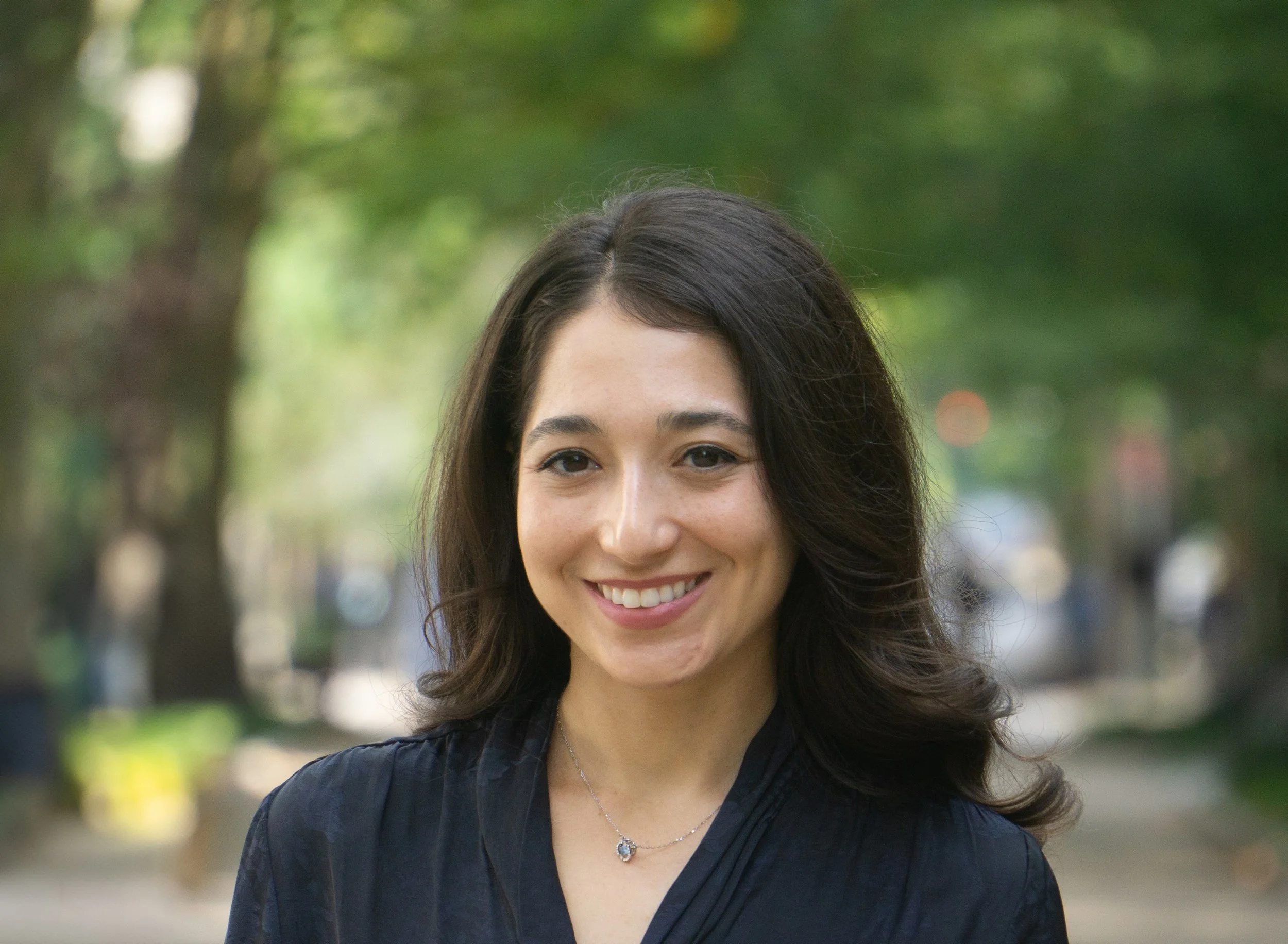
Eliana Rose Swerdlow is a poet living in New Haven, Connecticut. A graduate of Yale Divinity School and Yale College, she is pursuing a path in end-of-life chaplaincy.