
In fifth grade, for Halloween, I wanted to dress up like my mom.
In fact, I did. But only to show her. It was supposed to be a surprise, because I didn’t want to be a hippie for the third year in a row. I remember sitting on my pink, blue, and green swirled comforter thinking that I wanted to dress up like someone I like. I didn’t want to be just another witch or the fourth kid to have the brilliant idea to be the pink power ranger.
I liked my mom; she was the coolest. So I dug through my closet and found a pant suit that I had never worn, but mom bought me for some holiday. I sneaked into my dad’s office and stole one of his briefcases, and swiped my mom’s old glasses. I tied my hair back in a ponytail, and dressed in my best attempt or my mother, I proudly walked out of my room and into her office. “Look who I’m gonna be for Halloween!”

“Umm, who?”
I had clearly stumped her. It must have been the suit. My mom never wears suits, but it was the most adult thing I had in my closet!
“I’m you!”
The look on my mother’s face was one of pure horror. You would have thought I told her I murdered our dog and then wore his fur for a class project.
“No. Absolutely not.”
“Why not?”
I had no idea why she wouldn’t want this. I, honestly, thought I was going to make her proud or flatter her. It seemed like I had insulted her.

Midlife doesn’t announce itself with milestones — it arrives in contrasts. One moment, you’re lighting candles for a graduation. The next, you’re watching your mother shrink into a hospital gown.

“Any requests?” my daughter asks from the backseat of the car. I’m driving up Connecticut’s Merritt Parkway to drop her off for her first year of college. She plays DJ while my husband and younger daughter count passing Teslas. Through New Jersey and over the GW Bridge, we listen to their mix of Phoebe Bridgers, Kimya Dawson, and Big Thief. We’re all a little nervous, unsure about what life will be like once we say goodbye.
Josh and I sat in the waiting room, an office building with a view of the Manhattan skyline. I stared at the other women, wondering what they were getting done. I wondered how many of them were here not by choice. How many of them had never contemplated getting fake breasts before they learned they had breast cancer. I couldn’t have been the only one. But I was definitely the only pregnant woman getting a boob job in the crowd.

It is 10:34 p.m. I am journaling about the difference between what I eat and how I taste it.
In other words, it’s not about the chocolate cake. It’s about the pool of saliva swirling through each bite. It’s about the tongue pressing crumb into ganache, the esophagus readying itself to carry each sweet offering down. It is about my body knowing it is safe. Safe to sit, to enjoy, to receive.

One Sunday in January, my twelve year-old and I had an hour between appointments in the Denver suburbs, and found ourselves at a mall. In the age of “add to cart,” we rarely shopped together, and she had grown so much in the previous several months that none of her clothes fit. As we wandered into H&M, my daughter’s eyes lit up. She grabbed armfuls of clothes, including a pair of acid washed jeans with a chain that went from the front pocket to a back belt loop, each link a tiny heart. Maybe they won’t fit, I thought hopefully, as I trailed behind her in a daze. The Friday before, she had refused to go to school, her second school of the year, and one that had seemed promising only a couple of weeks before. I felt like I was hiking along the edge of a cliff in the fog; I had no idea what was going to happen, or how close we were to the edge.

There was a corner in my house that I came to dread nearing, where our daughter’s diaper changing table was set up. It was at the opposite end in our bedroom, where on the other side was the big window facing the endless mountains and winding roads, which got us sold on this house as a newly married couple.

In the minutes after she was born, all of the lights came on. We watched her climb the wall of my body and land, exhausted, at the shore of my breast. Under the sharp white of hospital light, they did the weighing and measuring, and she screamed so that every number and value only reached my ears as alive, alive, more evidence of her realness, her presence. She sent howls up into a brightness that must have been like looking at the sun.

Every week she asked me how I felt and every week, while, in general things were “fine,” I always told her there was almost always a day, or a couple of hours a day, where despondence grabbed me and wouldn’t let go. It was as if someone, something, was wrestling me and trying to get me to give in, to tap out. We were in different weight classes though. I was the lightweight and the despondence was the heavyweight and I didn’t have any agility or tricks up my sleeve to counteract the weight disparity between us.

I stood in front of the gate, but the Delta screen didn’t make any sense. Why wouldn’t the airline have cleared out the Denver flight if the Nashville flight was due to board in the next 10 minutes? I looked for any indication that the departure gate had been changed; I found none.
“You don’t want to be me. You be you. Dress up as something magical or make-believe. You can’t be me.”
I ran away in tears. I felt like my little ten-year-old heart had been cracked open and nothing but tears could come out of it. I just wanted to be like my mom! Why couldn’t she understand that that was the coolest, best thing in the world? She cooks, and drives us around, and takes care of my brother and me and Dad, and she works, and she gardens, and she does crafts with us, and she helps us with our homework. She does everything! She’s like a superhero, but a mom version!

And sure enough, for my tenth Halloween I was a hippie….for the third year in a row.
It wasn’t until years later that I realized something about that moment.
There were numerous reasons why dressing up as mom wasn’t okay for my mother. One of the biggest, and I didn’t know this until almost finishing college, my mom doesn’t want me to have the life she had. My mother gave up her career to be a wife and mother. She worked, but from home so that she could raise my brother and I.
She now confides in me, like a friend, or fellow adult, and she’s told me that she didn’t realize what she was giving up; that she was putting her husband and her children before herself, for always. And that she doesn’t regret having us, and I don’t doubt that, but she seems to wish that she had been more independent.
That was the word that was used the most in our household growing up. “You must be independent. Able to support yourself.” Now, my parents meant that in a financial meaning, but I took it to incorporate much more.
My mother was my hero. She still is my hero, but now, wrapped into the superhero outfit is my best friend.
She knows the slightest crack in my voice, means a flood of tears is not far behind.
I know that her pressed lips, really mean “That’s what you’re going to wear?”
She knows that I’m stubborn as hell, but I always have one ear listening.
I know that I have picked up her mannerisms and laugh.
She knows that silence doesn’t mean something’s wrong.
I know that I am proud to resemble her in anyway.
She knows that I’m sometimes too naive.
I know that she believes in me.
She knows that I love her so much it hurts. It hurts right on my heart.
-Michele Stine
This product gives you access to all four weeks of the workshop. Purchase one or more drop-in sessions here.
Build a habit in 20 sessions. In this 4 week workshop that meets Mondays through Fridays from 8:00-9:00 AM CST, we will focus on generating new writing—making headway on a current project, reviving an old project that’s been gathering dust, or writing based off of the daily prompts Leigh provides.
The first 45 minutes of class are a gentle, camera-off, silent writing session. The remaining 15 minutes are an opportunity to share excerpts of our work, reflect on progress made, and set intentions for the following day. Then we will read a passage together on the writing life and close each class with a new learning about habit formation. By the end of this course we’ll have a morning writing habit that is each our own to continue and build upon.
This listing is for an individual class. To purchase access for the full 4-week workshop, click here.
Build a habit in 20 sessions. In this 4 week workshop that meets Mondays through Fridays from 8:00-9:00 AM CST, we will focus on generating new writing—making headway on a current project, reviving an old project that’s been gathering dust, or writing based off of the daily prompts Leigh provides.
The first 45 minutes of class is a gentle, camera-off, silent writing session. The remaining 15 minutes are an opportunity to share excerpts of our work, reflect on progress made, and set intentions for the following day. Then we will read a passage together on the writing life and close each class with a new learning about habit formation. By the end of this course we’ll have a morning writing habit that is each our own to continue and build upon.
Many writers feel drawn to write about their lives but struggle with uncertainty: Why this story? Why now? And who is it really for? This workshop is designed to help writers move beyond doubt and toward clarity by focusing on the deeper meaning and purpose beneath their story.
In this interactive, craft-forward session, participants will be introduced to the Memoir Compass, a practical framework that helps writers articulate their motivation (why they are writing), mission (who the story serves), and message (what meaning or insight the story carries). Through guided reflection and writing exercises, participants will begin shaping a personal narrative rooted in intention rather than overwhelm.
This workshop is ideal for writers interested in memoir or personal narrative, as well as fiction writers drawing from lived experience, who want to move forward with greater confidence, focus, and direction.
Some of the most compelling creative nonfiction begins with the feelings we are tempted to avoid: anger, resentment, shame, fear, or the sense that we have an axe to grind. In this six-week workshop, writers will explore how to follow that emotional heat toward deeper, more honest work—without sacrificing compassion, complexity, or craft. Through close readings, writing exercises, discussion, and constructive feedback, we’ll consider how to transform strong feelings into writing that reaches beyond catharsis and connects with readers.
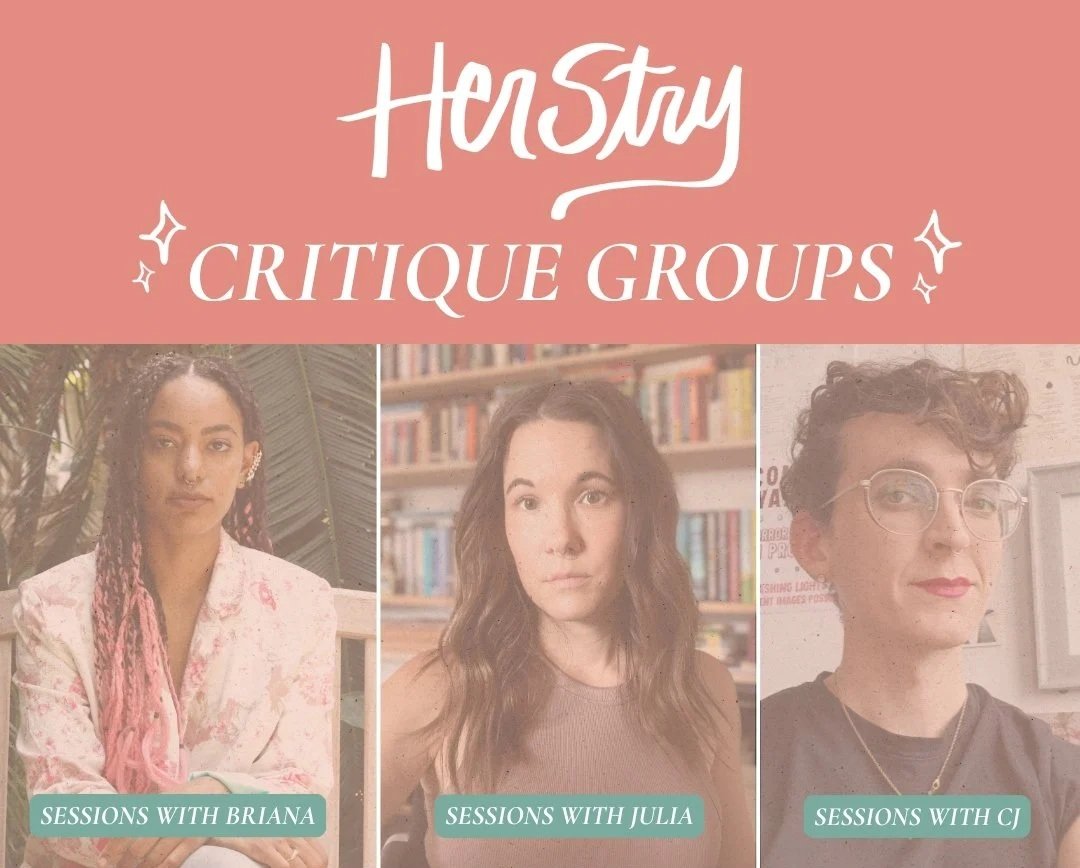
IT’S NO SECRET THAT FEEDBACK IS AN IMPORTANT PART OF THE WRITING PROCESS.
In fact, we argue that it might be the most important part of the process.
But it’s hard to find a writing community. It’s hard to find the people who are willing to take the time and the effort to read your work and give the feedback you really, truly deserves.
That’s where HerStry Critique Groups come in!
HerStry Critique Groups are small groups of 6 women who gather online for 6 weeks to share their writing, give constructive feedback and gain skills as writers.
Weekly online sessions last approximately ninety minutes, with three women sharing their work each week. Writers of all genres and levels are welcome and you may share both works of fiction and nonfiction.
Sessions take place on Mondays 7PM CT, Tuesdays 11AM CT, Fridays 11AM CT
WHAT’S INCLUDED IN THE HERSTRY CRITIQUE GROUPS?
Six 90 minute live workshop sessions
Three 20 minutes sessions in the “hot seat” to get you work critiqued
Written and verbal feedback from your fellow workshop participants
A weekly in depth edit and critique of your work from the group leader after each session
Weekly writing goals and accountability check ins
Full video recordings of each session to keep for your records
Say goodbye to the lonely, stuck in your head writing life!

LET’S WRITE!
From conception to submission. Let’s make summer sizzle with stories.
Writing a short story doesn’t happen in one session. It takes multiple drafts to get it exactly right, to create characters that come to life for the reader and a world they can’t stop thinking about. In this seven week course we will work on a single short story from conception to submission ready. The seven week session will include generative brainstorming sessions, short story craft talks, multiple workshops for feedback from fellow writers, and detailed line by line feedback and edits from your instructor. Plus, we’ll talk about submission venues, cover letters, and when to know if your story is ‘finished.’
IT’S NO SECRET THAT FEEDBACK IS AN IMPORTANT PART OF THE WRITING PROCESS.
In fact, we argue that it might be the most important part of the process.
But it’s hard to find a writing community. It’s hard to find the people who are willing to take the time and the effort to read your work and give the feedback you really, truly deserves.
That’s where HerStry Critique Groups come in!
HerStry Critique Groups are small groups of 6 women who gather online for 6 weeks to share their writing, give constructive feedback and gain skills as writers.
Weekly online sessions last approximately ninety minutes, with three women sharing their work each week. Writers of all genres and levels are welcome and you may share both works of fiction and nonfiction.
Sessions take place on Mondays 7PM CT, Tuesdays 11AM CT, Fridays 11AM CT
WHAT’S INCLUDED IN THE HERSTRY CRITIQUE GROUPS?
Six 90 minute live workshop sessions
Three 20 minutes sessions in the “hot seat” to get you work critiqued
Written and verbal feedback from your fellow workshop participants
A weekly in depth edit and critique of your work from the group leader after each session
Weekly writing goals and accountability check ins
Full video recordings of each session to keep for your records
Say goodbye to the lonely, stuck in your head writing life!
October 7, 14, 21, 28, November 4 and 18 CT
There is no class on November 11.
WRITING THE SEX SCENE.
Writing a sex scene can be delirious fun, a harrowing challenge, a literary milestone—possibly the most important part of building your short story or book. In our six weeks together, you’ll experience just about every possible emotion as you explore the erotic in different modes: comic, tender, harrowing, soul-shattering … because it really is all about the characters’ feelings, not just the mechanics. So we’ll talk about tone. Vocabulary. Metaphor. Sensory detail. How to get big emotions on the page … and when to pull back and let the reader’s imagination go to work.
This is a course for writers who want to explore the intersection between the novel and short stories, and would like to weave their short stories into a story cycle (or collection of "linked stories" or "composite novel"). This is also a class about the interaction of form and content, and how one influences the other. We will read works of interlinked stories by writers from diverse cultural and ethnic backgrounds, focusing on modern classics and contemporary practitioners of these hybrid forms. Weekly discussions will center on elements of craft, such as the expansion and compression of time, setting as an organizing and connecting principle, character development within and between stories, structure and plot for interconnected stories, and responding to literary influences in the same genre.
This six-week course guides writers through the literary submission process, offering insider insight and practical tools to help you get your work into the world. We’ll demystify everything from reading submission calls to writing cover letters and choosing the right journals. Along the way, we’ll workshop short bios, develop submission trackers, and build personalized plans that align with your voice and goals.
By the end of the course, you’ll walk away with a polished piece ready to send, a tailored submission list, and the confidence to navigate the lit mag world with clarity and purpose.
Ideal for writers of literary fiction, poetry, personal essay, memoir, and hybrid forms.

Michele Stine graduated with a B.S. in Acting and Political Science. She most recently returned home to Chicago after a three month self-produced tour of over five different Chicago based productions, called “A.O. The Traveling Trunk Show.” Michele has been fortunate to have performed with Collaboraction, First Floor Theatre, Indie Boots, trip, Manhattan Repertory, and the Illinois Shakespeare Festival, among others. As a writer, Michele co-wrote Collaboraction's Forgotten Future: The Education Project, has worked with The New Colony in work-shopping Hidden Resistance, and participated in a writing challenge with Red Theatre-Chicago.