
She was proud to be a redhead. She was proud to have been a grade school teacher. She was proud of the work she did as a waitress to support her three children when her husband went to fight in WWII. She was very outspoken. Her stories always had a moral, her jokes did not. “Have you heard the one about the fool who needed some shade? So he stood under a horses’ tail!” She was proud of the poetry she could recite from memory. She had a repertoire of stories, sayings, songs, and jokes which she repeated constantly, like a litany, throughout my childhood and into my adulthood. Most of the family could repeat them along with her. Her children coddled her and told her she was funny, knowing how much she liked to laugh. I saw no real value in all the stuff and even though I loved her very much, at times, it irritated me! She died when she was 87. She was my grandmother, Ruth Mandeville Robinson.

Her memorial service was planned. She had died while living in Florida. Her ashes were sent back to Warsaw, New York, where she had spent most of her life. My mother called to tell me the date and time of the service and to inform me it had been decided the grandchildren would each say a few words at the service. It was not my favorite idea!
I started trying to think of profound things to say. My knowledge of funerals was fuzzy. I remembered clergy speaking, not real people. I remembered sadness, quiet and the cloying smell of funeral bouquets. To add to the tension, not all my family members got along and sometimes were outright hostile towards each other. I wanted what I said to be good. It seemed to me at a funeral you were supposed to build the deceased up but I also knew not everyone there had actually liked my grandmother. I did not want to give them reason for ridicule. In truth, I wanted everyone to like my speech.
The day came and as chance would have it, I spoke first. When I reached the podium I saw all the faces were uncomfortable. ”Can’t we get this over with” hung in the air. I took a deep breath, pictured everyone in their underwear and began:

LOVE
noun | \ lev : an intense feeling of deep affection; a great interest and pleasure in something.
LUST
noun | \ lest : very strong sexual desire.

"Don't you think it's kinda weird, not showing your face for like, 229 months?" Bunnie, an anthropomorphic rabbit, lightly chided me. She wasn't wrong. I hadn’t booted up Nintendo’s original Animal Crossing game in nearly twenty years.

She opens the cupboard above the sink and stretches her body as far as it can go. The glasses and bowls have moved closer to the edge of the shelves since I was here last.
This is about my mama because I’m too stubborn, too proud, too self-conscious to tell these things to her in person. I’ll backpack around with luggage until I gain enough substance to face it head-on. For now, I’m simply going to make excuses and say that I’m too green to face this— pride(?) Perhaps sheepish-ness is a more suited term. English doesn’t wield such a single term that encases this feeling to its extent.

Just after the pandemic, I went to New York City with my aunt Mimi. We had planned the trip as a way for me to learn everything I could about my mother, who died thirty-five years ago from an aggressive form of breast cancer. It was the hottest day on record for the month of May and we sat in an air-conditioned restaurant in Greenwich Village.
Mimi listed things my mother loved: dancing, parties, fashion, Bailey’s Irish Cream.
There is a feeling I get when I travel alone. The moment I get to my destination—a hotel or Airbnb—when I walk in the room, roll my suitcase into a corner, and close the door, it hits me. I am hopeful on every trip that I won’t feel it this time, but I always do. My chest and stomach get tight. I can’t catch a full breath. There is a sense of dread and impending doom. And emptiness so loud one might think it is the thing I’ve come to visit. As if it lives right there in that room and has been waiting for me since the last time we saw each other.

I should have heard the warning growl before pulling open the dresser drawer in the garage. It had been twenty years since my husband and I had done any cleaning out here beyond superficial tidying. We’d plunked down his scratched childhood dresser in the garage when we first bought the house. Since there wasn’t enough room for the old dresser inside our new home, it never traveled any farther. The top of the dresser became a landing station for stray gardening tools, rafts of paper towels, and a box of Hannukah decorations.

Before she died, Nancy compiled a list of appropriate women she thought could be a good partner for me, which I told her was ridiculous. I was doing everything I could to keep her alive, nor did I like the women she had chosen for me. I had loved her for twenty-seven years. She would never be replaceable. My everything wasn’t enough; all I had of Nancy were her ashes. At sixty-one, I had vaulted into old age overnight, with grey roots grown inches during Nancy’s last months of hospice. I was the solo parent of two grieving teenage daughters, one who was depressed, the other defiant. My eros was exhausted, maybe dead even. But Nancy was not five months into her grave when I hooked up with Tami.
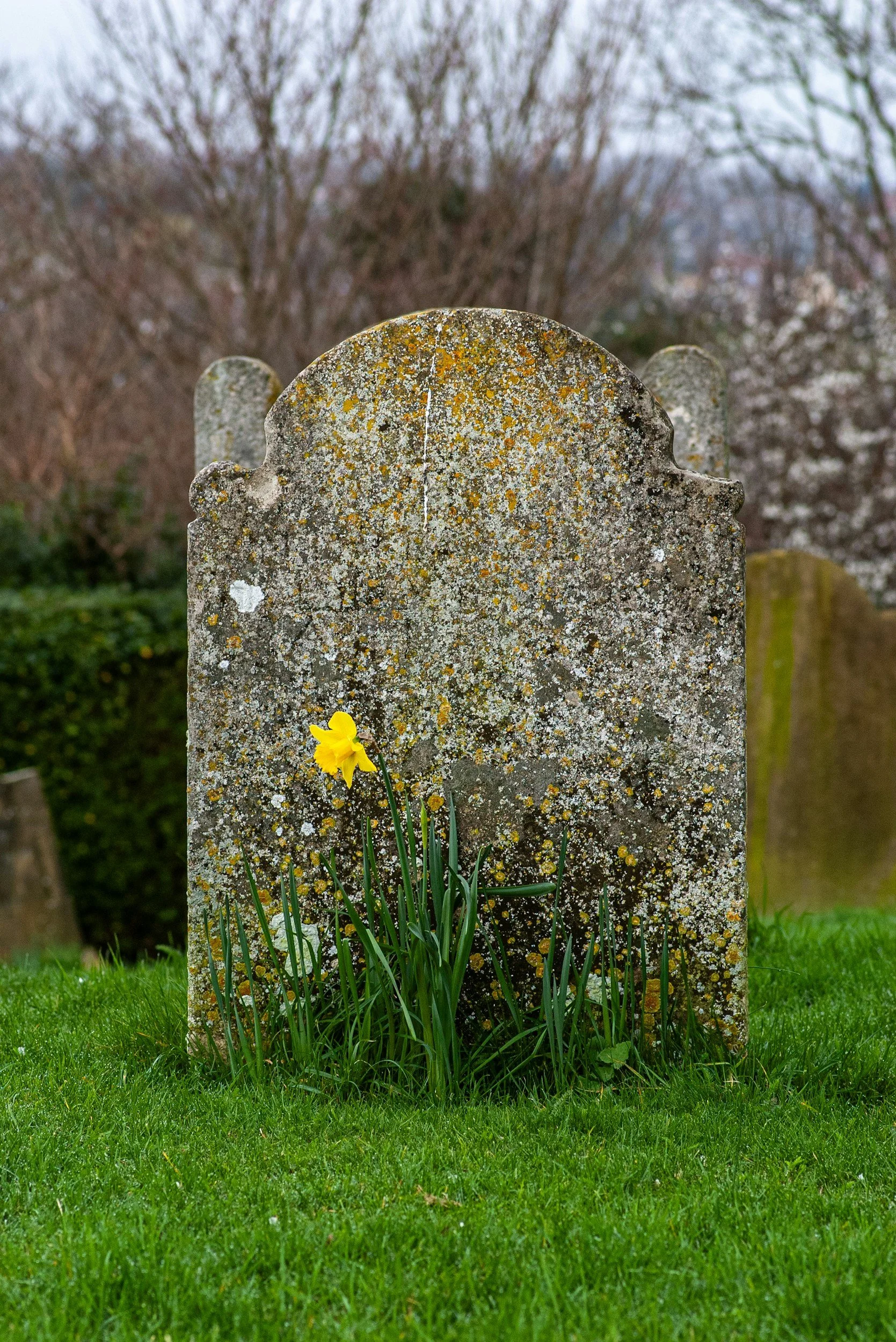
On Sundays, I take my grandmother to the cemetery to visit her mother. With her is a straw broom, small enough to carry in a reusable bag. When I was young, I would pull from that broom, break its straw to pieces, and throw them, watching as they spun to the ground like helicopter seeds. Now, in my grandmother’s hands, the broom brushes away dirt and moss and leaves from a headstone that shares my name.
“My grandmother was a unique person, as you all know. Undoubtedly she has taught us all many different things. I would like to share with you something very special she taught me. It inspires courage when you have none. It can put you at ease in any situation. It can make you appear clever or crazy, depending on your needs at the moment. It restores optimism. It makes children laugh. It’s the only thing I’ve been able to think of all week. Here it is:
I‘ve never seen a purple cow.
I never hope to see one.
But I can tell you anyhow,
I’d rather see than be one!
The room full of people laughed and relaxed. That had focused everyone on her life and not her death. My brother followed my lead and told some of his favorites of her stories. I was happy with the change in the mood. I had given my family a place from which they could start to remember her. They recalled her sense of humor, hard work and, most of all, the thing she loved the most…her family gathered around her.
I never would have believed any words of mine could have had such an effect. My grandmother was a very strong personality. I had always felt like I paled in comparison. That day, I discovered there is a large part of her I recognize in myself. I have her self-assurance, her sense of humor and her work ethic. The things she said and did are reflected in my daily behavior. Speaking at her memorial service gave me confidence I did not know I possessed. I don’t know if anyone remembers that day but me but it does not matter. The memory is priceless to me as it is the last one I have of my grandmother, Ruth
-Rachel Larensen
This product gives you access to all four weeks of the workshop. Purchase one or more drop-in sessions here.
Build a habit in 20 sessions. In this 4 week workshop that meets Mondays through Fridays from 8:00-9:00 AM CST, we will focus on generating new writing—making headway on a current project, reviving an old project that’s been gathering dust, or writing based off of the daily prompts Leigh provides.
The first 45 minutes of class are a gentle, camera-off, silent writing session. The remaining 15 minutes are an opportunity to share excerpts of our work, reflect on progress made, and set intentions for the following day. Then we will read a passage together on the writing life and close each class with a new learning about habit formation. By the end of this course we’ll have a morning writing habit that is each our own to continue and build upon.
This listing is for an individual class. To purchase access for the full 4-week workshop, click here.
Build a habit in 20 sessions. In this 4 week workshop that meets Mondays through Fridays from 8:00-9:00 AM CST, we will focus on generating new writing—making headway on a current project, reviving an old project that’s been gathering dust, or writing based off of the daily prompts Leigh provides.
The first 45 minutes of class is a gentle, camera-off, silent writing session. The remaining 15 minutes are an opportunity to share excerpts of our work, reflect on progress made, and set intentions for the following day. Then we will read a passage together on the writing life and close each class with a new learning about habit formation. By the end of this course we’ll have a morning writing habit that is each our own to continue and build upon.
Many writers feel drawn to write about their lives but struggle with uncertainty: Why this story? Why now? And who is it really for? This workshop is designed to help writers move beyond doubt and toward clarity by focusing on the deeper meaning and purpose beneath their story.
In this interactive, craft-forward session, participants will be introduced to the Memoir Compass, a practical framework that helps writers articulate their motivation (why they are writing), mission (who the story serves), and message (what meaning or insight the story carries). Through guided reflection and writing exercises, participants will begin shaping a personal narrative rooted in intention rather than overwhelm.
This workshop is ideal for writers interested in memoir or personal narrative, as well as fiction writers drawing from lived experience, who want to move forward with greater confidence, focus, and direction.
Some of the most compelling creative nonfiction begins with the feelings we are tempted to avoid: anger, resentment, shame, fear, or the sense that we have an axe to grind. In this six-week workshop, writers will explore how to follow that emotional heat toward deeper, more honest work—without sacrificing compassion, complexity, or craft. Through close readings, writing exercises, discussion, and constructive feedback, we’ll consider how to transform strong feelings into writing that reaches beyond catharsis and connects with readers.

IT’S NO SECRET THAT FEEDBACK IS AN IMPORTANT PART OF THE WRITING PROCESS.
In fact, we argue that it might be the most important part of the process.
But it’s hard to find a writing community. It’s hard to find the people who are willing to take the time and the effort to read your work and give the feedback you really, truly deserves.
That’s where HerStry Critique Groups come in!
HerStry Critique Groups are small groups of 6 women who gather online for 6 weeks to share their writing, give constructive feedback and gain skills as writers.
Weekly online sessions last approximately ninety minutes, with three women sharing their work each week. Writers of all genres and levels are welcome and you may share both works of fiction and nonfiction.
Sessions take place on Mondays 7PM CT, Tuesdays 11AM CT, Fridays 11AM CT
WHAT’S INCLUDED IN THE HERSTRY CRITIQUE GROUPS?
Six 90 minute live workshop sessions
Three 20 minutes sessions in the “hot seat” to get you work critiqued
Written and verbal feedback from your fellow workshop participants
A weekly in depth edit and critique of your work from the group leader after each session
Weekly writing goals and accountability check ins
Full video recordings of each session to keep for your records
Say goodbye to the lonely, stuck in your head writing life!

LET’S WRITE!
From conception to submission. Let’s make summer sizzle with stories.
Writing a short story doesn’t happen in one session. It takes multiple drafts to get it exactly right, to create characters that come to life for the reader and a world they can’t stop thinking about. In this seven week course we will work on a single short story from conception to submission ready. The seven week session will include generative brainstorming sessions, short story craft talks, multiple workshops for feedback from fellow writers, and detailed line by line feedback and edits from your instructor. Plus, we’ll talk about submission venues, cover letters, and when to know if your story is ‘finished.’
IT’S NO SECRET THAT FEEDBACK IS AN IMPORTANT PART OF THE WRITING PROCESS.
In fact, we argue that it might be the most important part of the process.
But it’s hard to find a writing community. It’s hard to find the people who are willing to take the time and the effort to read your work and give the feedback you really, truly deserves.
That’s where HerStry Critique Groups come in!
HerStry Critique Groups are small groups of 6 women who gather online for 6 weeks to share their writing, give constructive feedback and gain skills as writers.
Weekly online sessions last approximately ninety minutes, with three women sharing their work each week. Writers of all genres and levels are welcome and you may share both works of fiction and nonfiction.
Sessions take place on Mondays 7PM CT, Tuesdays 11AM CT, Fridays 11AM CT
WHAT’S INCLUDED IN THE HERSTRY CRITIQUE GROUPS?
Six 90 minute live workshop sessions
Three 20 minutes sessions in the “hot seat” to get you work critiqued
Written and verbal feedback from your fellow workshop participants
A weekly in depth edit and critique of your work from the group leader after each session
Weekly writing goals and accountability check ins
Full video recordings of each session to keep for your records
Say goodbye to the lonely, stuck in your head writing life!

October 7, 14, 21, 28, November 4 and 18 CT
There is no class on November 11.
WRITING THE SEX SCENE.
Writing a sex scene can be delirious fun, a harrowing challenge, a literary milestone—possibly the most important part of building your short story or book. In our six weeks together, you’ll experience just about every possible emotion as you explore the erotic in different modes: comic, tender, harrowing, soul-shattering … because it really is all about the characters’ feelings, not just the mechanics. So we’ll talk about tone. Vocabulary. Metaphor. Sensory detail. How to get big emotions on the page … and when to pull back and let the reader’s imagination go to work.
This is a course for writers who want to explore the intersection between the novel and short stories, and would like to weave their short stories into a story cycle (or collection of "linked stories" or "composite novel"). This is also a class about the interaction of form and content, and how one influences the other. We will read works of interlinked stories by writers from diverse cultural and ethnic backgrounds, focusing on modern classics and contemporary practitioners of these hybrid forms. Weekly discussions will center on elements of craft, such as the expansion and compression of time, setting as an organizing and connecting principle, character development within and between stories, structure and plot for interconnected stories, and responding to literary influences in the same genre.
This six-week course guides writers through the literary submission process, offering insider insight and practical tools to help you get your work into the world. We’ll demystify everything from reading submission calls to writing cover letters and choosing the right journals. Along the way, we’ll workshop short bios, develop submission trackers, and build personalized plans that align with your voice and goals.
By the end of the course, you’ll walk away with a polished piece ready to send, a tailored submission list, and the confidence to navigate the lit mag world with clarity and purpose.
Ideal for writers of literary fiction, poetry, personal essay, memoir, and hybrid forms.

Rachel is a working chef on summer holidays from feeding a passel of 7th & 8th graders. She has been twice published in the Freshwater Poetry Journal, Asnuntuck Community College, Enfield, CT. She has been writing for about 5 years. and ha discovered in writing and poetry, a way of exploring the magic which exists in the world.
December 22nd
One day after winter solstice
Five hours, forty-four minutes and twenty-seven seconds of daylight
Sunrise: 10:13 a.m.
Sunset: 3:41 p.m.