
Love Entwined with Forgiveness
I wasn’t really sure if I should write about this incident on social media platform. Then I thought why shouldn’t I? It is indeed something that we all should learn from. We, as parents, often spend most of our time teaching our children, the right values, the right manners and many other “right” things that are too many to list here. We are so engrossed in teaching them things that we forget they also have a thing or two to teach us. Things, which, if implemented, will make our lives a tad bit simpler.
With a three day weekend coming up and my forever pile of workload, it was pleasant surprise to receive an invite to my toddler’s friend’s birthday party. A friend he often mentions in his conversations about school. It seemed like my level of excitement was more than his and since the party was on a weekend, I was sure I could get him to the party. I even called the dear friend’s mom to thank her for the invite.
Our bedtime chores are very different to the usual toddler routines. Yes we do have story-time as one of our primary tasks, but we also have the task of finding a new toy to take to bed every day. It is through one of these, “barging through the treasure trove” sessions, I found the birthday invite and I realized, I had forgotten to attend the party!

I lost my mother on Christmas Eve. Colored lights twinkled up and down the block as I arrived but her window was dark. A pile of mail in the hall. Television on, cold coffee in her mug. The radiator banging away. The tree was half trimmed and the cats were prowling around the apartment crying, unfed. Overflowing ashtray. Cat
toys and dust balls, empty bottles of bourbon.

My preferred route, Back Cove Trail, curves its way around the water of Portland, Maine’s Casco Bay, following Baxter Boulevard to Tukey’s Bridge, bending back toward the parking lot, a Mobius strip circuit for contemplation and exercise. Its gravel is familiar to me, smelling of ocean, sun, fauna, and dog. The tide is coming in.

It is the wettest, coldest winter you can have without the gift of any snow. We slog through one rainy day after another. My husband is working late, and I know I will crash into bed before he gets home. That means that only conversations I will have today are with people who call me “mom.” I am swallowed up in momming. As I trudge upstairs with another bowl of cereal, and a towel to clean up the first bowl my son knocked over in anger that it was “too milky”, I recall a time when I didn’t feel like a mom at all.

My twelve-year-old son is conducting research, interviewing as many people as he can at the Hugo’s Supermarket downtown. He’s on a mission and there’s no stopping him. His statistical analysis involves the following variables: person, car driven, and favorite soda. I’m not sure which is the dependent variable, but I’m sure he’ll correlate vehicles with soda type soon. Maybe make a discovery he can sell to Pepsi. That’s his favorite one, after all.

I’ve done a lot of writerly things for money: reporting, editing, and teaching. I managed to write and teach until I had kids, but parenting was the kiss of doom for balance in my life. Something had to go, and since my spouse was on board, I quit teaching. What little extra time I had, I spent writing. It didn’t pay, but it satisfied a creative need, and it didn’t require a wardrobe. Or parking.

You are sixteen years old, your twin sister just had a miscarriage two days prior, and your mother is taking you both to the gynecologist for the first time. The sound of your heartbeat pounding in your ears envelops the male doctor’s words as he pokes and prods between your open, shaking thighs. You’ve only had sex a handful of times and you’re still thoroughly uncomfortable with a strange man standing between your open legs, looking closely inside of you.

I held in my hands the facts describing how he died. The question was whether to share with my mom the details of her father’s combat death.

I stretch out my legs on the sand. I can see her almost approach me. She is wearing a white beach jacket and a straw hat with a veil over it. In sunglasses and standing proud, her breasts sprout. No one would ever have suspected the loss of one or the other. She is smiling, and her mouth says, ‘I am happy in the land of palm trees, coconuts, and certainly, I don’t have to search for any monkeys because I was never one.’

It is not true today that my children are in school learning about ratios and raising hands. It is not true that my husband is at work teaching teachers about equity in education. It is not true that my dog is sleeping with her nose on her thigh alone in a quiet home. It is true that I go to work as always, but it is not true that my day as a doctor unfolds with its predictable rhythm.
I immediately apologized to my child but before I knew it, I was in tears. Then the most compassionate thing happened, my little love immediately hugged me and said it was ok for us to not attend the party. He even went on telling me, that we could always attend the party on another birthday of his friend.
My heart was chockfull of love and adoration, But mixed with adulation too –towards my four year old to whom forgiving someone’s mistake came so easily. Besides being forgiving he was also hopeful that he would get to attend the birthday another year. The optimism came to him so naturally, even though he didn’t know what it meant.
They say, “Time is the best teacher.” It indeed is! I’d also say children are the best teachers. Their innocence and virtuousness will leave you with lessons for a lifetime.
-sabiha gulraysd
This product gives you access to all four weeks of the workshop. Purchase one or more drop-in sessions here.
Build a habit in 20 sessions. In this 4 week workshop that meets Mondays through Fridays from 8:00-9:00 AM CST, we will focus on generating new writing—making headway on a current project, reviving an old project that’s been gathering dust, or writing based off of the daily prompts Leigh provides.
The first 45 minutes of class are a gentle, camera-off, silent writing session. The remaining 15 minutes are an opportunity to share excerpts of our work, reflect on progress made, and set intentions for the following day. Then we will read a passage together on the writing life and close each class with a new learning about habit formation. By the end of this course we’ll have a morning writing habit that is each our own to continue and build upon.
This listing is for an individual class. To purchase access for the full 4-week workshop, click here.
Build a habit in 20 sessions. In this 4 week workshop that meets Mondays through Fridays from 8:00-9:00 AM CST, we will focus on generating new writing—making headway on a current project, reviving an old project that’s been gathering dust, or writing based off of the daily prompts Leigh provides.
The first 45 minutes of class is a gentle, camera-off, silent writing session. The remaining 15 minutes are an opportunity to share excerpts of our work, reflect on progress made, and set intentions for the following day. Then we will read a passage together on the writing life and close each class with a new learning about habit formation. By the end of this course we’ll have a morning writing habit that is each our own to continue and build upon.
Many writers feel drawn to write about their lives but struggle with uncertainty: Why this story? Why now? And who is it really for? This workshop is designed to help writers move beyond doubt and toward clarity by focusing on the deeper meaning and purpose beneath their story.
In this interactive, craft-forward session, participants will be introduced to the Memoir Compass, a practical framework that helps writers articulate their motivation (why they are writing), mission (who the story serves), and message (what meaning or insight the story carries). Through guided reflection and writing exercises, participants will begin shaping a personal narrative rooted in intention rather than overwhelm.
This workshop is ideal for writers interested in memoir or personal narrative, as well as fiction writers drawing from lived experience, who want to move forward with greater confidence, focus, and direction.
Some of the most compelling creative nonfiction begins with the feelings we are tempted to avoid: anger, resentment, shame, fear, or the sense that we have an axe to grind. In this six-week workshop, writers will explore how to follow that emotional heat toward deeper, more honest work—without sacrificing compassion, complexity, or craft. Through close readings, writing exercises, discussion, and constructive feedback, we’ll consider how to transform strong feelings into writing that reaches beyond catharsis and connects with readers.
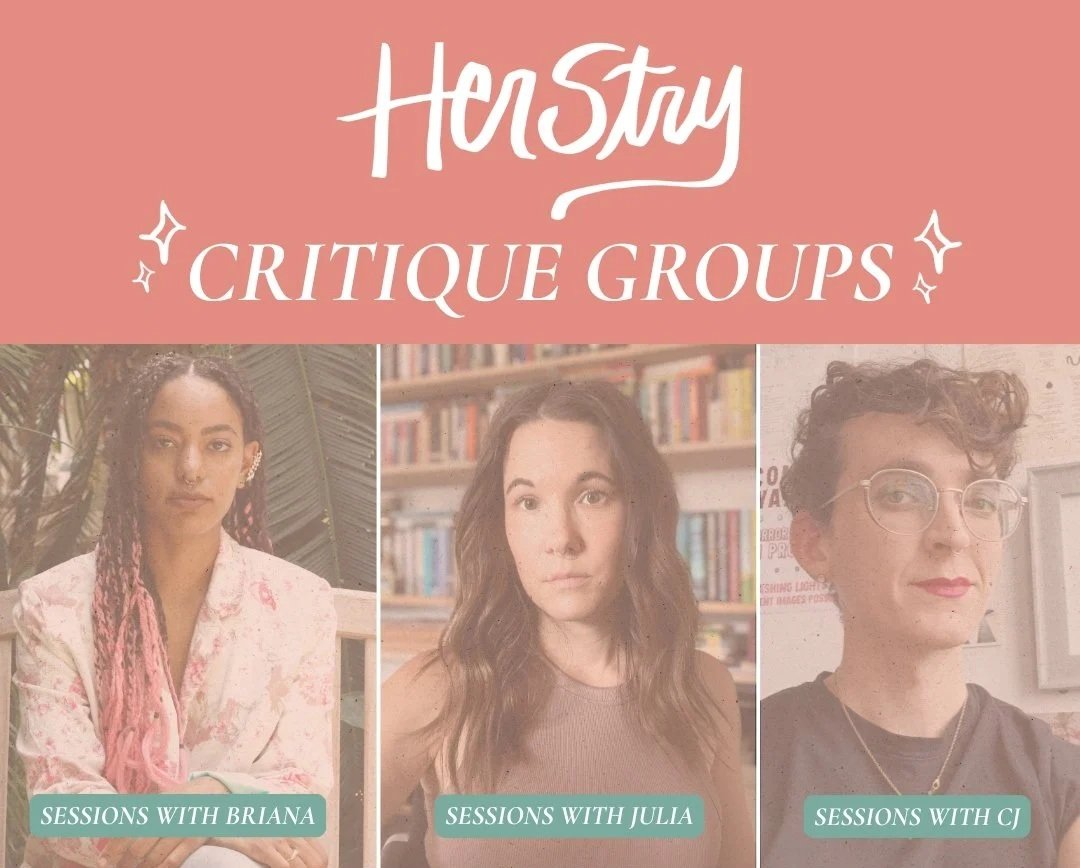
IT’S NO SECRET THAT FEEDBACK IS AN IMPORTANT PART OF THE WRITING PROCESS.
In fact, we argue that it might be the most important part of the process.
But it’s hard to find a writing community. It’s hard to find the people who are willing to take the time and the effort to read your work and give the feedback you really, truly deserves.
That’s where HerStry Critique Groups come in!
HerStry Critique Groups are small groups of 6 women who gather online for 6 weeks to share their writing, give constructive feedback and gain skills as writers.
Weekly online sessions last approximately ninety minutes, with three women sharing their work each week. Writers of all genres and levels are welcome and you may share both works of fiction and nonfiction.
Sessions take place on Mondays 7PM CT, Tuesdays 11AM CT, Fridays 11AM CT
WHAT’S INCLUDED IN THE HERSTRY CRITIQUE GROUPS?
Six 90 minute live workshop sessions
Three 20 minutes sessions in the “hot seat” to get you work critiqued
Written and verbal feedback from your fellow workshop participants
A weekly in depth edit and critique of your work from the group leader after each session
Weekly writing goals and accountability check ins
Full video recordings of each session to keep for your records
Say goodbye to the lonely, stuck in your head writing life!

LET’S WRITE!
From conception to submission. Let’s make summer sizzle with stories.
Writing a short story doesn’t happen in one session. It takes multiple drafts to get it exactly right, to create characters that come to life for the reader and a world they can’t stop thinking about. In this seven week course we will work on a single short story from conception to submission ready. The seven week session will include generative brainstorming sessions, short story craft talks, multiple workshops for feedback from fellow writers, and detailed line by line feedback and edits from your instructor. Plus, we’ll talk about submission venues, cover letters, and when to know if your story is ‘finished.’
IT’S NO SECRET THAT FEEDBACK IS AN IMPORTANT PART OF THE WRITING PROCESS.
In fact, we argue that it might be the most important part of the process.
But it’s hard to find a writing community. It’s hard to find the people who are willing to take the time and the effort to read your work and give the feedback you really, truly deserves.
That’s where HerStry Critique Groups come in!
HerStry Critique Groups are small groups of 6 women who gather online for 6 weeks to share their writing, give constructive feedback and gain skills as writers.
Weekly online sessions last approximately ninety minutes, with three women sharing their work each week. Writers of all genres and levels are welcome and you may share both works of fiction and nonfiction.
Sessions take place on Mondays 7PM CT, Tuesdays 11AM CT, Fridays 11AM CT
WHAT’S INCLUDED IN THE HERSTRY CRITIQUE GROUPS?
Six 90 minute live workshop sessions
Three 20 minutes sessions in the “hot seat” to get you work critiqued
Written and verbal feedback from your fellow workshop participants
A weekly in depth edit and critique of your work from the group leader after each session
Weekly writing goals and accountability check ins
Full video recordings of each session to keep for your records
Say goodbye to the lonely, stuck in your head writing life!

October 7, 14, 21, 28, November 4 and 18 CT
There is no class on November 11.
WRITING THE SEX SCENE.
Writing a sex scene can be delirious fun, a harrowing challenge, a literary milestone—possibly the most important part of building your short story or book. In our six weeks together, you’ll experience just about every possible emotion as you explore the erotic in different modes: comic, tender, harrowing, soul-shattering … because it really is all about the characters’ feelings, not just the mechanics. So we’ll talk about tone. Vocabulary. Metaphor. Sensory detail. How to get big emotions on the page … and when to pull back and let the reader’s imagination go to work.
This is a course for writers who want to explore the intersection between the novel and short stories, and would like to weave their short stories into a story cycle (or collection of "linked stories" or "composite novel"). This is also a class about the interaction of form and content, and how one influences the other. We will read works of interlinked stories by writers from diverse cultural and ethnic backgrounds, focusing on modern classics and contemporary practitioners of these hybrid forms. Weekly discussions will center on elements of craft, such as the expansion and compression of time, setting as an organizing and connecting principle, character development within and between stories, structure and plot for interconnected stories, and responding to literary influences in the same genre.
This six-week course guides writers through the literary submission process, offering insider insight and practical tools to help you get your work into the world. We’ll demystify everything from reading submission calls to writing cover letters and choosing the right journals. Along the way, we’ll workshop short bios, develop submission trackers, and build personalized plans that align with your voice and goals.
By the end of the course, you’ll walk away with a polished piece ready to send, a tailored submission list, and the confidence to navigate the lit mag world with clarity and purpose.
Ideal for writers of literary fiction, poetry, personal essay, memoir, and hybrid forms.
This is about my mama because I’m too stubborn, too proud, too self-conscious to tell these things to her in person. I’ll backpack around with luggage until I gain enough substance to face it head-on. For now, I’m simply going to make excuses and say that I’m too green to face this— pride(?) Perhaps sheepish-ness is a more suited term. English doesn’t wield such a single term that encases this feeling to its extent.