
Statistics
My twelve-year-old son is conducting research, interviewing as many people as he can at the Hugo’s Supermarket downtown. He’s on a mission and there’s no stopping him. His statistical analysis involves the following variables: person, car driven, and favorite soda. I’m not sure which is the dependent variable, but I’m sure he’ll correlate vehicles with soda type soon. Maybe make a discovery he can sell to Pepsi. That’s his favorite one, after all.
He will approach possible participants, standing inches from their faces for questioning.
I worry how nervous they will be with him so close. Wonder if they’ll be irate. Worried they’ll catch COVID. But he doesn’t really take no for an answer, because he’s learned persistence is key to get the information he wants. I feel for him, ache knowing he might be rejected, or possibly yelled at. Sometimes I wonder if it’s harder on me.
I often feel like an outside observer, watching the stranger’s bodies for signs of flight. Signs of agitation. I analyze their grip on the shopping cart. I watch their eyes. Do they look him in the eye or fixate on cereal and candy displays, as if they couldn’t be bothered? Do they cross their arms across their chest or turn to face him? A part of me wants to veer him from people, to keep him safe from cruelty, but I remember when I didn’t even know if he’d ever speak, and this stops me stepping in.
He runs ahead, approaching an older woman. The woman brushes aside a strand of gray hair, moving it from her rosy, round cheek. She’s bundled in a floppy cloth jacket, wearing pink plastic glasses, and a mask.
Her cart has two types of soda. There’s Schweppes Ginger Ale in a two liter and Mountain Dew in a twelve pack. He’s furrowing his brow staring at them. Maybe he wonders who she’s buying them for. There’s a moment’s hesitation from him. Finally, he nods, and approaches her with confidence.

Midlife doesn’t announce itself with milestones — it arrives in contrasts. One moment, you’re lighting candles for a graduation. The next, you’re watching your mother shrink into a hospital gown.

“Any requests?” my daughter asks from the backseat of the car. I’m driving up Connecticut’s Merritt Parkway to drop her off for her first year of college. She plays DJ while my husband and younger daughter count passing Teslas. Through New Jersey and over the GW Bridge, we listen to their mix of Phoebe Bridgers, Kimya Dawson, and Big Thief. We’re all a little nervous, unsure about what life will be like once we say goodbye.

She opens the cupboard above the sink and stretches her body as far as it can go. The glasses and bowls have moved closer to the edge of the shelves since I was here last.

I should have heard the warning growl before pulling open the dresser drawer in the garage. It had been twenty years since my husband and I had done any cleaning out here beyond superficial tidying. We’d plunked down his scratched childhood dresser in the garage when we first bought the house. Since there wasn’t enough room for the old dresser inside our new home, it never traveled any farther. The top of the dresser became a landing station for stray gardening tools, rafts of paper towels, and a box of Hannukah decorations.
My last child has just turned three. I want another child—a fourth child. The number of children that gets you stares at the supermarket, that makes your mom and sister say, “You’re fucking crazy.” I want this child so badly I can feel it close by, as if it is hiding within me, not to be eventually expelled from my body, but a shadow—a ghost child.
Josh and I sat in the waiting room, an office building with a view of the Manhattan skyline. I stared at the other women, wondering what they were getting done. I wondered how many of them were here not by choice. How many of them had never contemplated getting fake breasts before they learned they had breast cancer. I couldn’t have been the only one. But I was definitely the only pregnant woman getting a boob job in the crowd.

It is 10:34 p.m. I am journaling about the difference between what I eat and how I taste it.
In other words, it’s not about the chocolate cake. It’s about the pool of saliva swirling through each bite. It’s about the tongue pressing crumb into ganache, the esophagus readying itself to carry each sweet offering down. It is about my body knowing it is safe. Safe to sit, to enjoy, to receive.

One Sunday in January, my twelve year-old and I had an hour between appointments in the Denver suburbs, and found ourselves at a mall. In the age of “add to cart,” we rarely shopped together, and she had grown so much in the previous several months that none of her clothes fit. As we wandered into H&M, my daughter’s eyes lit up. She grabbed armfuls of clothes, including a pair of acid washed jeans with a chain that went from the front pocket to a back belt loop, each link a tiny heart. Maybe they won’t fit, I thought hopefully, as I trailed behind her in a daze. The Friday before, she had refused to go to school, her second school of the year, and one that had seemed promising only a couple of weeks before. I felt like I was hiking along the edge of a cliff in the fog; I had no idea what was going to happen, or how close we were to the edge.
He touches the edge of her cart and says, Who is the ginger ale for?
She pulls down her mask to talk to him. It’s mine. She smiles. I relax.
What’s your name? he asks her.
Sue, she tells him.
Who is the Mountain Dew for? he asks.
It’s mine, she says.
What kind of car do you drive?
A blue one. She runs a hand through her tousled gray hair.
Make?
Ford.
Model?
Er—Sue bites her lip. A Fusion.
Yep, mmhmmm, he says, lower than normal. That’s a Sudan with five seats. Yep, mmhmmm. I know he’s trying to impersonate a car salesman.
What’s your name? Sue asks.
He leaves without answering, on to the next potential participant.
I say, Thanks, before chasing after him again.
I might forget most of this. So might Sue.
But my son will remember the logo on Sue’s jacket, how she smelled faintly of cigarettes, her favorite soda, and her vehicle. I know because he’ll tell me about it. Even when it’s been a year since he met Sue. He’ll recall it was February 25, 2021, on a cold winter’s day, when Sue became his friend in Hugo’s, if only for a little while.
-Brigid Pine
This product gives you access to all four weeks of the workshop. Purchase one or more drop-in sessions here.
Build a habit in 20 sessions. In this 4 week workshop that meets Mondays through Fridays from 8:00-9:00 AM CST, we will focus on generating new writing—making headway on a current project, reviving an old project that’s been gathering dust, or writing based off of the daily prompts Leigh provides.
The first 45 minutes of class are a gentle, camera-off, silent writing session. The remaining 15 minutes are an opportunity to share excerpts of our work, reflect on progress made, and set intentions for the following day. Then we will read a passage together on the writing life and close each class with a new learning about habit formation. By the end of this course we’ll have a morning writing habit that is each our own to continue and build upon.
This listing is for an individual class. To purchase access for the full 4-week workshop, click here.
Build a habit in 20 sessions. In this 4 week workshop that meets Mondays through Fridays from 8:00-9:00 AM CST, we will focus on generating new writing—making headway on a current project, reviving an old project that’s been gathering dust, or writing based off of the daily prompts Leigh provides.
The first 45 minutes of class is a gentle, camera-off, silent writing session. The remaining 15 minutes are an opportunity to share excerpts of our work, reflect on progress made, and set intentions for the following day. Then we will read a passage together on the writing life and close each class with a new learning about habit formation. By the end of this course we’ll have a morning writing habit that is each our own to continue and build upon.
Many writers feel drawn to write about their lives but struggle with uncertainty: Why this story? Why now? And who is it really for? This workshop is designed to help writers move beyond doubt and toward clarity by focusing on the deeper meaning and purpose beneath their story.
In this interactive, craft-forward session, participants will be introduced to the Memoir Compass, a practical framework that helps writers articulate their motivation (why they are writing), mission (who the story serves), and message (what meaning or insight the story carries). Through guided reflection and writing exercises, participants will begin shaping a personal narrative rooted in intention rather than overwhelm.
This workshop is ideal for writers interested in memoir or personal narrative, as well as fiction writers drawing from lived experience, who want to move forward with greater confidence, focus, and direction.
Some of the most compelling creative nonfiction begins with the feelings we are tempted to avoid: anger, resentment, shame, fear, or the sense that we have an axe to grind. In this six-week workshop, writers will explore how to follow that emotional heat toward deeper, more honest work—without sacrificing compassion, complexity, or craft. Through close readings, writing exercises, discussion, and constructive feedback, we’ll consider how to transform strong feelings into writing that reaches beyond catharsis and connects with readers.
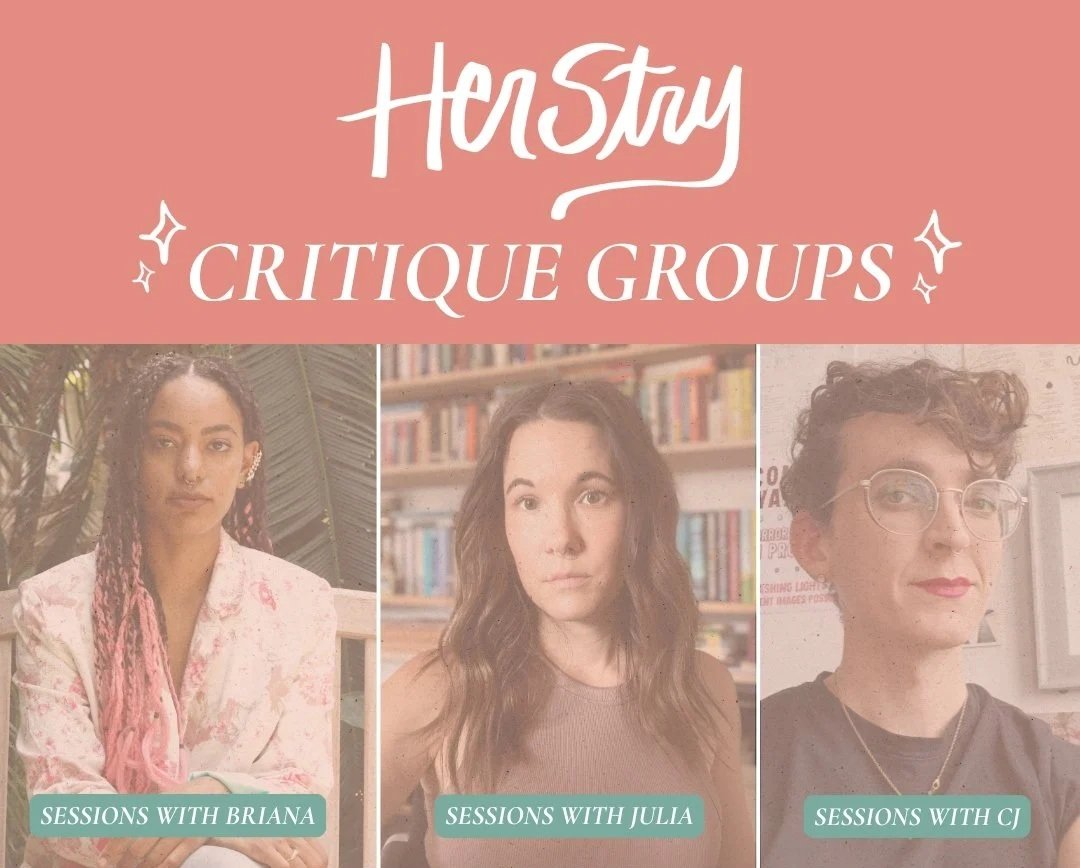
IT’S NO SECRET THAT FEEDBACK IS AN IMPORTANT PART OF THE WRITING PROCESS.
In fact, we argue that it might be the most important part of the process.
But it’s hard to find a writing community. It’s hard to find the people who are willing to take the time and the effort to read your work and give the feedback you really, truly deserves.
That’s where HerStry Critique Groups come in!
HerStry Critique Groups are small groups of 6 women who gather online for 6 weeks to share their writing, give constructive feedback and gain skills as writers.
Weekly online sessions last approximately ninety minutes, with three women sharing their work each week. Writers of all genres and levels are welcome and you may share both works of fiction and nonfiction.
Sessions take place on Mondays 7PM CT, Tuesdays 11AM CT, Fridays 11AM CT
WHAT’S INCLUDED IN THE HERSTRY CRITIQUE GROUPS?
Six 90 minute live workshop sessions
Three 20 minutes sessions in the “hot seat” to get you work critiqued
Written and verbal feedback from your fellow workshop participants
A weekly in depth edit and critique of your work from the group leader after each session
Weekly writing goals and accountability check ins
Full video recordings of each session to keep for your records
Say goodbye to the lonely, stuck in your head writing life!

LET’S WRITE!
From conception to submission. Let’s make summer sizzle with stories.
Writing a short story doesn’t happen in one session. It takes multiple drafts to get it exactly right, to create characters that come to life for the reader and a world they can’t stop thinking about. In this seven week course we will work on a single short story from conception to submission ready. The seven week session will include generative brainstorming sessions, short story craft talks, multiple workshops for feedback from fellow writers, and detailed line by line feedback and edits from your instructor. Plus, we’ll talk about submission venues, cover letters, and when to know if your story is ‘finished.’
IT’S NO SECRET THAT FEEDBACK IS AN IMPORTANT PART OF THE WRITING PROCESS.
In fact, we argue that it might be the most important part of the process.
But it’s hard to find a writing community. It’s hard to find the people who are willing to take the time and the effort to read your work and give the feedback you really, truly deserves.
That’s where HerStry Critique Groups come in!
HerStry Critique Groups are small groups of 6 women who gather online for 6 weeks to share their writing, give constructive feedback and gain skills as writers.
Weekly online sessions last approximately ninety minutes, with three women sharing their work each week. Writers of all genres and levels are welcome and you may share both works of fiction and nonfiction.
Sessions take place on Mondays 7PM CT, Tuesdays 11AM CT, Fridays 11AM CT
WHAT’S INCLUDED IN THE HERSTRY CRITIQUE GROUPS?
Six 90 minute live workshop sessions
Three 20 minutes sessions in the “hot seat” to get you work critiqued
Written and verbal feedback from your fellow workshop participants
A weekly in depth edit and critique of your work from the group leader after each session
Weekly writing goals and accountability check ins
Full video recordings of each session to keep for your records
Say goodbye to the lonely, stuck in your head writing life!
October 7, 14, 21, 28, November 4 and 18 CT
There is no class on November 11.
WRITING THE SEX SCENE.
Writing a sex scene can be delirious fun, a harrowing challenge, a literary milestone—possibly the most important part of building your short story or book. In our six weeks together, you’ll experience just about every possible emotion as you explore the erotic in different modes: comic, tender, harrowing, soul-shattering … because it really is all about the characters’ feelings, not just the mechanics. So we’ll talk about tone. Vocabulary. Metaphor. Sensory detail. How to get big emotions on the page … and when to pull back and let the reader’s imagination go to work.
This is a course for writers who want to explore the intersection between the novel and short stories, and would like to weave their short stories into a story cycle (or collection of "linked stories" or "composite novel"). This is also a class about the interaction of form and content, and how one influences the other. We will read works of interlinked stories by writers from diverse cultural and ethnic backgrounds, focusing on modern classics and contemporary practitioners of these hybrid forms. Weekly discussions will center on elements of craft, such as the expansion and compression of time, setting as an organizing and connecting principle, character development within and between stories, structure and plot for interconnected stories, and responding to literary influences in the same genre.

Brigid Pine is an emerging writer who consumes dairy-free ice cream whenever possible. Her nonfiction has been published with Pithead Chapel, Chaotic Merge, and Barren. She’s tinkering with twitter at @brigidpine