
A mass of white caps on a disheveled sea crisscrosses the horizon, the aftermath of a hurricane that skidded up the western face of Baja from Cabo past Punta Hughes. The storm made a westerly turn on its northern trajectory, just far enough off the coast to send a small amount of rain and mountainous surf to our small pueblo. Wave after wave, a tight fetch. a disorganized army of marching swell lines with little space between them, and out the far points, close-out walls of water.
Mesmerizing in any case, the sun now glistens on the ocean surface, the clouds pushed northward. I watch in awe, the sea always my homing device. From the broken-hearted fifteen-year-old me who found solace at the constancy of a blue horizon, to the eighteen-year-old who flew midway across the Pacific for the freedom of island living and never-ending waves, the watery motion has held my soul. Memories of living on the North Shore reignited when I rode that first wave after a forty-year hiatus.
I remember that girl, the one who surfed storms and challenged her fear until it became undetectable.
1968 – Sunset Beach, Hawaii
Like electrical pulses, charged energy runs from surfer to surfer as the waves build overnight. A south swell on the North Shore is pumping eight feet and growing. I kneel on the sand, fingertips tingling as I press wax onto the surface of my board. My chest tightens and my breath comes in short bursts as I watch the increasing size. My stomach pushes a belch, the morning papaya less sweet, churning as nervous excitement claims my body.
I swallow hard, stifle the gastric distress and focus on the task at hand. Like all the other surfers lined up on the beach, I lay down more wax, insuring a solid footing in this swirling mass of water. Six or so have already paddled out, and one by one, the rest excitedly follow.
This is it. This is what everyone here waits for. Big storm surf. Monster waves that pound the reef and can be felt on the sand as movements in the earth. Crowds gather, bodies plunked down in chairs and on towels to watch the show. Sunset Beach at size.
“What’d ya think?” A dark-skinned Hawaiian, Tiger, who’s become a good friend, cups his hand over his brows, staring out at the foaming mess of the inside reef. ‘“Looks heavy.”
Heavy doesn’t mean heavy, but is surfer speak for cool or awesome. I nod, not sure exactly how to respond, because in that moment, heavy to me means big water and hard paddle. This is the moment for me to choose – go or no go. When I look up, Tiger’s already in the water.

“Bitchin’,” I say to the air, grateful that adrenalin is kicking into overdrive, a counterpart to my anxiety. I rub one more layer of wax on the board’s surface and launch myself into the foam.
The paddle out is tough, tougher than I’ve ever experienced. This storm, bulkier. The sets closer together. The water heavier, faster. I have to roll under wave after wave, fighting to get beyond the white water pushing me backwards. A short respite between sets and I paddle like a madwoman to close the gap. Now, outside the break line, I survey how far away the beach seems.
Tiger floats in the lineup, waiting his turn, watching outside. His ease is a perfect foil for my sub-surface frenzy. A nod from him and my mind settles. I dreamt of this, longed for this, and now, my most wanted wave is coming for me. A wall of water pushes toward us and I paddle a bit farther out. I want to assess these waves. Assure myself of the peak, watch from the backside how the wave breaks. Tiger paddles for the second wave and is gone.
I wait out a second set, continue to judge and set my timing, watch other surfers peel off one by one down the overhead faces. After the take-off, they simply disappear. I can no longer see them behind the wall of water. I wonder if they are okay. If they made the drop or wiped-out. When it’s my turn, I suck in my breath and paddle with all I’ve got, matching the speed. The wind catches under the nose and pushes my board upward. I push all my weight forward against the wind and suddenly, I’m sliding down the crest of a huge wall of water, racing away from the crashing lip. My hair streams out behind me, my heart reaches out before me. The pelting spray of the offshore winds stings my skin.
this is incredible…this is…this is…the dream …
I’ve never gone this fast on my board. There’s little time to think about turns or drops, instead I rely on instinct, muscle memory. Trim close to the face, stay in the power pocket. Before I can inhale again, the wave hits the inside bowl and I fly up and out the backside. My whole body is beaming, beating, my heart maybe outside my chest. I maneuver toward the channel and work my way back into the lineup.
Back outside, no one says a word. Everyone on a board focuses on the horizon, the incoming rise, the paddle, the drop. The summer before, I had wiped out an 8’ wave, broken my board in half, and have not since been in any sizeable surf. I press the memory of falling out of focus and turn my attention back to minute shifts in timing and approach. Again, I wait my turn, and when the next set comes, I catch the second wave, look up from my bottom turn, and I realize the wave is double my height. Over ten feet. I am a speck against the face. I suck in my breath and am skidding, sliding, flying across a wall of water that dwarfs me. I have no time to be afraid. A wild elation, a pulling into myself while simultaneously exploding outward, earthquakes through my body. It feels like driving my car over 100mph down a straightaway. I am communing with giants.
Present - San Juanico
I walk the land, my eyes following the curve of the slope, the rockpiles and bare areas. Spindly cactus and tiny ground brush lean southward, toward the blue horizon line, the Pacific ever-present.
The first time my eyes traveled the wave train in San Juanico, I sensed the heartstrings of home begin to compose a song within me. An odd beckoning of the stark craggy desert, the dryness, bereft of lush trees dotted with towering cardon, scrub shrubbery. The earth a geologic mix of volcanic and sedimentary features reminiscent of the plateaus of Utah and Arizona, framed against an ocean tableau. Without question, it was the sea that drew me here, the often-perfect wave. The wave that wraps a smile across my face edge to edge, cresting in a spray of white foam around the tail of my board, the wave that fills me with a sense of belonging and freedom.
It took me nine years to find the land to match the connections I feel with the waves. Nine years of looking, of considering, of making offers. Nine years until all the pieces slipped together, like a Tetris puzzle. Two contiguous ½ hectares, the lower halves of two separate owner’s hectares, the seaside halves. Together, the land spreads 100 meters along the Pacific and climbs the back slope for ninety meters. A wave that breaks directly in front of the house that reminds me of San Onofre
Originally, I thought to build a vacation home, a small get-a-way far from city life and the roar of freeways. I didn’t realize I would actually find myself living here. I hadn’t known then how hypnotic the land would be, how the thought of leaving causes a ripple of upset up and down my spine. How I miss “my” wave before I climb into my truck.
Before the plans, before the first shovel of dirt for the foundation was dug, I communed with the property. For a full year I measured the seasonal shifts, tracked the wind direction, marked how the sun crossed east to west, its arc moving northward in the summer and southward in approach to winter.
“Why so much land?” my friend Cynthia asked.
How could I explain to her my need for space? That I like some people very much, but lots of people not so much. That quiet and serenity have a grip on me in this iteration of my life.
The land is three miles outside of town, an outpost to some, down a rutted dirt road that bounces my truck from side to side. My dog opens his eyes wide and wraps his paw around my arm for support every single trip. I have three somewhat distant neighbors, a perfect situation.

You either love being here, or you run screaming. The sun and the wind are persistent. My home is off grid. The power plant is an array of solar panels and a room full of lithium-ion batteries with a high-tech inverter system that hums as it translates sunlight into electricity. The first night I spent in the completed house, I ran around turning off lights, until with a giggle I realized I didn’t have to turn off the lights. I own the power. My water is delivered via a truck which fills the 6000-liter cistern under my garage floor. Living without city delivered water has taught me conservation on an experiential basis. I cringe at how much I used on my former water-sucking southern California lawn. How precious every drop of water.
After the hurricane gifted its rains, the desert flora took its cue. Within five days the first sprouts of green appeared, turning desiccated and grey-dry shrubbery into an explosion of color. Tiny tips, leaflets and sprigs of growth, followed quickly by flowers, some smaller than my pinky finger nail, unfurled their blossoms to the army of pollinators, the birds, the moths, the bees and butterflies. The window for procreation precarious. The lifeline of rain, more like an errant breeze, caressing the desert floor and rapidly disappearing. A carpet of green blanketed the land, only to wither under the hot southern sun. Retreating to dormancy, awaiting once again, the potential of a cloud-filled sky.
The sea a troubled shade of brown, after dry flashed arroyos flushed dirt and refuse into her waters. After a few days, the silt settles, and the gentle blue curve of wave once again decorates the shoreline.
Living here, away from the bustle of city life, the rhythm of land and the sea have become my teachers. I rise to the lyricism of bird call: an osprey hunting fish, quail scratching for seed, cactus wrens arguing, while doves coo to one another. Their sounds blend with the roll of sea stones against the cliff face as the tide ebbs and flows, pulled and pushed by the moon.
The infrequency of rain, the constancy of afternoon winds, the rise and fall of waves, drive decisions that tie me to the flow of life. The eighteen-year-old me could never have imagined that this land would one day be home. Yet here I am, landed between desert and sea, learning that to be present, to simply be, is enough.
-Catharine Cooper
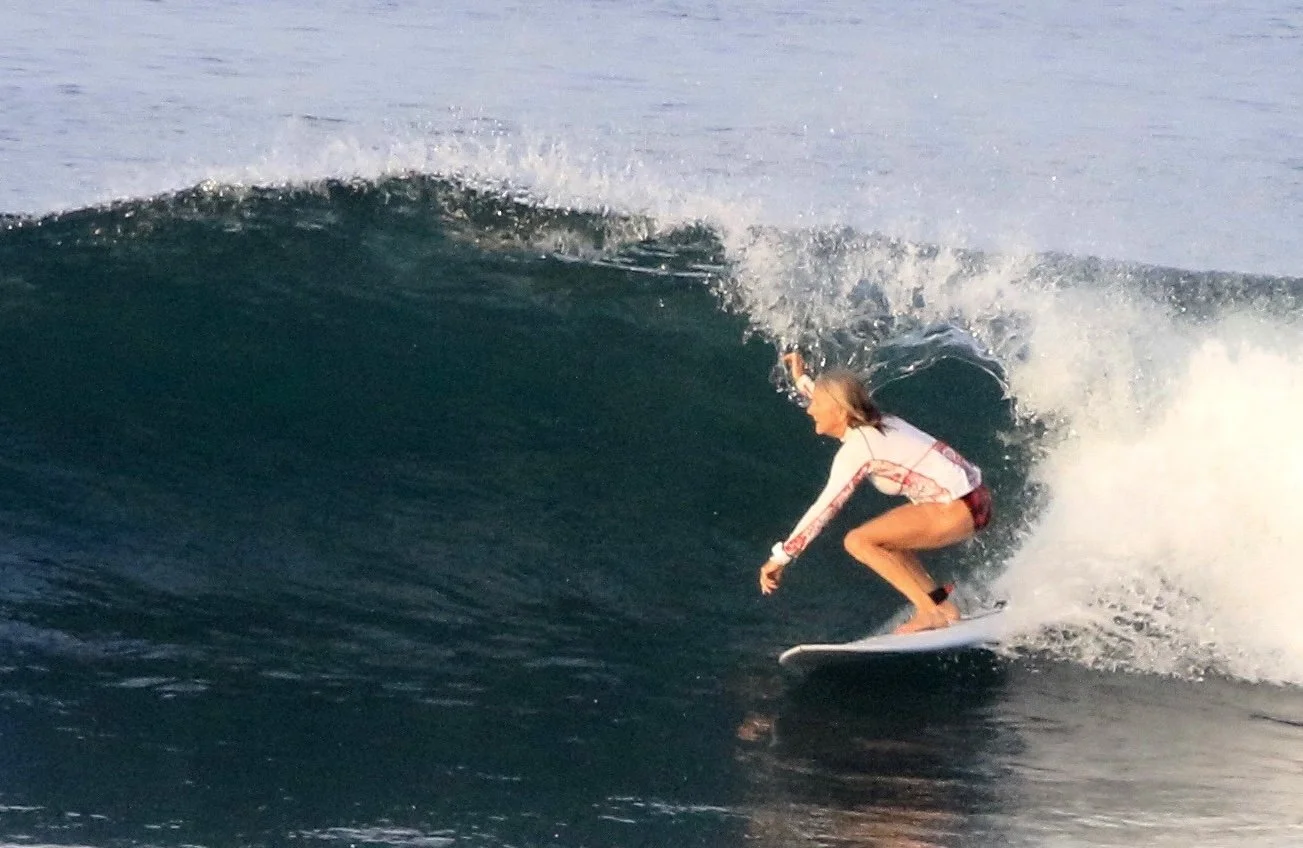
Catharine Cooper’s work has appeared in regional and environmental magazines, and she is completing a memoir that also centers on surfing, aging, and belonging. She lives in Baja California with her dog, Loki, grows her own vegetables and surfs as often as possible.