
Dear Lesley
Dear Past Me,
The one sitting by an incubator in the NICU. I see you- I am you. Today was hard. A doctor with a brash attitude blindsided you in a room full of people. She told you to pull the plug- to abandon hope because even if your sick child does manage to pull through- the burden will be too great. Her words- not yours, not mine.
Right now, your world is caving in on itself. You’re faced daily with decisions that absolutely no parent should ever have to make. Currently, you contemplate which child you’re failing more: the healthy one that’s been living with his grandparents for three months or the dying one you can do nothing for. You wonder who needs your time most. Presently, I still can’t answer that question for you. I can’t tell you which decision is best, but I do know that spending time with either child is never time wasted. Wasted time is all the time you spend stressing over insignificant details. The things you either can’t change or have no desire to do so. If family wants to fight amongst themselves- let them. Maybe they’ll start an all-out brawl in the waiting room next week. It’s not your problem. The only things that matters are those babies. Your babies.

I remember being you. Being you, with your hands tucked under your thighs in skinny jeans that never quite fell to the ankle. I remember those hands, & how they wanted to wander over into his & how you told him with your lips that you would always wonder what it would be like to kiss him, but your lips stayed tucked together. He said he'd always feel that way too, and you let the moment pass, utterly kissless.

I am so sorry everyone deconstructs and changes your beautiful,
complicated name. The pieces of your soft “ca” and lopping “o”
rebranded into southern alternatives like Caroline or Coraline or Carol
or even Carly once, after the doctor said the only Carolyn he’d ever heard

Dear me from one year ago,
I regret to inform you that tomorrow will be one of the worst days of your life.
Tomorrow you will reset the password to log into your joint bank account. You asked him for the password many, many times. He always says, “Oh it’s on my phone… I don’t remember it…I will get it to you when I have time…I can’t do it right now.”

There is no time for pleasantries, let’s get to it.
You will fight a good fight from a place of absolute terror. You will list improbable reasons why you might be the person for whom antidepressants just really aren't the solution. You will throw pseudoscience and bad journalism against a woman with twenty years’ experience and a prescription pad. And then you will give in.

Dear Trish,
It was so annoying how Marlee slid on her jeans, buttoned them easily, and pulled a cream-colored, cable-knit sweater over her head, ready to party. She didn’t wonder if the pants were too tight, if they made her look fat, if the shirt covered the soft rolls of her stomach.

Dear Melina,
I write this love-letter to you when I am old enough to be your grandmother, and when Grandma was my age. Time is a funny thing. It unspools before us and then folds in on itself to be carried forward into the memories of body and soul. You are eleven years old in this memory. You are a child on the cusp of womanhood, and I am a woman on the cusp of old age.

At this time, your purpose is unclear. But eventually, it will be apparent why you are here on Earth. I know every day is routine – your forty-five-minute commute to your job, the mundane workday, the chaotic drive back home through traffic to smoke weed in your living room, then eat something and fall asleep.

Dear Teenage Deb,
Coming of age in the 1970s, you sometimes marvel at the inconceivable notion of one day living in the twenty-first century, of being forty-three (ancient!), when chimes clang and horns blare, welcoming a fresh numeral on humanity’s odometer. However, you also doubt the probability of living to the year 2000, since the Rapture is bound to occur at any moment.

Dear Past Me,
Congratulations. You are flying high and holding on tight. From the perspective of those on the ground, it seems like you could be floating up there forever, gripping the strings of a colorful bunch of balloons, symbols of success in a society that requires outward markers. One of yours is filled with the confidence of a post-graduation job as a public defender, where you will save the lives of your clients and probably fix the entire criminal justice system while you’re at it.
I can’t promise you that things get easier from here, because they don’t. They get harder. When you think that life has thrown absolutely everything she can throw at you, she digs a little deeper and buries you further. Don’t give up.

No, you can’t save this one. That doctor, she was harsh and today shouldn’t have happened- not like it did. Not completely without warning. Underneath her harsh bravado was a gift- a gift of truth. That it’s okay. Today might not be that day, but when the day comes, its okay to let our little one go. That maybe that’s the motherly decision. Maybe being a good mother means doing what is needed rather than what is wanted. When the time comes, you will know.
I wish I could tell you that this is the one and only time you’ll sit in a hospital room and fear for your child’s life, but it’s not. You’ll do something very similar again, and you’ll wonder why. You’ll wonder why you were so stupid to force your family to relive the same horrors. You’ll wonder why they told you it could never happen again when it clearly does. You’ll wonder what you did to deserve this. The truth is, you did nothing, nothing to bring this upon yourself. People will question what went wrong, what did you do that made these pregnancies different from the first? Doctors will pass the blame from one another, pass it to you. Don’t you dare pick it up. Leave that guilt where it lands. It doesn’t belong to you.
Instead of three living children to drive you nuts, you have one beautiful, healthy child and two urns. It’s not fair, and I won’t tell you it is. I won’t tell you things get easier or time heals all. I will tell you that, as much regret as you have now, it’s not a part of your future. You will learn to accept your decisions. You will learn that, through all your pain, you have had a good life.
With love,
Lesley
This product gives you access to all four weeks of the workshop. Purchase one or more drop-in sessions here.
Build a habit in 20 sessions. In this 4 week workshop that meets Mondays through Fridays from 8:00-9:00 AM CST, we will focus on generating new writing—making headway on a current project, reviving an old project that’s been gathering dust, or writing based off of the daily prompts Leigh provides.
The first 45 minutes of class are a gentle, camera-off, silent writing session. The remaining 15 minutes are an opportunity to share excerpts of our work, reflect on progress made, and set intentions for the following day. Then we will read a passage together on the writing life and close each class with a new learning about habit formation. By the end of this course we’ll have a morning writing habit that is each our own to continue and build upon.
This listing is for an individual class. To purchase access for the full 4-week workshop, click here.
Build a habit in 20 sessions. In this 4 week workshop that meets Mondays through Fridays from 8:00-9:00 AM CST, we will focus on generating new writing—making headway on a current project, reviving an old project that’s been gathering dust, or writing based off of the daily prompts Leigh provides.
The first 45 minutes of class is a gentle, camera-off, silent writing session. The remaining 15 minutes are an opportunity to share excerpts of our work, reflect on progress made, and set intentions for the following day. Then we will read a passage together on the writing life and close each class with a new learning about habit formation. By the end of this course we’ll have a morning writing habit that is each our own to continue and build upon.
Many writers feel drawn to write about their lives but struggle with uncertainty: Why this story? Why now? And who is it really for? This workshop is designed to help writers move beyond doubt and toward clarity by focusing on the deeper meaning and purpose beneath their story.
In this interactive, craft-forward session, participants will be introduced to the Memoir Compass, a practical framework that helps writers articulate their motivation (why they are writing), mission (who the story serves), and message (what meaning or insight the story carries). Through guided reflection and writing exercises, participants will begin shaping a personal narrative rooted in intention rather than overwhelm.
This workshop is ideal for writers interested in memoir or personal narrative, as well as fiction writers drawing from lived experience, who want to move forward with greater confidence, focus, and direction.
Some of the most compelling creative nonfiction begins with the feelings we are tempted to avoid: anger, resentment, shame, fear, or the sense that we have an axe to grind. In this six-week workshop, writers will explore how to follow that emotional heat toward deeper, more honest work—without sacrificing compassion, complexity, or craft. Through close readings, writing exercises, discussion, and constructive feedback, we’ll consider how to transform strong feelings into writing that reaches beyond catharsis and connects with readers.
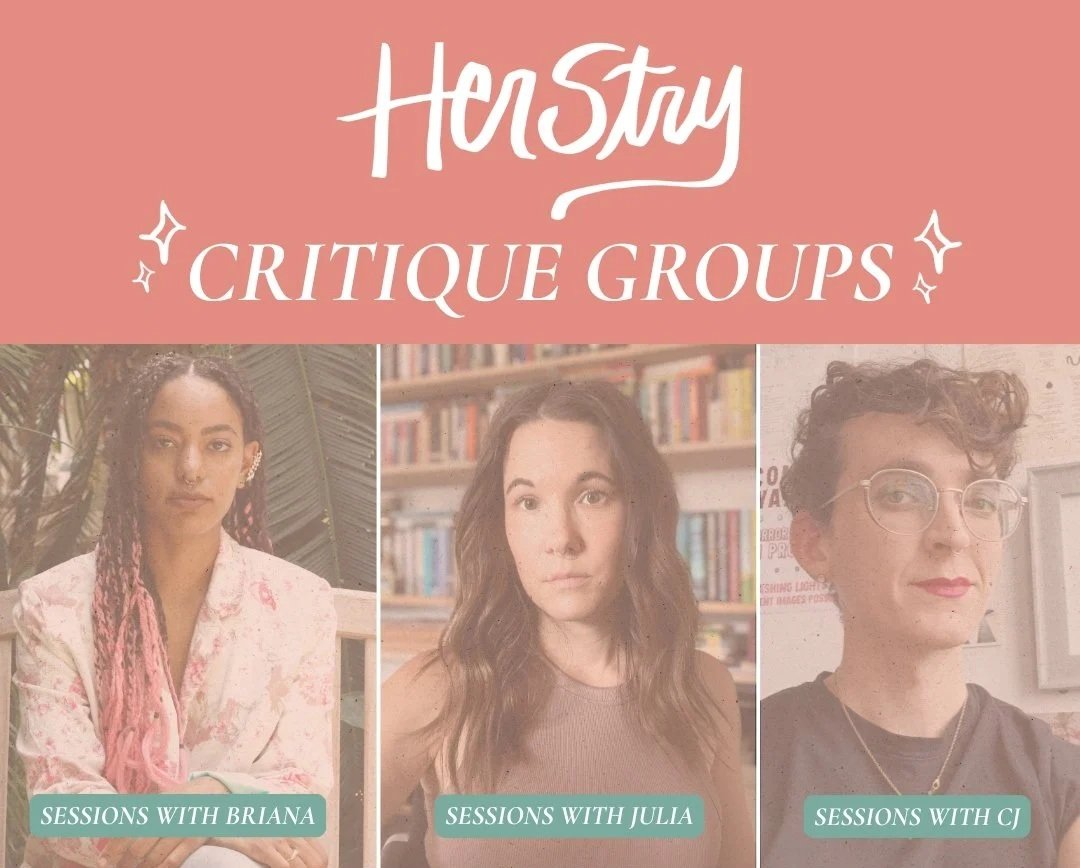
IT’S NO SECRET THAT FEEDBACK IS AN IMPORTANT PART OF THE WRITING PROCESS.
In fact, we argue that it might be the most important part of the process.
But it’s hard to find a writing community. It’s hard to find the people who are willing to take the time and the effort to read your work and give the feedback you really, truly deserves.
That’s where HerStry Critique Groups come in!
HerStry Critique Groups are small groups of 6 women who gather online for 6 weeks to share their writing, give constructive feedback and gain skills as writers.
Weekly online sessions last approximately ninety minutes, with three women sharing their work each week. Writers of all genres and levels are welcome and you may share both works of fiction and nonfiction.
Sessions take place on Mondays 7PM CT, Tuesdays 11AM CT, Fridays 11AM CT
WHAT’S INCLUDED IN THE HERSTRY CRITIQUE GROUPS?
Six 90 minute live workshop sessions
Three 20 minutes sessions in the “hot seat” to get you work critiqued
Written and verbal feedback from your fellow workshop participants
A weekly in depth edit and critique of your work from the group leader after each session
Weekly writing goals and accountability check ins
Full video recordings of each session to keep for your records
Say goodbye to the lonely, stuck in your head writing life!

LET’S WRITE!
From conception to submission. Let’s make summer sizzle with stories.
Writing a short story doesn’t happen in one session. It takes multiple drafts to get it exactly right, to create characters that come to life for the reader and a world they can’t stop thinking about. In this seven week course we will work on a single short story from conception to submission ready. The seven week session will include generative brainstorming sessions, short story craft talks, multiple workshops for feedback from fellow writers, and detailed line by line feedback and edits from your instructor. Plus, we’ll talk about submission venues, cover letters, and when to know if your story is ‘finished.’
IT’S NO SECRET THAT FEEDBACK IS AN IMPORTANT PART OF THE WRITING PROCESS.
In fact, we argue that it might be the most important part of the process.
But it’s hard to find a writing community. It’s hard to find the people who are willing to take the time and the effort to read your work and give the feedback you really, truly deserves.
That’s where HerStry Critique Groups come in!
HerStry Critique Groups are small groups of 6 women who gather online for 6 weeks to share their writing, give constructive feedback and gain skills as writers.
Weekly online sessions last approximately ninety minutes, with three women sharing their work each week. Writers of all genres and levels are welcome and you may share both works of fiction and nonfiction.
Sessions take place on Mondays 7PM CT, Tuesdays 11AM CT, Fridays 11AM CT
WHAT’S INCLUDED IN THE HERSTRY CRITIQUE GROUPS?
Six 90 minute live workshop sessions
Three 20 minutes sessions in the “hot seat” to get you work critiqued
Written and verbal feedback from your fellow workshop participants
A weekly in depth edit and critique of your work from the group leader after each session
Weekly writing goals and accountability check ins
Full video recordings of each session to keep for your records
Say goodbye to the lonely, stuck in your head writing life!
October 7, 14, 21, 28, November 4 and 18 CT
There is no class on November 11.
WRITING THE SEX SCENE.
Writing a sex scene can be delirious fun, a harrowing challenge, a literary milestone—possibly the most important part of building your short story or book. In our six weeks together, you’ll experience just about every possible emotion as you explore the erotic in different modes: comic, tender, harrowing, soul-shattering … because it really is all about the characters’ feelings, not just the mechanics. So we’ll talk about tone. Vocabulary. Metaphor. Sensory detail. How to get big emotions on the page … and when to pull back and let the reader’s imagination go to work.
This is a course for writers who want to explore the intersection between the novel and short stories, and would like to weave their short stories into a story cycle (or collection of "linked stories" or "composite novel"). This is also a class about the interaction of form and content, and how one influences the other. We will read works of interlinked stories by writers from diverse cultural and ethnic backgrounds, focusing on modern classics and contemporary practitioners of these hybrid forms. Weekly discussions will center on elements of craft, such as the expansion and compression of time, setting as an organizing and connecting principle, character development within and between stories, structure and plot for interconnected stories, and responding to literary influences in the same genre.
This six-week course guides writers through the literary submission process, offering insider insight and practical tools to help you get your work into the world. We’ll demystify everything from reading submission calls to writing cover letters and choosing the right journals. Along the way, we’ll workshop short bios, develop submission trackers, and build personalized plans that align with your voice and goals.
By the end of the course, you’ll walk away with a polished piece ready to send, a tailored submission list, and the confidence to navigate the lit mag world with clarity and purpose.
Ideal for writers of literary fiction, poetry, personal essay, memoir, and hybrid forms.

Lesley is an amateur author trying to find her voice. She lives in a small town in West Virginia with her husband, son, and two cats.
Wash your hands after using the bathroom, before using the bathroom if you’ve been outside first, before dinner, after playing with any toys, instruments, or feeding your fish. Even if you’re about to take a bath, if you’ve just done