
The Cyclical Closet
I lost count after the first ten, twenty, seventy-five, a thousand. I remember the first time. Driving with my sisters, one of them said, I’ve had sex with a woman. Stunned into revelation, I blurted, so have I. But she was kidding. Entrapment, and I fell for it.
After that, I came out and that’s the end of the story.
Except, I never stopped coming out. I came out years later when an employer asked me why I didn’t have a boyfriend. And again, when a well-meaning client tried to set me up with her cousin, Ted. A very nice guy, she insisted over my protestations until I finally and firmly said, I don’t date. The word “men” silently hung in the air between us and she never asked again.
I came out every time my mother asked how “my friend” was and I had to tell her my partner was having knee surgery and sends her love.
I came out every time I met a new person, started a new job, went to a new party. I took to wearing rainbow shirts, rainbow converse, and a lesbian feminist button on my jean jacket.
Why do you have to be in people’s faces about it? I was asked, repeatedly, by people who bear the privilege of being the correct orientation by societal consensus. Asked by people who had never seen the fast blink of surprise on the faces of even well-meaning people when they referred to my husband and I corrected them to wife.

I’d been told in my psychologist’s office that I scored “high” in areas of the MMPI (a psychiatric test used in the seventies to determine where one’s area of mental health needed attention)—translation, “Not good.” Identity and Orientation were the categories I rang the bell on and in a voice worthy of that slug character in Star Wars, my psychologist asked, “Are you aroused by women?”

I practice punching at the kitchen table. I practice on the couch. I practice in my sleep. I make a fist and see my life there. I make a fist and study the veins that press out against the skin of my forearms. Hating your hate of love, I practice punching at the kitchen table.

I couldn’t make myself heard for fifty years. Not even the boy could hear me, the boy I lived inside. My vocal anatomy worked fine—larynx, mouth, lungs beneath my breasts—I just didn’t have the words. Nobody did, not in the sixties. I had to resort to signals. Most of them he missed.

I was on my hands and knees trying to hide a twelve-piece dinner set under my single bed when I heard Mum calling from the bedroom next door. She’d been in bed for two days, suffering from either a bad back or codeine withdrawals. I pushed the crockery behind a box of stainless steel cutlery and some gingham tea towels I’d bought from Woolworth’s the day before.

I lost count after the first ten, twenty, seventy-five, a thousand. I remember the first time. Driving with my sisters, one of them said, I’ve had sex with a woman. Stunned into revelation, I blurted, so have I. But she was kidding. Entrapment, and I fell for it.

Paris, City of Love, where we lay our scene of adventurous study abroad college students. Me and the girls were out in a little bar late at night. The lights were cool, a featured musician was playing acoustic, and my friends and I were ready for some dessert.

The day I came out? I’m sure it’s not uncommon to come out on multiple occasions. I expect the circumstances in which I came out are a bit unusual though. To understand that takes context: My girlfriend was once my neighbor—at a Southern Baptist Theological Seminary—where we lived with our husbands—who were studying to be pastors.

The first time that I really tell someone, the words belong to her, like me and everything else in the world around us. We are alone, and I don’t remember where the rest of our friends are or maybe we aren’t alone and all of our friends are with us but I can only ever think of her.

hen I was 14, I walked into a church youth lock-in and fell head-over-heels in love with the most beautiful girl I had ever seen. I immediately knew four things:
1. I liked a girl. A lot.
2. I was a girl.
3. Girls couldn’t like girls.
4. This was an especially bad situation given that I was at church.
I came out, I come out, I will continue to come out.
I’m pushed back into the closet almost daily. And every day, sometimes dozens of times, I make a choice whether to come out again. The closet’s pernicious cycle pulls me back in by default. I claw my way out every time a new acquaintance at a networking event takes a sip of wine and says, I don’t have a problem with the gays, I really don’t. I just don’t think they deserve special rights.

Fifty years old and I’m pushed back into the closet by a cashier who clucks her tongue in disapproval at the retreating backs of a male couple, then turns to me with an almost conspiratorial look before saying, I just wish they wouldn’t flaunt it. Pushed back into the closet when I’m walking with my wife and someone drives by yelling dyke, and I wrestle my hand from hers, in fear for her life more than my own.
I came out of the closet at nineteen. I came out of the closet at twenty-one, thirty-five, forty-four. Fifty years old and I’m pushed back into the closet by a kindly postal clerk who looks at my ring and says, Your husband must be a lucky man.
My wife is the best person I know. She bolsters me when I’ve lost my confidence. She’s the rock of our family, the light of my life. We laugh together and dance in the kitchen. She gets up early and feeds the pets when I hit snooze one too many times. People often accuse us, the royal us, the LGBTQIA+ population as a whole us, of having a gay agenda. My gay agenda is to be as good to her as she is to me. My gay agenda is to spend the rest of my life loving this woman who loves me beyond anything I’ve ever experienced.
But, your husband, the clerk says. I see in my mind the disapproving frown of the grocery store cashier and I force a smile. Yes, I say. Yes, he is.
-Beth Burnett
This product gives you access to all four weeks of the workshop. Purchase one or more drop-in sessions here.
Build a habit in 20 sessions. In this 4 week workshop that meets Mondays through Fridays from 8:00-9:00 AM CST, we will focus on generating new writing—making headway on a current project, reviving an old project that’s been gathering dust, or writing based off of the daily prompts Leigh provides.
The first 45 minutes of class are a gentle, camera-off, silent writing session. The remaining 15 minutes are an opportunity to share excerpts of our work, reflect on progress made, and set intentions for the following day. Then we will read a passage together on the writing life and close each class with a new learning about habit formation. By the end of this course we’ll have a morning writing habit that is each our own to continue and build upon.
This listing is for an individual class. To purchase access for the full 4-week workshop, click here.
Build a habit in 20 sessions. In this 4 week workshop that meets Mondays through Fridays from 8:00-9:00 AM CST, we will focus on generating new writing—making headway on a current project, reviving an old project that’s been gathering dust, or writing based off of the daily prompts Leigh provides.
The first 45 minutes of class is a gentle, camera-off, silent writing session. The remaining 15 minutes are an opportunity to share excerpts of our work, reflect on progress made, and set intentions for the following day. Then we will read a passage together on the writing life and close each class with a new learning about habit formation. By the end of this course we’ll have a morning writing habit that is each our own to continue and build upon.
Many writers feel drawn to write about their lives but struggle with uncertainty: Why this story? Why now? And who is it really for? This workshop is designed to help writers move beyond doubt and toward clarity by focusing on the deeper meaning and purpose beneath their story.
In this interactive, craft-forward session, participants will be introduced to the Memoir Compass, a practical framework that helps writers articulate their motivation (why they are writing), mission (who the story serves), and message (what meaning or insight the story carries). Through guided reflection and writing exercises, participants will begin shaping a personal narrative rooted in intention rather than overwhelm.
This workshop is ideal for writers interested in memoir or personal narrative, as well as fiction writers drawing from lived experience, who want to move forward with greater confidence, focus, and direction.
Some of the most compelling creative nonfiction begins with the feelings we are tempted to avoid: anger, resentment, shame, fear, or the sense that we have an axe to grind. In this six-week workshop, writers will explore how to follow that emotional heat toward deeper, more honest work—without sacrificing compassion, complexity, or craft. Through close readings, writing exercises, discussion, and constructive feedback, we’ll consider how to transform strong feelings into writing that reaches beyond catharsis and connects with readers.
IT’S NO SECRET THAT FEEDBACK IS AN IMPORTANT PART OF THE WRITING PROCESS.
In fact, we argue that it might be the most important part of the process.
But it’s hard to find a writing community. It’s hard to find the people who are willing to take the time and the effort to read your work and give the feedback you really, truly deserves.
That’s where HerStry Critique Groups come in!
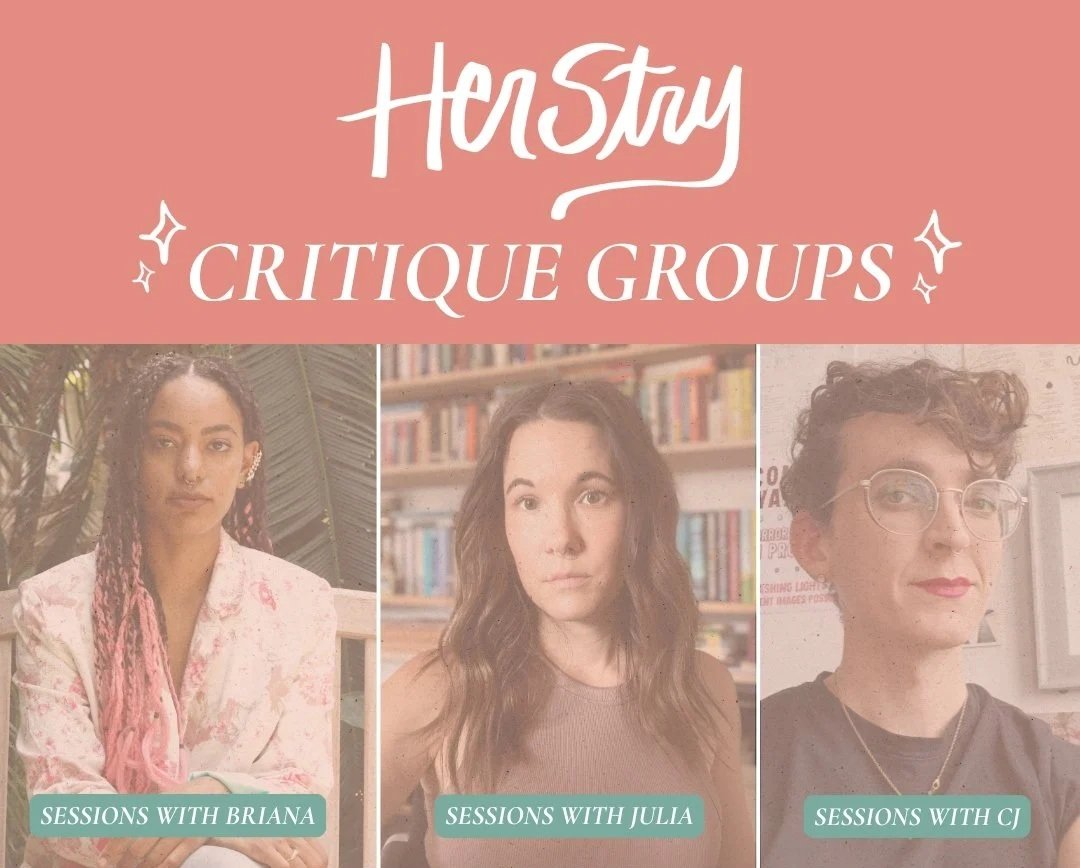
HerStry Critique Groups are small groups of 6 women who gather online for 6 weeks to share their writing, give constructive feedback and gain skills as writers.
Weekly online sessions last approximately ninety minutes, with three women sharing their work each week. Writers of all genres and levels are welcome and you may share both works of fiction and nonfiction.
Sessions take place on Mondays 7PM CT, Tuesdays 11AM CT, Fridays 11AM CT
WHAT’S INCLUDED IN THE HERSTRY CRITIQUE GROUPS?
Six 90 minute live workshop sessions
Three 20 minutes sessions in the “hot seat” to get you work critiqued
Written and verbal feedback from your fellow workshop participants
A weekly in depth edit and critique of your work from the group leader after each session
Weekly writing goals and accountability check ins
Full video recordings of each session to keep for your records
Say goodbye to the lonely, stuck in your head writing life!

LET’S WRITE!
From conception to submission. Let’s make summer sizzle with stories.
Writing a short story doesn’t happen in one session. It takes multiple drafts to get it exactly right, to create characters that come to life for the reader and a world they can’t stop thinking about. In this seven week course we will work on a single short story from conception to submission ready. The seven week session will include generative brainstorming sessions, short story craft talks, multiple workshops for feedback from fellow writers, and detailed line by line feedback and edits from your instructor. Plus, we’ll talk about submission venues, cover letters, and when to know if your story is ‘finished.’
IT’S NO SECRET THAT FEEDBACK IS AN IMPORTANT PART OF THE WRITING PROCESS.
In fact, we argue that it might be the most important part of the process.
But it’s hard to find a writing community. It’s hard to find the people who are willing to take the time and the effort to read your work and give the feedback you really, truly deserves.
That’s where HerStry Critique Groups come in!
HerStry Critique Groups are small groups of 6 women who gather online for 6 weeks to share their writing, give constructive feedback and gain skills as writers.
Weekly online sessions last approximately ninety minutes, with three women sharing their work each week. Writers of all genres and levels are welcome and you may share both works of fiction and nonfiction.
Sessions take place on Mondays 7PM CT, Tuesdays 11AM CT, Fridays 11AM CT
WHAT’S INCLUDED IN THE HERSTRY CRITIQUE GROUPS?
Six 90 minute live workshop sessions
Three 20 minutes sessions in the “hot seat” to get you work critiqued
Written and verbal feedback from your fellow workshop participants
A weekly in depth edit and critique of your work from the group leader after each session
Weekly writing goals and accountability check ins
Full video recordings of each session to keep for your records
Say goodbye to the lonely, stuck in your head writing life!
October 7, 14, 21, 28, November 4 and 18 CT
There is no class on November 11.
WRITING THE SEX SCENE.
Writing a sex scene can be delirious fun, a harrowing challenge, a literary milestone—possibly the most important part of building your short story or book. In our six weeks together, you’ll experience just about every possible emotion as you explore the erotic in different modes: comic, tender, harrowing, soul-shattering … because it really is all about the characters’ feelings, not just the mechanics. So we’ll talk about tone. Vocabulary. Metaphor. Sensory detail. How to get big emotions on the page … and when to pull back and let the reader’s imagination go to work.
This is a course for writers who want to explore the intersection between the novel and short stories, and would like to weave their short stories into a story cycle (or collection of "linked stories" or "composite novel"). This is also a class about the interaction of form and content, and how one influences the other. We will read works of interlinked stories by writers from diverse cultural and ethnic backgrounds, focusing on modern classics and contemporary practitioners of these hybrid forms. Weekly discussions will center on elements of craft, such as the expansion and compression of time, setting as an organizing and connecting principle, character development within and between stories, structure and plot for interconnected stories, and responding to literary influences in the same genre.
This six-week course guides writers through the literary submission process, offering insider insight and practical tools to help you get your work into the world. We’ll demystify everything from reading submission calls to writing cover letters and choosing the right journals. Along the way, we’ll workshop short bios, develop submission trackers, and build personalized plans that align with your voice and goals.
By the end of the course, you’ll walk away with a polished piece ready to send, a tailored submission list, and the confidence to navigate the lit mag world with clarity and purpose.
Ideal for writers of literary fiction, poetry, personal essay, memoir, and hybrid forms.

Beth Burnett has a passion for education. She teaches creative writing, college English, and early British Literature. She is also a part-time adjunct with the MFA program at SNHU and a doctoral student at Murray State University. In her spare time, Beth sits on the board of a non-profit literary organization and runs an online writing academy. Beth has published five books with Sapphire Publishing. Her sixth book, Coyote Ate the Stars, won first place in fantasy in the Writer’s Digest Self-published book awards. She recently moved to British Columbia where she lives with her wife, their geriatric dog, and a cat named Gordo the Magnificent.
In my married life in Palo Alto, in our new condo, with congenial neighbors and other friends who were all interested in the usual Boomer preoccupations—ethnic foods, excellent but cheap wines, places to travel to, movies--I kept pressing down cryptic feelings I couldn’t name or understand, was afraid to acknowledge but couldn’t ignore