
Cooking in Secret
The first recipe I ever attempted was Baked Alaska. I was eleven.
I’m not sure how my mother conveyed that she didn’t want to teach me how to cook. It was more implied than directly stated. I understood her meaning in the same way I understood that I should not ask why, unlike my younger, fair-haired brother and sister, who looked nothing like me, I was born in a town four hours north of our home in Hanford, California.
Later, I would discover that the successful, sometimes hot-tempered war hero I believed was my biological father was not, and that my mother had tidied up the details of my existence to make my lack of legitimacy palatable for all concerned, especially for herself and perhaps even for me. But the accidental discovery of my heritage didn’t occur until I was fourteen. In those years before, when my parents were frequently gone in the evening, I taught myself to cook. I wasn’t entirely alone, however. I had a nonjudgmental accomplice I called Chubby W.
I named Chubby after the only real chef I knew, our family friend Richard Wing. Handsome and elegant, Richard created a five-star restaurant in our small town of Hanford in 1958. His Imperial Dynasty featured chinois, one of the first fusion cuisines, incorporating Chinese and French with touches of other cultures in dishes like Eastern Blue Point Oysters Chablis, Crab Imperial, and Steak Au Poivre. He won international honors, attracting everyone from Walt Disney to Beverly Sills, Bing Crosby, and Jackson Browne, as well as a group of New York business executives who flew in once a month for Richard’s escargot.
I wanted to be like Richard, taking every chance, combining every spontaneous ingredient. Long before writing found me, cooking was my first step toward creativity, and I had to try it even though I felt I must do so secretly.
Garbage disposals were relatively new in our town in the sixties, and I realized that I could hide whatever mistakes I made by shoving them down that open mouth in our kitchen sink and flipping the switch on the yellow wallpaper above it. This disposal, I decided, would be the opposite of Richard Wing, kind of like a less-than-elegant, less-than-talented cousin, and he would accept every failed dish I offered him. Enter Chubby W.
The moment I saw the photograph of Baked Alaska in my mother’s recipe book, I knew that was my goal. First, the name Alaska sounded exotic, like something Richard might prepare. Second, I’d never heard of it. I not only wanted to cook, but I wanted to cook something so amazing that it might transform everything about me, something that might possibly change my life.
In a generation of PTA mothers striving to be Donna Reed, my mother was Grace Kelly. Back then, when a man’s worth was measured by how much he owned and a woman’s by how little she weighed, my mother excelled at pretty, not only in her petite, perpetually blond appearance, but in the perfectly executed, magazine-cover dishes she created. Although I can’t remember how her three-layer German Chocolate Cake tasted, I can recall every detail of how it looked with the coconut-pecan filling gleaming from every layer, including the top one, which she carefully dotted with chocolate chips like miniature checkers on a board. I don’t remember how her angel-food cake tasted, but I can still see those thirteen egg whites transform into magically rising peaks, and I can remember the perfectly crackled surface and the piercing vanilla scent when she pulled that cake from the oven. In those days, we had no celebrity chefs to emulate, no cooking shows to offer guidance. My mother was my cooking show, and even though she probably didn’t want me to, I learned by watching her.
I’m not sure why she was opposed to teaching me something at which she excelled. She often said my job was to be the student, so perhaps she wanted more for me than she had. Or maybe she simply didn’t want any competition in the kitchen.
Before my parents left for a party one New Year’s Eve, she broiled steaks for my siblings and me, repeating, as she did frequently, that she would not go out for a fancy dinner and leave her children to eat hot dogs or macaroni and cheese the way some mothers did. That term, ‘Some mothers,’ was as close as she got to naming the dreadful creatures who did things like feed their families food out of a box or, just as bad, hold a job outside the home.
That New Year’s Eve, alone in the kitchen, I opened the pantry, hoping I had all the ingredients for the Baked Alaska I planned to make. As always, flour and sugar were plentiful, and the entire top shelf in the pantry held jars of my mother’s homemade jams. In the freezer, I found three kinds of ice cream and settled on raspberry sherbet, which I pressed with a large spoon into a light blue Pyrex mixing bowl and then replaced in the freezer. Once I inverted it, that sherbet would form a perfect dome on its pound cake base. Now came the fun part.
Thanks to watching numerous angel-food cakes take shape, I knew how to separate and beat the egg whites, turning the bowl upside down, as my mother always did, to be sure they were stiff enough. For the first time in my life, cookbook on the counter, I followed a recipe, all the while, pushing past those simple instructions and imagining the results. A pinch of salt; yes. Cream of tartar; double yes. Almond extract; absolutely. My hands moved instinctively. My brain buzzed the way it did when I wrote in my diary.
Then, I took the pound cake from a cupboard and cut off three large chunks, which I trimmed and pieced together in the bottom of a round cake pan. As I coated the cake layer with some homemade apricot jam I found in the refrigerator, I hoped my mother would think, if she thought anything about the missing cake, that we’d had it for dessert.
I preheated the broiler, knowing I needed to only brown the meringue to match those dark, dramatic tips in the cookbook photo. Then, I put the cake base on a cookie sheet, took the raspberry dome out of the freezer, let it soften for a moment in the warm kitchen, and placed it on top of the cake. Finally, as I sealed the whole thing under a blanket of the egg whites I’d managed to whip into clouds rising out of the mixing bowl, I could barely believe I had created such beauty out of nothing. To this day, I don’t know which is more exciting, the actual creating or witnessing the results.
Ten minutes later, I pulled out the cookie sheet from the broiler and marveled at the sight. With the dark-brown edges against its snow-white meringue, the Baked Alaska was as stunning as anything my mother had ever made.
I can still see it, and I can still taste it.
Like steak.
My Baked Alaska tasted just like the steak we’d had for dinner. It had soaked up the smells of the broiler.
For a moment, a voice in my head said, “You’re a failure.”
Yet, I knew that wasn’t true. I had created something beautiful; I’d just put it under the wrong broiler.
“Okay,” I told my siblings. “Let’s feed this to Chubby W.”
Standing over the sink, garbage disposal grinding, we did just that.
Next time, I thought, as I watched the raspberry-ivory swirl disappear into the jaws of Chubby W., I’ll clean the oven first. Next time, I’ll do better.
And I did. I continued to follow recipes out of my mother’s cookbook and the women’s magazines on our coffee table. Cooking was something I could do on my own, without judgment or fear, and I was not about to stop.
Regardless of how prettily it is packaged, deception has a shelf life; it can last only so long. I was almost twenty when my parents finally divorced. By then, I no longer hid my love for cooking or for writing. That was my other passion, one that continues to challenge and nurture me today.
Over time, I’ve come to believe that cooking is like writing; it is an art and a craft. You’re born with a certain amount of one, and by studying structures that work, you can learn everything you need to know about the other. The way you learn, of course, the way we all do, is by failing. As an author, I rely on the delete key as I once did on Chubby W.
Today, I cook for my writing critique group. What was once an act of curiosity, maybe even an act of defiance for me, is now an act of love. Once, when I accidentally dumped too much cayenne into a sauce for Singapore street noodles, and the fiery smell brought us all to tears, I dumped the contents of the pot down the garbage disposal and told my friends about Chubby W.
When I was young and uncertain, he was a reminder that my life was full of possibilities and promise, even if at first, they tasted like steak. Today, he lives on as a metaphor for pushing the limits, taking chances, and living without judgment or restriction in what is still an often too-judgmental world.
-Bonnie Hearn Hill
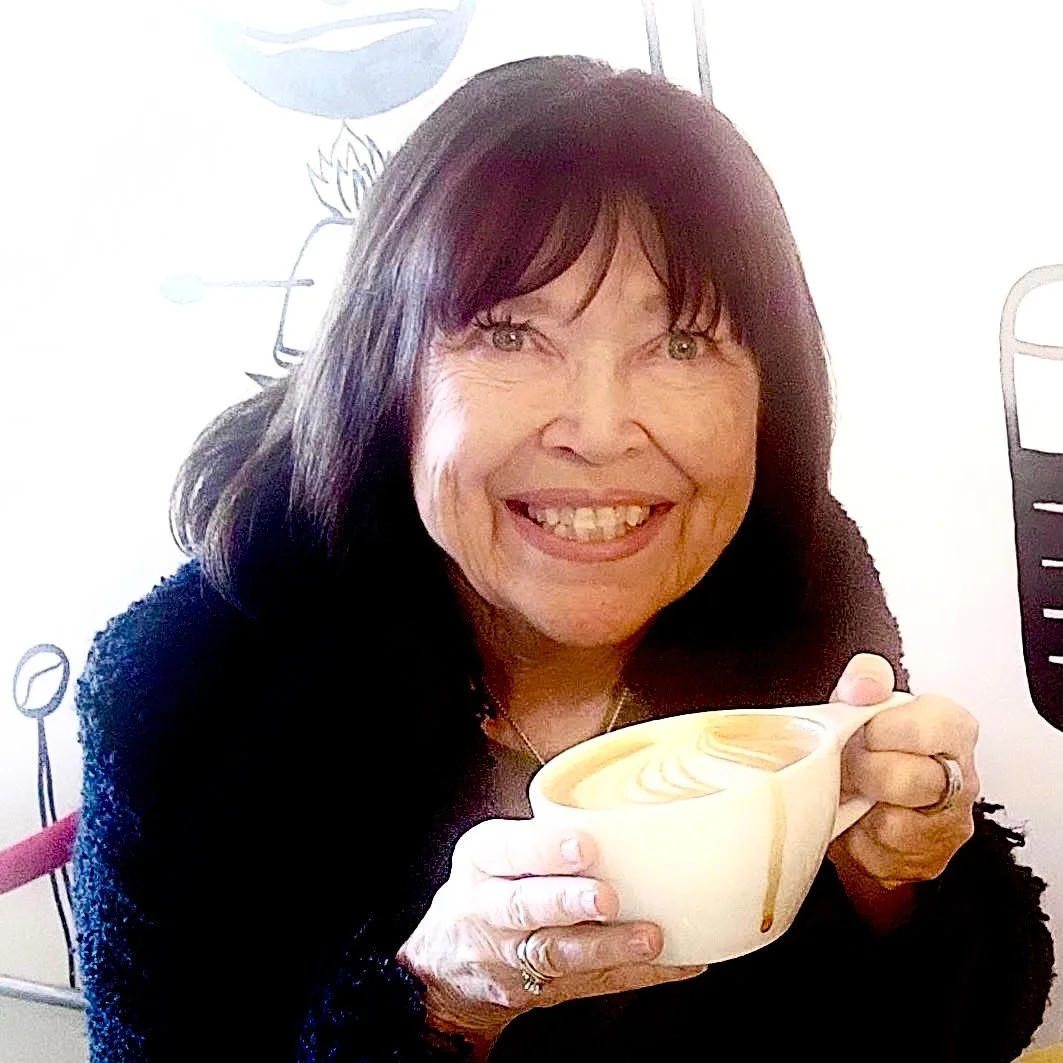
Bonnie Hearn Hill is the author of 16 novels, as well as numerous essays and short stories. Her most recent publications were in a story in the 2024 Anthony-winning anthology Crime Hits Home: A Collection of Stories by Crime Fiction’s Top Authors, edited by S.J. Rozan, and an essay in HerStry. Bonnie has co-hosted a monthly book segment on a major Central California television news network since 2002. She holds an MFA degree in Creative Writing from Antioch University Los Angeles.
I left on a clear October Monday. Seated at the bulkhead, my elbow rested next to a man who asked if I was going to Chicago for business. I lied, nodding my head yes. Ambivalence prevented me from updating my second-generation iPod earlier in the day, leaving Missy Elliott and Usher to comfort me. A leathery skinned smoker picked me up at baggage claim. She drove me forty-five minutes to our rural destination while I imagined what happens when car doors open and bodies land on I-55 at seventy-five miles per hour.