
Death in a Happy Meal
The first time I saw a circus, I was fascinated by the clowns. They roared into the ring in a tiny car then jumped out one after another after another, falling over each other and leaping up to perform juggling and feats of magic. One white-faced clown in a top hat came up to me and pulled a coin from my ear. That did it. I told my mom I was going to run off with them and become a clown. But, the next day, when we drove past the lot where the circus had been, I saw my dream had been betrayed. They were gone.
I grew up in a small town so removed from the excitement of everywhere else that, in 1972, when it was announced a McDonalds was opening up in a city half-an-hour away, my whole school talked about it. Ronald McDonald was going to be there – in person! – at the grand opening. I begged my mom to take me to meet him.
The night before the big event, my mom set my long dark hair to curl the way she always did for special occasions, by wrapping it around strands of her old nylon stockings. The next day, I had long, springing curls. When it was time to go, I put on my best church dress and white patent-leather shoes. As my mom drove along the country roads heading toward the city, we could see huge searchlights scanning the evening sky, pulling us like a magnet to the golden arches.
We arrived to find a line of children outside the restaurant waiting to meet Ronald, whom we all recognized from the TV commercials. A real celebrity! My older brother, also in his Sunday best, stood in front of me and, as the line moved forward, I saw we were being led to a plastic red and yellow bridge set up amid the crowd on the patio. The arched bridge, about as tall as 5-year-old me, allowed everyone a view of each of us during the big moment. A cameraman from the local TV station recorded the scene. It felt like the whole county was there.
At the peak of the bridge, there he was – Ronald McDonald himself, with his halo of cherry red curls, his shockingly white face, large red nose and his shoes – his absurdly large, red shoes.
The children in front of me climbed up the bridge to shake his hand and receive a bright red balloon. I saw my brother walk up to Ronald but, when it was my turn, I found I couldn’t move. It was all too strange. My stomach turned at the oily smell of the french fries. My head buzzed with the noise of the generators powering the searchlights, which seemed to draw a million moths from across the valley.
Seeing Ronald up close, my illusion began to clear. Under the bright lights, his makeup looked like cracked paint and beads of sweat cut streaks down the sides of his face. Who was Ronald after all?, I wondered. Was he really a clown? Or, was he just a man wearing make up?
Children behind me began to push. A young lady in a McDonald’s uniform gently encouraged me to walk up the bridge. My brother, already on the other side holding his balloon, raised his hand, beckoning me to come over. I looked down at my shiny white shoes and then at the slope of the plastic bridge. It seemed impossibly slick. I looked up and saw Ronald look at me through his flaky white makeup and oversized red lips. He smiled and stretched out his gloved hand to call me closer, saying “Come on up.”
I wanted to turn away, but I couldn’t. I was frozen. Kids behind me began to press at my back. I heard my brother call out, “Come on!”
The young lady in the uniform took my hand and led me up the bridge. Ronald held out his hand to give me a balloon. In a daze, I didn’t even say thank you as I took it and turned to go. I then saw that Ronald’s oversized shoes took up half the bridge. I shifted my weight to step over them and, as I began to fall, I saw my balloon escaping into the moth-filled beams of light. The last thing in my eyes before I tumbled down the slope was Ronald’s strange white face as his smile transformed into a look of terrified helplessness.
It would be years before I ever went to a McDonald’s again. I’ve been suspicious of clowns ever since.
Suspicion is not natural to me. I grew up in a small town where I trusted everyone around me. As a child, I could ride my bike from one corner of town to the other without a care. I knew that, if I ever ran into trouble, I could walk up to any door and whoever answered would say “Why, aren’t you Al’s little girl?” and they’d help me out. My dad had been a mailman delivering letters door-to-door. He knew everybody and everybody knew him.
Growing up with that sense of security is wonderfully empowering. Trust is what gave me the courage to become a journalist and a foreign correspondent. Trust is what allowed me to feel safe when I had to head into hurricanes, camp out with rebels, chase down world leaders or sit with convicted criminals. But trust can also be dangerous. With trust as my default state, I don’t always see the warning signs, I don’t even realize until it’s too late, that I’m face to face with trouble.
At the end of 2013, I was living in Mexico again. I had lived there twice in my 20s. But, this time, now in my 40s, I was a mom and a solo parent. My three boys and I had spent the holidays visiting my ex-husband’s family in Acapulco and we’d decided to take one last swim in the Pacific before heading home to Mexico City. We were laughing and shouting to each other as we played in the waves. Then, as I came out of the water to check the time, I saw him – a man in clown makeup. He smiled and called out in English, “Hello! You’re Americans?”
Street clowns are common on the beach, selling balloons and performing tricks for the tourists. Plenty of Acapulqueños speak English and make small talk as they try to convince you to buy something. The clown had a string of balloon animals tied around his waist, white face make up and a cheap red nose held on with elastic. He asked all sorts of questions – Where was I visiting from? Where was my husband? Did I drive by myself all the way from Mexico City? How long would I be in Acapulco?
Too many questions were answered before I grew annoyed enough to finally cut him off and go back to swimming with my boys. By the time I reached the water, the clown was gone.
Hours later, we were on the road heading back to the capital. I was eager to get home in time to go to a New Year’s Eve party with my friends. My boys were hungry and I knew there was a drive-thru spot in Chilpancingo where we could grab a quick lunch, a spot that would give my boys a much-desired taste of home – a McDonalds.
The smell of french fries filled our rented Prius as the boys pulled open their Happy Meal boxes. Eight-year-old Mateo stuffed his mouth with the salty warmth as he dug out his new toy and I heard him ask “What IS this?”
He handed me the plastic figure of a slender, pale woman with thick black hair and a form-hugging, long red dress. She was beautiful, wearing an oversized sun hat with a wide brim, tiny candles circling its edge. “She looks like La Catrina,” I said. “In Mexican art, she’s a symbol of Death.”
He reluctantly took it back in his hands, adding “That’s a weird toy to put in a Happy Meal.”
I should have seen it coming then, but I was too at ease from our holiday on the beach, too trusting to spot the warning sign.
We were barely out of the drive-thru lane when the trouble started. Unsure how to get back on the highway, I pulled out only to realize I was going the wrong way. I quickly backed up to change course when two large pickup trucks came squealing to a stop in front of me. I assumed their aggression was a road-rage fit between them. I cut a sharp left, forced my way out through the entry lane and jumped back onto the highway.
As we picked up speed, in my mirror, I noticed a large pickup truck coming up from behind, pushing its way forcefully through the traffic. It was painted a dull military green. It pulled in front of us and began zig-zagging across the lanes, slowing the busy highway to a crawl. From the passenger seat, my oldest son, 14-year-old Alejandro, asked: “What’s going on?”
“Not sure,” I said. “I’ve seen the highway patrol do this back home when they need to stop traffic. Maybe there’s an accident ahead of us.”
I noticed cars in the far left lane managing to slip past the truck, which continued to cut a snaking zig-zag across the asphalt. I tried to make the pass, too, but the truck’s driver swerved to keep me in place. Bit by bit, the green truck slowed until it brought the entire freeway to a dead stop.
Among all the cars, our rental car was unique. Painted black and white, its hood was emblazoned with a giant orange carrot, the logo of the car rental company. We sat right in the front of the center lane, our Carrot car like a treat dangling before a hungry beast.
Stopped about 30 feet ahead of me, the green truck’s door swung open and out slid the driver, a tall and slender man in black clothes – civilian, not a uniform. He turned his dark, angular face in our direction. Though his eyes were hidden behind mirrored sunglasses, I could feel his gaze centered on me. Then, he raised his arm before him and, with a curl of his fingers, beckoned me to come closer.
Wait, was he really motioning to me?, I wondered. I looked to my left where a small pickup truck held two men in work overalls who sat motionless, their eyes locked on the dark man. The man, however, kept his face set on me. His hand slowly rose again and his fingers curled once more, calling me to come closer.
No one else on the highway moved. The slow realization finally became clear to me: This. This moment here. This was a kidnapping. And the target was me. Me and my three boys.
I had lived in Mexico long enough to know these things happen. During my first stint in Mexico City, I’d been the victim of a crime so common it has a deceptively innocuous name: an express-kidnapping. Many of my friends had been targeted at road blockades, but those usually happened at night, in remote areas of the mountains. This was different. It was the middle of the day, in the middle of a freeway crowded with holiday traffic, in the middle of the goddamned capital of Guerrero state. I had trusted we were safe.
Sitting there on the highway in Chilpancingo, my kids happily eating their nuggets and fries, I gripped the steering wheel tightly. The only thing I knew to do was to stay calm and not let my boys understand the danger of what was happening. I turned toward the men in the pickup truck on my left. Catching the passenger’s eye, I shrugged up my shoulders and mouthed the question:
“¿Que hago?” – what do I do?
His reaction was a hit to my gut. He shrugged and gave me a dismissive flip of his hand. Translation: “It’s your problem.” He then pounded at the shoulder of his driver urging him to get the hell out of there, which he did, joining the other cars fleeing the scene.
That was how it dawned on me. I was on my own. No one on this highway would help me or my boys. There were no good neighbors here. There would be no hero I could trust to save us.
As the drivers around me began to realize they were not the targets, they began to slip away, moving one by one past the green truck along the left shoulder. The man was now talking into his cell phone and seemed to be looking beyond our car. I sensed what was happening: He was calling for backup. I remembered the two trucks that had tried to block me off at the drive-thru. They’d been part of this. How long did I have before they made their way through the traffic jam and reached me? Minutes? Less? I asked Alejandro to hand me my cell phone and I dialed the only number I could think of - 078. The Angeles Verdes.
The Green Angels are a network of mechanics who can be called when your car breaks down on the highway, a government-sponsored roadside assistance system. I knew this wasn’t their sort of issue, but I figured they could at least summon the police – hopefully police who would actually help.
The man who answered asked me what the trouble was. Calmly, not wanting to worry my boys, I said in Spanish, “I’m about to be kidnapped.” He asked where I was. On the highway in the middle of Chilpancingo, I said. His voice was steady, but I could tell he understood the seriousness of our situation. “What sort of car are you in?,” he asked. I described the rented Prius with the stupid giant orange carrot painted on its hood. “What sort of car is he in?,” he asked. A large pickup truck, the kind the military uses. But it doesn’t have any signage on it. Then, he told me what to do: “Get out of there.”
“What?,” I said with surprise.
“Get out of there,” he repeated. “Now.”
“You mean, just drive past him?”
“Yes. You have a Prius. He has a truck. Your car is faster than his. He can’t catch you. Get out.”
It seemed insane. But — he was right. He was calling for the police, he explained, but with traffic backed up behind me, they wouldn’t be able to reach me. It was up to me to get out of there. I was on my own.
The dark man continued to talk into his cell phone and he looked both toward me and at the lines of vehicles crowding the highway behind us. The lanes on my left were beginning to loosen as drivers scooted past the blockade.
That line was moving. His backup would soon arrive. I watched him carefully as I put my phone on speaker, gave it to Alejandro to hold, and braced myself to make our getaway.
I shifted the Prius into gear and reminded myself that I like to drive fast, that I’m good at it. Then, I saw the man make his move. He climbed back into his truck and began to slowly drive forward. The cars around me all began to move, too, keeping his pace but keeping our distance.
“He’s starting to go,” I told the angel.
“Que bien,” he said. “Just keep going. When you can, get past him. He won’t catch you.”
I doubted a Prius would actually go that fast, but I didn’t have another option. I just needed to have enough space to get past the truck and take off.
The cars were all beginning to pick up speed, with the green truck moving faster, too.
“We’re moving,” I said. “We’re all moving.”
“Good,” the angel told me. “Keep going.”
We were beginning to get up to highway speeds and the lanes of traffic were starting to loosen up. I moved to the left lane to prepare for my pass. But, as I stepped onto the gas, the dark man suddenly cut hard to the right, squealing across the right lane and driving his truck over the edge of the highway and down a steep embankment.
“He’s jumped off the highway!” I told the angel.
I saw the truck slide down then make another hard right that sent him careening back down a frontage road in the other direction. I kept moving forward, picking up speed as I checked my rearview mirror and saw a cloud of dust rising up from behind him.
“He’s gone,” I said. “He went the other way.”
“Good,” the angel told me. “Just keep going. Get out of there.”
I thanked him, and did as he said.
I pushed that Prius as hard as I could, not caring about the speedometer. I kept an eye on the mirror, looking for any sign we were being followed. I gripped the steering wheel as we raced around the curves. To keep my boys at ease, I made up songs, inventing silly lyrics for each of them every time we crossed a bridge. “Oh, this bridge is tall and pretty. It’s the finest bridge in the whole big city – ‘cause it’s – Robbie’s – bridge!”
We sang brightly as I roared through the mountains of Guerrero not slowing at all until I reached a toll station on the state line. There, I pulled up to a patrol car and told the officer I wanted to make sure we weren’t being followed. He said he’d keep an eye out for the green truck. Foolishly or not, I trusted him enough to believe he would.
That night, safely home in Mexico City, I went to the New Year’s Eve party as planned. I told friends and colleagues what had happened. Someone asked how I’d been picked as a target. I reviewed my time in Acapulco and then realized what I had done: I’d naively told him everything he needed to know to set us up. It had been the clown.
I had trusted him, foolishly believed he was just making small talk while hoping to pull a few coins from my purse. I had trusted that he was actually a clown, not just a man in face paint.
On the way home from the party, I shared a cab with my boss, the woman who had persuaded me to take the job in Mexico. I’d been on edge at work for some time because things hadn’t been going as I’d trusted they would. Her promise that my salary would remain solid even though I’d be paid in pesos fell apart; her assurances that I’d have no trouble getting my boys into good schools, turned out to be wrong. Though she, like everyone else at the party, heard about what had happened that day in Chilpancingo, we rode together in silence. Not once did she ask if I was OK.
Soon after that ride, I left that job, ending a 25-year run with a company I realized was not really looking out for me. Companies are not family, they’re not friends, they’re not even good neighbors.
My trust in others had led me wrong. My trust that, if I ever met trouble, there’d be someone to rescue me faded like the illusion it was. In the end, I saw the only person I could trust to really save me, was me.
Michelle Morgante Del Rio
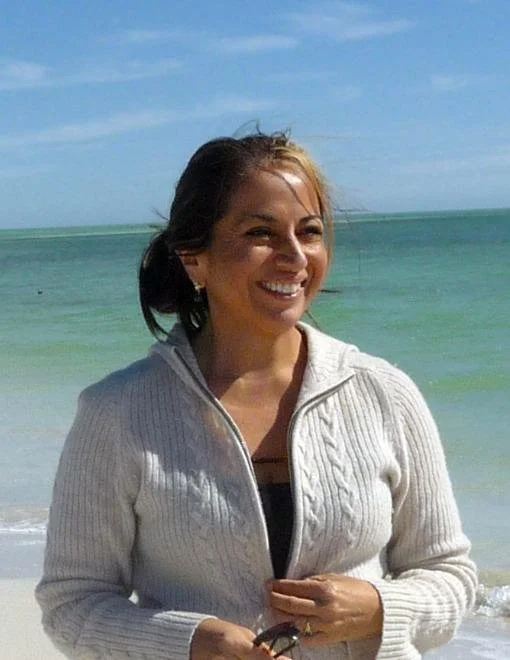
Michelle Morgante Del Rio is a writer based in Merced, California, a small farming town in the heart of the San Joaquin Valley. She is currently working on her thesis to complete her MFA in creative writing at the University of Texas, El Paso. Michelle's long years in journalism included time as a reporter, editor and foreign correspondent for The Associated Press as well as in roles with NPR, Time Magazine and other publications. In 2025, she was selected as an Emerging Voices workshop fellow in fiction by PEN America Los Angeles.
As a Latina writer and first-generation American, Michelle's writing explores questions of identity and attempts to map out the liminal space between cultures.
I left on a clear October Monday. Seated at the bulkhead, my elbow rested next to a man who asked if I was going to Chicago for business. I lied, nodding my head yes. Ambivalence prevented me from updating my second-generation iPod earlier in the day, leaving Missy Elliott and Usher to comfort me. A leathery skinned smoker picked me up at baggage claim. She drove me forty-five minutes to our rural destination while I imagined what happens when car doors open and bodies land on I-55 at seventy-five miles per hour.