
The Edge of the World
When I was small, the line where the grain fields met the sky through my bedroom window was the edge of the world. I stood on my tiptoes at that window, little fingers pressed hard into the scarred wood of the sill, nose pressed to the window screen that smelled of thunderstorm and dirt. That enormous, faceless sky and the ungiving line of the land—I tore myself from the window and ran for the safety of my dad’s lap. I threw my arms around his neck and curled my body over his big belly. I clung to him. He told me I couldn’t fall off the earth. There was gravity, he assured me, and gravity holds us here.
But gravity meant nothing to me.
My dad holds me here.
*
Forty-two years later, I stand at the same window, resting my forehead against its cool, grimy glass. This is my childhood home, but it’s always been Dad’s house. The farmyard and fields that stretch beyond this window are Dad’s too, acres carved into perfect rectangles and planted with wheat in clean, straight rows. There’s not so much as a stray patch of milkweed or thistle. The land yielded to my dad. I never could.
*
I used to ride alongside Dad in the cab of his John Deere tractor in these fields. A young girl with too-short brown hair wearing too-short jeans, I was just small enough to wedge myself in between him and the cab door. It was bumpy, noisy, and monotonous, but also comforting. It felt good to be close to him, to have him to myself, away from my little brother and stepmom. Over the drone of the tractor, he poured out his thoughts to me. This land had been passed down from father to son, father to son, he told me. Now it belonged to him, and it had to be kept in the family name—meaning, he wanted to pass it down to his son one day.
He kept his eyes straight ahead as he spoke. He didn’t look at me; he could have been talking to his tractor or to the land itself. It was all the same to him; it was all his.
In the cab of his tractor, Dad talked about his fear that his farm could somehow be taken away from him.
“Who would take it?” I asked, confused, fear tickling the sides of my belly.
“Well, her family would love to get their hands on it.” Her meaning his wife, my stepmom. They’d been married less than a year.
I was only eight. I didn’t understand how my stepmom’s family could take his land away, or why, but I believed him. His words, his worries, his resentments, were seeds planted in my ears. Every jounce of the tractor tamped them deeper down in my body. I’ve tended to them ever since.
*
It’s early spring when Dad tells my husband and me that he is dying—it won’t be long now, he says, but it’s okay; he’s at peace with it, we aren’t to worry. When we ask him what exactly is going on, he won’t answer. He just says, “I just wanted you to know. You go on now, go back home, let me be.”
Confused, I look to my stepmom, who won’t meet my eyes. She’s been his wife for more than forty years; she knows she has no say in the matter.
I won’t accept that I don’t have a say in the matter, so I make the forty-minute drive out to the farm several times over the next few weeks, to try to reason with him.
He’s depressed, not dying, I tell myself. I’ll get him some help. I’m confident I can make him see logic so he’ll let me take him to the doctor. I’m wrong.
I steel myself each time I get out of my car and walk to the house. Dad and I have always been the Unstoppable Force clashing with the Immovable Object—although I’m still not certain who is which.
His anger has never scared or swayed me, but his tears bring me up short, during one of these visits.
“I’m dying and no one believes me,” he moans, looking down at his hands folded on his belly and shaking his head. Then his mouth sets itself in the old frown that lets me know he’s done talking. I leave.
Two days later, I come back to find him in bed in the middle of the day, his eyes squeezed shut. I stand in the doorway of his bedroom, frozen. This is not my dad. This cannot be happening.
I say “Dad,” and I know he hears me, but he doesn’t open his eyes. Oh, Dad. He’s right; I don’t believe he’s dying, but something is.
“Dad, maybe we should talk about what you want done about the farm. Should we talk about that?”
He gets out of bed immediately and takes me to his office, his legs chicken-skinny in long underwear. He gives me a list of things he wants done after he dies, and tells me where to find his will and other pertinent information. I promise I’ll do whatever he wants, but add that if his condition worsens, we’ll need to talk about seeing a doctor.
“I’m fine right where I am. This is where I want to die—under my own roof, in my own bed,” he says. “That’s all I want, honey.”
The sight of him, diminished and old in his thermal underwear, but still so stubborn, so unreachable, so impossible—still trying to rule the world, even now—it’s too much for me. That tight, hard, necessary ball of steel inside me gives way, breaks open. Suddenly, my chest is an immense and empty sky. I begin to cry. Dad pats and rubs my back, telling me it’s alright. That he’s alright. That it’s going to be alright. We hug when I leave, and I think, yes, it’s going to be alright.
He dies the next morning.
In his will, he leaves my stepmother enough money to live comfortably. He leaves my brother out of his will completely. He leaves his farm to me.
After Dad’s funeral, my stepmom moves into a senior living apartment in town. What she can’t take with her, I put in storage or throw away. Now the house is empty. I really don’t have a reason to come here as often as I do, but still I come.
This is Dad’s house. In every room, I expect to hear the intake of his breath before he asks, what are you doing here? I don’t hear anything but the sound of my own footsteps, but I answer him anyway. You hold me here, Dad.
This house is the centerpiece of the farmyard, sheltered from the northern Minnesota winds by an L-shaped windbreak of cottonwood, ash, elm and chokecherry. A white story and a half with yellow trim, the house shelters my childhood bedroom under one of its eaves, the pimply-textured plaster ceiling of my room sloping almost to the floor on one side.
*
I padded out of that room one summer morning when I was four years old, making my way down the semi-gloom of the short hallway to my parents’ bedroom. It was empty. Before I could call out, the stairs creaked under the weight of a strange step. It was a surprise to see my aunt Viv appear around the corner of the landing. She told me my mommy had gotten sick in the night, that my daddy took her to the hospital, and they were still there.
Later that afternoon, as my little brother and I played on the living room floor, I heard the crunch and ping of an approaching car on the gravel road. Through the picture window, I saw the nose of my parents’ light blue Impala turning the corner into our yard. It was moving too slowly; maybe that was why I stayed where I was instead of running to the front door. The next and last thing I remember from that day is staring down at Dad’s brown shoes on the harvest gold shag carpet, as he stood above my brother and me trying, through sobs, to tell us our mother was dead.
What is “dead?” What is a “brain aneurysm?” I went to bed one night with a mother and when I woke up the next morning, she was gone. Where was she? When would she come back?
She didn’t.
Dad, me, my brother—we went on, but all that remained of Mom was the fact she was missing. When I called up her face in my memory, it was her face from a photo, not from real life.

The photos of her. The ornamental clock in the shape of a covered wagon that ticked, ticked, ticked on top of our boxy television set. The Baldwin upright piano that sat at the foot of the steps, sheet music and song books within its bench, waiting for her return. I would go into the shadowy closet in my parents’ bedroom and touch the thick polyester and nylon dresses that still smelled of lilies and hairspray. I would rummage through her padded pink jewelry box and hold dangling rhinestone earrings up to my unpierced earlobes, drag her lipsticks—now dried with age— across my own mouth. But I could only imagine her standing behind me in the mirror, watching me with the face from a photo.
Three years after she died, Dad knocked softly at my bedroom door and sat on the edge of the bed to ask me, almost shyly, if I’d like a new mommy. I lit up inside like a small sun; I did want a new mommy. I wanted to know if she was the mommy I’d been imagining. Does she have long brown hair? Does she sing and play guitar? Is she nice, and pretty? He said her hair was short but yes, it was brown, and he supposed she could sing. She didn’t play the guitar that he knew of. Yes, she was nice and he thought she was very pretty.
Immediately after the marriage, our house filled with a purposeful, infectious urgency. My new stepmom, Fran, and her mother went room to room, discussing wallpaper, carpet, drapes. I trailed along, tolerated but not invited into the conversation. She asked what color I wanted my bedroom to be, and I said “pink,” picturing a princess-style canopy bed filled with dolls in pretty dresses, and lacy white curtains.
My brother and I were sent to stay with our grandma for a few days. When we came home, the house was transformed. New carpeting, fresh paint, windows covered in gold sheers framed with heavy faux-silk curtains. There was striped wallpaper on the kitchen walls and shiny new Formica countertops in place of the old linoleum ones. New table, new dining chairs, a matching china cabinet with Fran and Dad’s new wedding china inside.
The wagon clock on the television set was gone; a ceramic set of two cherubs on either side of an ornately framed mirror replaced a grouping of old family photos on the wall. I didn’t know what happened to the old stuff—the clock, the photos, furniture—and I didn’t ask. The newness of everything was intoxicating. It held the promise of what had been wrong being set aright. I ran from room to room, burying my nose and fingers in the plush new carpeting and throwing myself on the slick, velvety new furniture.
The door to my bedroom was closed and Fran and Dad stood behind me as I eagerly pushed it open to reveal its makeover.
The walls were pistachio green, the carpeting a nightmarish mishmash of green, gold, and brown. My bed was covered in a formal-looking cream bedspread with enormous water-color flowers in dull earth tones. Matching curtains hung stiffly on either side of my window. It was the bedroom of an old lady. Something hot spread its wings across the inside of my chest and over my cheeks.
“Well,” Dad said jovially. “What do you think?”
“I said I wanted it pink.”
“You told me green,” Fran said, coolly.
Her voice made it clear she didn’t care what I thought I wanted, but it was Dad’s silence that made me understand I was alone.
In the shapes of those big, ugly flowers I could make out faces—stern, accusing adult faces. They said, this is what you deserve. This is what you get. They said, you don’t matter.
Those flowers saw me the way Dad saw me. I was a girl. Girls didn’t factor into keeping the farm in the family name, following in a father’s footsteps, carrying on a legacy. Girls were for mothers; he’d found a new mother for me.
But I still wanted to be for him.
*
Those curtains—dirty, faded, years of collapsed cobwebs along their tops—still hang in my old bedroom. Imposed on me as a girl. Covering my dreams of a room that reflected the girl I wanted to feel like; framing my view of the edge of the world.
Now I own those curtains, the room they hang in, the house the room occupies, the fields beyond the house. I inherited them.
I could rip those curtains down. I could burn them.
Dad’s been gone almost four months. I’m only now beginning to admit to myself that I want to sell the farm. I know he left it to me mostly because of a long-standing rift between him and my brother. It wasn’t a “reward” for being a good daughter. I was simply his only other option. This knowledge sits in my body like a poison I’ve eaten, spoonful by spoonful, since I was young. I’ve acclimated to it—it won’t kill me, I know—but it’s still poison.
These fields beyond my window—they’re just dirt. But to my dad, they were his empire, his destiny, his immortality. He poured himself into that dirt and dragged me in with him.
The possession of the land—not the wealth it represented—was everything to him, so I grew up in the shadow of his fear of losing that land. I was so desperate to hold my dad’s world together so he would keep me in it. I burned with a fierce, protective love of him that required me to love what he cherished more than he cherished me.
Maybe the land was the one thing he could leave me that could truly be mine—but only if I get rid of it. Sell it.
If I sell the farm, I do wonder what becomes of the girl whose small body had to carry the anguish of knowing that if her dad lost what he needed, she’d lose what she needed. She’s been alive in me for so long, orbiting around my dad. The gravitational force of him is so powerful that even after his death, I’m still circling and circling the question of what it would mean to let the land go—to let him go. Because I know it’s not him who holds me here, now.
I can’t haunt my dad’s house forever. I don’t want to; I lived here, but it was never mine, and never will be. It’s just a place to bring my body, my grief, my longing. This old, empty house has room for all of it. Whatever compels me to come here will start to wane, or, if I sell the farm I’ll lose my access to it.
One of the last things Dad told me the day before he died was “After I’m gone, just lock the door behind me and let the whole house fall in on itself.”
Okay, Dad. I’ll do that.
Soon.
Soon.
I turn from the window, my fingertips trailing on the sill for a moment before I walk out and close the door behind me. I know I’ll be back here at least once more. I might bring gasoline and matches—finally burn those damn curtains.
-Lisa Hatlestad
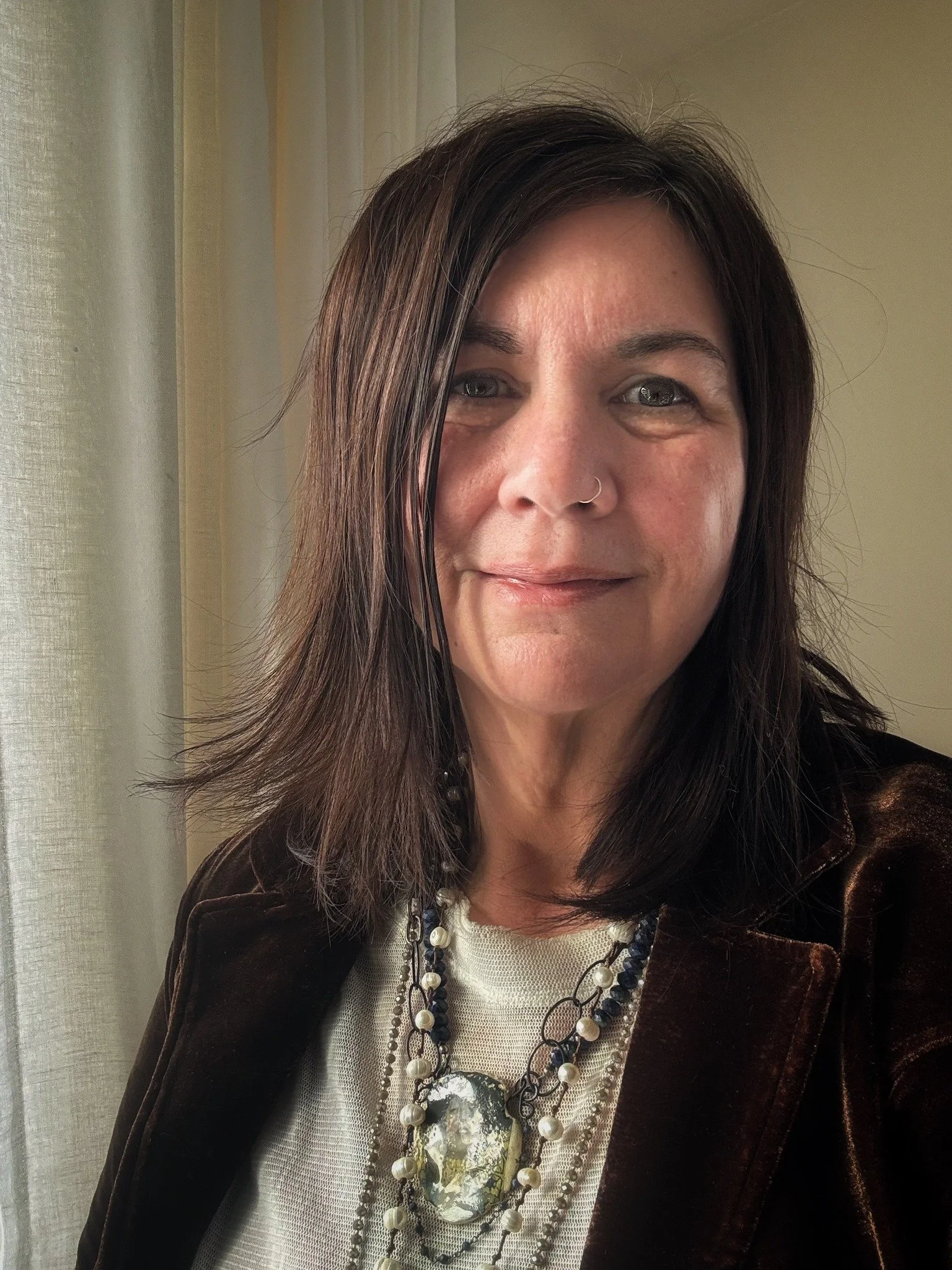
Lisa Hatlestad is a writer living in northwestern Minnesota with her husband, two dogs and two cats. As an adoptee who also lost her adoptive mother in early childhood, she often explores themes of identity, motherlessness, and belonging in her work. Lisa credits her nine-year-old self for first sparking the determination to become a writer. Each of her stories is a love letter to that girl, as well as amends to her for waiting until she was in her late fifties to take that dream seriously.

I left on a clear October Monday. Seated at the bulkhead, my elbow rested next to a man who asked if I was going to Chicago for business. I lied, nodding my head yes. Ambivalence prevented me from updating my second-generation iPod earlier in the day, leaving Missy Elliott and Usher to comfort me. A leathery skinned smoker picked me up at baggage claim. She drove me forty-five minutes to our rural destination while I imagined what happens when car doors open and bodies land on I-55 at seventy-five miles per hour.