
The following is an excerpt from the Untold Stories Project, an oral history project dedicated to capturing the stories of elders and their experiences of life before technology. The Untold Stories Project is a nonprofit. You can donate to their Kickstarter by clicking here. You can nominate an elder to be interviewed by clicking here.
“Are you serious?” I implored. We were sitting curled among each other on the couch, familiarity breeding comfort. I’d always had a hard time staying warm during winter, and that day in March I was hoping for some contact warmth.
“Yeah. Earlier this week.”
My boyfriend, Tyler, had just told me of a story he’d heard on NPR a couple days ago that proclaimed that children being born now will never know what a telephone pole is. It added serious perspective to the rapidity of technology’s advance.

Veronica with Gus Katsoris, the cobbler, and his apprentice, Jesse.
That moment was my wake up call, I think. I had been working countless hours to rebuild my website design company after rebranding at the end of 2014. Frantic is the word that best describes my efforts, and I hadn’t yet noticed how I was suffering. In a few months I’d come to reflect that my eyes were losing their sharpness, my back was aching, and my friendships had thinned. But at this point, I only knew I was tired.
That conversation with my boyfriend took place a month after I’d started a side project called Untold Stories (now a nonprofit called the Untold Stories Project). In February of 2015 I was tired from working so hard for my own small gain, and wanted instead to spend my time inspiring others. The idea was simply to drive across the country to find meaningful stories and photograph them for a book.

“We start with some nice deep breaths.” The Teutonic embodiment of nineties feminine perfection and I bend at the knees and arc our hands above our heads. Behind her, the aquamarine water of St. Barts, or terracotta rooftops of Prague, depending on the day of filming. Video cameras crane to capture her every lunge and squat. I mimic her from my parents’ basement den, her moving image beamed to me from a wood-paneled eighties television that hides the sump-pump hole in the concrete floor. Behind me, sticky seventies photo albums of camera-flash red-eyed babies, long-forgotten Atari cartridges. We are on two sides of a mirror..

The bathroom light hummed above me, too bright and too sharp, like it was trying to expose something I was not ready to see. Two pink lines. My breath caught in my throat, suspended in the thick, humming air. My hands stayed steady, but something inside me shifted; a hairline crack under pressure. I stared at the test as if staring hard enough might undo it, might turn the lines back into the uncertainty I had been clinging to. For a moment, everything went still. Not peaceful stillness, the kind that comes right before something breaks. It was the kind of stillness that feels like a held breath, a pause in the universe, a moment when the world waits to see what you will do next. I remember thinking, this cannot be real. And then, almost immediately after: Of course it is.

I was called sand.
My family and I didn’t travel to beaches full of it. We couldn’t. Being Iranian in the 1980s and 1990s came with a label: terrorist.
My nickname didn’t come from a beautiful beach.
It came from hatred.


Dear Ezra,
I know we’ve never met…
And yet my hungry mind keeps feeding me
slow-burning images of you in your kitchen.

December 22nd
One day after winter solstice
Five hours, forty-four minutes and twenty-seven seconds of daylight
Sunrise: 10:13 a.m.
Sunset: 3:41 p.m.
By the time Tyler told me of the bulletin he’d heard, I’d already begun to veer the project toward interviewing elders. I needed to narrow my original scope, and the one idea I noticed myself talking about over and over was meeting with elders and veterans. Maybe I gravitated that way because my grandparents passed before I got to know them, so I personally felt the urgency to record our elders’ history. It was that story that put the final touch on the project. Over the next weeks I noticed I spoke more and more of technology, how we’ve recklessly abandoned our lives to it, the effects it’d had on me (physical and emotional), the studies that were being done about it, and their findings. I was realizing this was my new path.

Veronica (right) with Dagmar and John Booth in New Orleans
Today the project has one goal - to answer the pressing question “How is technology changing us?” by interviewing those that lived before it. My first love was writing, so the goal is still a book. My second love was Anthropology, so the interviews are meticulously thought out and the sample is broad. My third love was photography, so I photograph every person I interview.
This book is not about me, and yet it is only about me. I noticed during some of my first interviews that I felt like a conduit. I still get that feeling. I am given these narratives in confidence that I will carry them to the rest of the world. The elders want their voices heard, and they seem to recognize that they hold the key to understanding the changes we’ve seen in our culture as of late. But the project isn’t just about my catching the ball and then thrusting it back to the world. I’m changing. With every interview with an elder, another piece is placed inside me, shifting who I am just a bit. After the thousands of interviews I have scheduled across the nation this fall, the shift will be profound. In that way, I’m becoming the project.
In recording the changes I’m experiencing and chronicling their origin - that is, the interviews - I hope to provide our youth with a guidepost to the greater joys of life.
Want to know what makes agents request pages? It all starts with a captivating query letter, and you can bet giraffe there’s a formula agents look for. Join literary agent and founder of GiraffeLight Media Agency, Stephanie Katz, as she talks how to structure query letters that will get agents’ attention, the key Green Flags agents look for and the Icks that turn them off, the all important Comp Titles that authors unknowingly live and die by, and how so many authors are using Comp Titles wrong. The Query Letter is your industry handshake, and Stephanie will help teach you how to make it strong.
Wednesdays at 6pm CST, March 31 - June 2, 2027
How do we make sense of the terrifying and unknown? For both ancient times and the modern era, fairytales, myths, and legends have provided insights into the human mind and community at large, but at the center of those stories are the experiences and truths of women. In this special topics craft course, we will explore contemporary retellings of magic and myth across writing genres through the lens of womanhood. Required readings in the course will feature work by Helen Oyeyemi, Sabrina Orah Mark, and others. Students will read and write across the genres in writing prompts, and the class will culminate in a workshop.
The hermit crab essay is a term originally coined by Brenda Miller and Suzanne Paola in their craft book Tell It Slant: Creating, Refining, and Publishing Creative Nonfiction. Like its namesake, the hermit crab essay borrows an existing container, such as a list, set of directions, tarot card reading, or real estate listing, and makes it its own.
In this workshop, we’ll explore how different authors use the Hermit Crab Essay as a creative vehicle for approaching topics that may feel too difficult, vulnerable, or traumatic to write about directly. I’ll share writing exercises, practical tools, and techniques that you can take with you to experiment with this form and begin crafting your own next essay.
The success of Gillian Flynn’s Gone Girl (2012) heralded a new era of domestic suspense. Most of the novels that came to define this genre featured white women narrators behaving badly. While this convention invokes the precedent of the pathologization of hysterical women, we must also consider how this convention relies on contemporary white privilege. How do Caro Claire Burke’s Yesteryear (2026), Alice Feeney’s My Husband’s Wife (2026), and Meagan Church’s The Mad Wife (2025) use unreliable narration to suggest that madness is a privileged state?
Women characters are still too often judged by one question: Is she likeable? That question can do a lot of damage on the page. Anger gets softened. Ambition needs an explanation. Bad decisions need a sympathetic reason behind them. A woman can be selfish, difficult, ruthless, jealous, furious, or want something she probably shouldn't, but writers often start sanding those edges down because they're afraid the reader won't like her. But liking a character and wanting to keep reading about her are two very different things. Stop Making Her Likeable is a 90-minute workshop about what actually keeps a reader invested in a complicated woman. We'll look at why readers can become completely absorbed by characters they don't approve of, what makes difficult behaviour fascinating rather than simply frustrating, and how motivation, contradiction, desire, and agency affect the way a reader responds to her. We'll also look at our own pages. Where are we explaining a woman because we're afraid she'll be judged? Where are we making her apologize for wanting something? Where have we given her a tragic reason for behaviour that we might simply allow from a male character? The goal isn't to teach writers how to create an “unlikeable female character.” It's to stop treating likeability as the price a woman has to pay to be worth reading about.
In this course, author Piper L. White will discuss feminism through the use of fairytales and how to take these beloved childhood stories and twist them into our modern writing by delving deep into the psyche of women-identifying people and their everyday horrors to craft their own prose pieces.
This product gives you access to all four weeks of the workshop. Purchase one or more drop-in sessions here.
Build a habit in 20 sessions. In this 4 week workshop that meets Mondays through Fridays from 8:00-9:00 AM CST, we will focus on generating new writing—making headway on a current project, reviving an old project that’s been gathering dust, or writing based off of the daily prompts Leigh provides.
The first 45 minutes of class are a gentle, camera-off, silent writing session. The remaining 15 minutes are an opportunity to share excerpts of our work, reflect on progress made, and set intentions for the following day. Then we will read a passage together on the writing life and close each class with a new learning about habit formation. By the end of this course we’ll have a morning writing habit that is each our own to continue and build upon.
This listing is for an individual class. To purchase access for the full 4-week workshop, click here.
Build a habit in 20 sessions. In this 4 week workshop that meets Mondays through Fridays from 8:00-9:00 AM CST, we will focus on generating new writing—making headway on a current project, reviving an old project that’s been gathering dust, or writing based off of the daily prompts Leigh provides.
The first 45 minutes of class is a gentle, camera-off, silent writing session. The remaining 15 minutes are an opportunity to share excerpts of our work, reflect on progress made, and set intentions for the following day. Then we will read a passage together on the writing life and close each class with a new learning about habit formation. By the end of this course we’ll have a morning writing habit that is each our own to continue and build upon.
Some of the most compelling creative nonfiction begins with the feelings we are tempted to avoid: anger, resentment, shame, fear, or the sense that we have an axe to grind. In this six-week workshop, writers will explore how to follow that emotional heat toward deeper, more honest work—without sacrificing compassion, complexity, or craft. Through close readings, writing exercises, discussion, and constructive feedback, we’ll consider how to transform strong feelings into writing that reaches beyond catharsis and connects with readers.
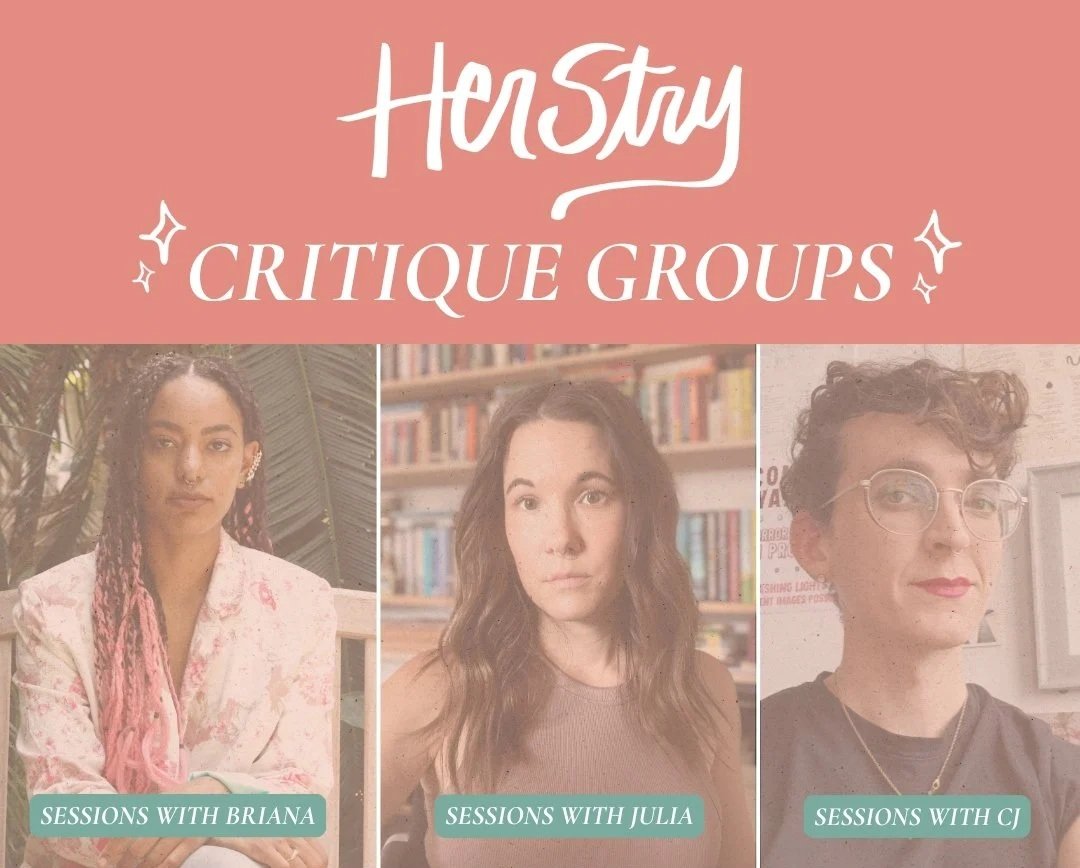
IT’S NO SECRET THAT FEEDBACK IS AN IMPORTANT PART OF THE WRITING PROCESS.
In fact, we argue that it might be the most important part of the process.
But it’s hard to find a writing community. It’s hard to find the people who are willing to take the time and the effort to read your work and give the feedback you really, truly deserves.
That’s where HerStry Critique Groups come in!
HerStry Critique Groups are small groups of 6 women who gather online for 6 weeks to share their writing, give constructive feedback and gain skills as writers.
Weekly online sessions last approximately ninety minutes, with three women sharing their work each week. Writers of all genres and levels are welcome and you may share both works of fiction and nonfiction.
Sessions take place on Mondays 7PM CT, Tuesdays 11AM CT, Fridays 11AM CT
WHAT’S INCLUDED IN THE HERSTRY CRITIQUE GROUPS?
Six 90 minute live workshop sessions
Three 20 minutes sessions in the “hot seat” to get you work critiqued
Written and verbal feedback from your fellow workshop participants
A weekly in depth edit and critique of your work from the group leader after each session
Weekly writing goals and accountability check ins
Full video recordings of each session to keep for your records
Say goodbye to the lonely, stuck in your head writing life!

-Veronica Kirin