
My sister Stephanie and I were born 5 years apart. I was born with Hemiplegia Spastic Cerebral Palsy, so our relationship as sisters has always been unique. Stephanie grew up as self-sufficient, and extremely stubborn. She always knew better than anyone one else. She had the makings of a great defense attorney.
But alas, her love for taking things apart and “inventions” won out. And she would eventually begin to grow her wings In the big apple. Steph and her future were all hers for the taking. I have had the awesome experience as her big sister watching Steph overcome, and deal with whatever was thrown her with very stubble and with a quiet confidence while remaining humble.
Even when she was diagnosed as a type1 diabetic at the age of 14, Steph handled it as if it was an ordinary day in her life. My sister is no stranger to health issues, and nothing ever seemed to phase my sister or keep her down for long. That all changed seven years ago. From the time Steph was eleven years old she had several different kinds of headaches and was always told a variety of things. But, when she was twenty-one, and in school, she noticed a drastic change in them. And once again she was told, “it’s just stress, your a student with a full plate. Take some Motrin.”
We’re a few hours in when something starts to go wrong with the epidural. Not all at once, but a creeping awareness of sensation starts to tug at my attention as I lie there and look at the trees outside, and read, and make small talk with my husband.
At first, I ignore it. But then I start to get nervous.
“I can wiggle my left toes,” I say, not really to anyone. Observationally.

Who would have thought we’d be back here again? Me, blinded by your headlamp, white-knuckling a tooth-shaped stress toy with your name and number printed on it. You, on your swivel stool, tapping your running shoes to the eighties soft rock that seeps through the walls like the smell of the salmon your assistant reheated for lunch.

My friends and I share six-word memoirs, which are supposed to be a story in a nutshell. This was the one I wrote yesterday: “Naked, I paraded through the jimjilbang.” I sent this stingy, six-word sentence out to them with no further explanation. Let them wonder. But for you, I’ll flesh it out: I recently visited a Korean bathhouse, and here’s a crash course in all things jimjilbang.

“You want me to put that where?” was my first response when my pelvic floor therapist handed me a three-inch piece of plastic connected to a cord, which she plugged into a computer. It was a sensor used to measure muscle strength that we were going to use to test out my vagina muscles. “Ohhhh…kay, well here goes nothing.”

When I was younger my mom called me Skinny Minnie. I’m not sure what she meant by this or why she called me it, but I know that I was confused. Even at a young age, I thought it was weird to have a nickname revolving around my weight -- especially because I wasn’t even particularly skinny; I was completely average.

Most of us have scrolled past this quote on Facebook or Instagram. You may have liked it or re-posted it. If you are the strong one then you know how painstakingly true this is. Like, ugh. Why is there so much truth in this statement? Somehow the people around you have created the idea that you have traveled through a magical parallel universe that rendered you emotionally void. No feelings, no heart, just empty.

When I was a small child, my grandmother took me to see The Elephant Man, a movie about Englishman Joseph Merrick. Joseph was born with severe facial deformities and was exhibited as a human curiosity in the late 1800’s. The depiction of Joseph Merrick shocked me, but not for the reasons it shocked others. For me, the shock was recognition. I knew Joseph Merrick. I was Joseph Merrick.

Dear Cerebral Palsy,
Although you are and have always been a part of me, I’ve worked hard to make certain I don’t allow you to consume my life. If I am honest, it has been a rather difficult process. Let’s start from the beginning though.

On those rare occasions that I venture out into the world and interact with other humans, common courtesy makes people ask how I’m doing, but I never know how to respond. I’d say “I’m tired,” but my mind says I haven’t the right, haven’t earned that descriptor. When ‘tired’ is for marathon runners or physical laborers, when ‘exhausted’ is reserved for working 100 hours a week or a harried mom of 3, I’m not allowed to be tired. When the adolescent me had aches, they were ‘just growing pains;’ when youth me was feeling down I got reminded that there was ‘nothing to be sad about;’ and teen me falling asleep in class was labeled ‘bored’ at best or ‘lazy’ at worst.
My sister never took that as an answer and followed her intuition. After taking upon herself my sister found a local neurologist who specialized in two medical conditions Cerebral Palsy and Cluster Headaches. Upon my sister’s description of the pain she was, and still is, experiencing she was diagnosed as not only as a chronic migraine suffer, but she was also diagnosed as a chronic cluster headache sufferer. If you do a simple YouTube or Google search you will find that this condition is not only life-changing for the person who has this disease, but it is not a common conversation in the medical field. Very few in the medical profession have any prior knowledge of this disease. And those that have recognized it as a serious condition have dubbed it the world’s most painful condition.
But unfortunately, like most invisible and chronic illnesses, it’s not taken seriously enough or even acknowledged something that exists at all. As Steph’s big sister I became increasingly frustrated by, not only the lack of help my sister desperately needs, but also at the lack of compassion and empathy. So, I took it upon myself to turn this mess into a message no one could simply just ignore or dismiss. I took it upon myself to create a place where we could highlight, educate, acknowledge, and support those who are far too easily judged rather accepted. On July 30, 2016, I created the blog, The Abler. In November of 2016, I created the Official Facebook Group For The Abler Blog.
In just a little over a year, The Abler has covered 13 topics, completed 9 interviews, and has a growing social media presence. With the Facebook group that has over 300 members, the abler can also be found on Instagram, Pinterest, Twitter, and Facebook” like” page. And it is soon to have its own monthly video series. If you asked me today what my sister’s chronic/invisible illness has taught me I’d say this, that no one should be thought of as less than or dismissed because you do not have evident proof that your illness exists. Everyone should use their voice to empower and lift one another. If education is power why don’t we as a society count on personal knowledge and experience into that equation? And that is one of my goals that I hope I can continue to strive for with The Abler, and it’s growing community.
To raise people’s awareness, to educate, and learn from one another. As well as provide a safe and non-judgemental place where people can find kindness, compassion, and caring. While also attempting to make a tremendous effort in erasing the stigma and misconceptions that come with far too many topics in today’s society. Because, my motto for not only The Abler, but life is, “the more you know; the more you grow.” And watching something beautiful grow from something as painful as watching someone you love more than life itself suffer so much Is not only sanity-saving but empowering.
And, that I believe, is how anyone can overcome whatever monster you face in life. Never bow down, instead go to toe with it, find, fight, and keep your power.
-Jessica Niziolek
The hermit crab essay is a term originally coined by Brenda Miller and Suzanne Paola in their craft book Tell It Slant: Creating, Refining, and Publishing Creative Nonfiction. Like its namesake, the hermit crab essay borrows an existing container, such as a list, set of directions, tarot card reading, or real estate listing, and makes it its own.
In this workshop, we’ll explore how different authors use the Hermit Crab Essay as a creative vehicle for approaching topics that may feel too difficult, vulnerable, or traumatic to write about directly. I’ll share writing exercises, practical tools, and techniques that you can take with you to experiment with this form and begin crafting your own next essay.
The success of Gillian Flynn’s Gone Girl (2012) heralded a new era of domestic suspense. Most of the novels that came to define this genre featured white women narrators behaving badly. While this convention invokes the precedent of the pathologization of hysterical women, we must also consider how this convention relies on contemporary white privilege. How do Caro Claire Burke’s Yesteryear (2026), Alice Feeney’s My Husband’s Wife (2026), and Meagan Church’s The Mad Wife (2025) use unreliable narration to suggest that madness is a privileged state?
Women characters are still too often judged by one question: Is she likeable? That question can do a lot of damage on the page. Anger gets softened. Ambition needs an explanation. Bad decisions need a sympathetic reason behind them. A woman can be selfish, difficult, ruthless, jealous, furious, or want something she probably shouldn't, but writers often start sanding those edges down because they're afraid the reader won't like her. But liking a character and wanting to keep reading about her are two very different things. Stop Making Her Likeable is a 90-minute workshop about what actually keeps a reader invested in a complicated woman. We'll look at why readers can become completely absorbed by characters they don't approve of, what makes difficult behaviour fascinating rather than simply frustrating, and how motivation, contradiction, desire, and agency affect the way a reader responds to her. We'll also look at our own pages. Where are we explaining a woman because we're afraid she'll be judged? Where are we making her apologize for wanting something? Where have we given her a tragic reason for behaviour that we might simply allow from a male character? The goal isn't to teach writers how to create an “unlikeable female character.” It's to stop treating likeability as the price a woman has to pay to be worth reading about.
In this course, author Piper L. White will discuss feminism through the use of fairytales and how to take these beloved childhood stories and twist them into our modern writing by delving deep into the psyche of women-identifying people and their everyday horrors to craft their own prose pieces.
This product gives you access to all four weeks of the workshop. Purchase one or more drop-in sessions here.
Build a habit in 20 sessions. In this 4 week workshop that meets Mondays through Fridays from 8:00-9:00 AM CST, we will focus on generating new writing—making headway on a current project, reviving an old project that’s been gathering dust, or writing based off of the daily prompts Leigh provides.
The first 45 minutes of class are a gentle, camera-off, silent writing session. The remaining 15 minutes are an opportunity to share excerpts of our work, reflect on progress made, and set intentions for the following day. Then we will read a passage together on the writing life and close each class with a new learning about habit formation. By the end of this course we’ll have a morning writing habit that is each our own to continue and build upon.
This listing is for an individual class. To purchase access for the full 4-week workshop, click here.
Build a habit in 20 sessions. In this 4 week workshop that meets Mondays through Fridays from 8:00-9:00 AM CST, we will focus on generating new writing—making headway on a current project, reviving an old project that’s been gathering dust, or writing based off of the daily prompts Leigh provides.
The first 45 minutes of class is a gentle, camera-off, silent writing session. The remaining 15 minutes are an opportunity to share excerpts of our work, reflect on progress made, and set intentions for the following day. Then we will read a passage together on the writing life and close each class with a new learning about habit formation. By the end of this course we’ll have a morning writing habit that is each our own to continue and build upon.
Many writers feel drawn to write about their lives but struggle with uncertainty: Why this story? Why now? And who is it really for? This workshop is designed to help writers move beyond doubt and toward clarity by focusing on the deeper meaning and purpose beneath their story.
In this interactive, craft-forward session, participants will be introduced to the Memoir Compass, a practical framework that helps writers articulate their motivation (why they are writing), mission (who the story serves), and message (what meaning or insight the story carries). Through guided reflection and writing exercises, participants will begin shaping a personal narrative rooted in intention rather than overwhelm.
This workshop is ideal for writers interested in memoir or personal narrative, as well as fiction writers drawing from lived experience, who want to move forward with greater confidence, focus, and direction.
Some of the most compelling creative nonfiction begins with the feelings we are tempted to avoid: anger, resentment, shame, fear, or the sense that we have an axe to grind. In this six-week workshop, writers will explore how to follow that emotional heat toward deeper, more honest work—without sacrificing compassion, complexity, or craft. Through close readings, writing exercises, discussion, and constructive feedback, we’ll consider how to transform strong feelings into writing that reaches beyond catharsis and connects with readers.
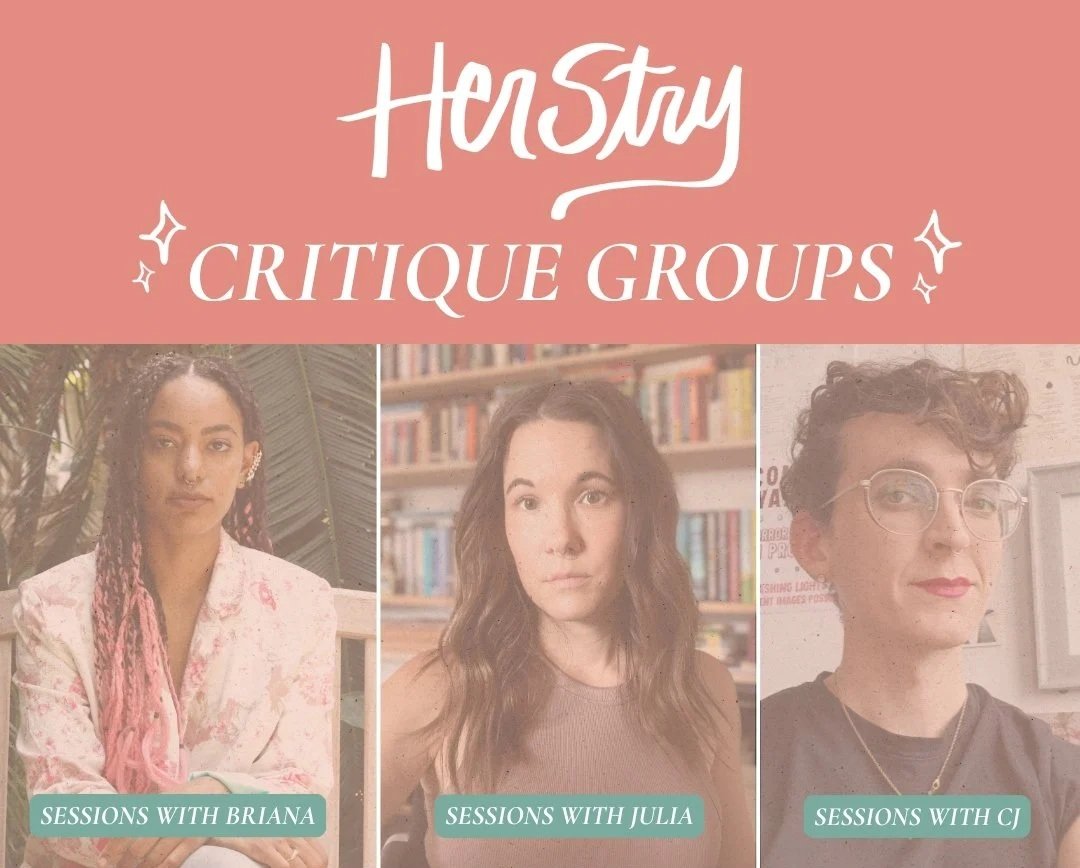
IT’S NO SECRET THAT FEEDBACK IS AN IMPORTANT PART OF THE WRITING PROCESS.
In fact, we argue that it might be the most important part of the process.
But it’s hard to find a writing community. It’s hard to find the people who are willing to take the time and the effort to read your work and give the feedback you really, truly deserves.
That’s where HerStry Critique Groups come in!
HerStry Critique Groups are small groups of 6 women who gather online for 6 weeks to share their writing, give constructive feedback and gain skills as writers.
Weekly online sessions last approximately ninety minutes, with three women sharing their work each week. Writers of all genres and levels are welcome and you may share both works of fiction and nonfiction.
Sessions take place on Mondays 7PM CT, Tuesdays 11AM CT, Fridays 11AM CT
WHAT’S INCLUDED IN THE HERSTRY CRITIQUE GROUPS?
Six 90 minute live workshop sessions
Three 20 minutes sessions in the “hot seat” to get you work critiqued
Written and verbal feedback from your fellow workshop participants
A weekly in depth edit and critique of your work from the group leader after each session
Weekly writing goals and accountability check ins
Full video recordings of each session to keep for your records
Say goodbye to the lonely, stuck in your head writing life!
LET’S WRITE!
From conception to submission. Let’s make summer sizzle with stories.
Writing a short story doesn’t happen in one session. It takes multiple drafts to get it exactly right, to create characters that come to life for the reader and a world they can’t stop thinking about. In this seven week course we will work on a single short story from conception to submission ready. The seven week session will include generative brainstorming sessions, short story craft talks, multiple workshops for feedback from fellow writers, and detailed line by line feedback and edits from your instructor. Plus, we’ll talk about submission venues, cover letters, and when to know if your story is ‘finished.’
She opens the cupboard above the sink and stretches her body as far as it can go. The glasses and bowls have moved closer to the edge of the shelves since I was here last.