Shaky Madam
Life in a small mountain town means it’s not unusual to be recognized. But to hear my name when dressed up in an ostentatious ruby dress and black fishnet stockings, a magenta-and-bubblegum-pink-boa draped across my back and over my elbows, a cerise silk ribbon tied around my throat and vermilion lipstick—to look nothing like myself, yet stand out in kodachromatic vividity whilst hearing my name was abnormal.
I’d been rushing to Town Hall, the streets full of traffic forced to wait for the jaywalkers, the sidewalk swamped with oglers unable to enter the stores overflowing with sweaty, dehydrated bodies, wallets opening and closing, a crush of consumption.
I turned to the sound of my name again and saw my boss; he and his wife stared at me agog, the hustle of tourism flowing around us. I had a momentary flash of what they must be going through seeing me, the woman who doesn’t know how to do her hair or wear make-up, the woman always in slacks, now looking like the madam from any western imaginable. I gave them my biggest, fakest smile, and winked. What could I do? I’d agreed to play this role three days a week, every weekend, for a month, and I’d do my best.
“I’m late for the show!” I said, “Come see it if it’s not sold out.” I waved and click-clacked away down the sidewalk at a clip, the jaunty feather in my hair threatening to come loose at any moment.
He can’t fire me for what I do outside of work, right? I thought, zipping along as best I could, “excuse me!” and “pardon me!” and “come to the Melodrama!” escaping my lips repeatedly as I made my way down the final block. A pause for a quick moment as someone with a camera insisted on a photo; I bawdily crook up my knee and the skirts of my dress, drape my arm around their shoulders. The moment the shutter snaps, I’m off.


It is 10:34 p.m. I am journaling about the difference between what I eat and how I taste it.
In other words, it’s not about the chocolate cake. It’s about the pool of saliva swirling through each bite. It’s about the tongue pressing crumb into ganache, the esophagus readying itself to carry each sweet offering down. It is about my body knowing it is safe. Safe to sit, to enjoy, to receive.

Life in a small mountain town means it’s not unusual to be recognized. But to hear my name when dressed up in an ostentatious ruby dress and black fishnet stockings, a magenta-and-bubblegum-pink-boa draped across my back and over my elbows, a cerise silk ribbon tied around my throat and vermilion lipstick—to look nothing like myself, yet stand out in kodachromatic vividity whilst hearing my name was abnormal.

Sometimes I wonder why lovers hold hands when they walk around. I wonder how long they have been dating. Are they in that new stage, where it feels like they have to hold on tight, constantly let the other person know that they are there, that they aren’t going anywhere, that they want to touch them, that they want to be touched. Or is it the older couples, the ones who have been together for longer that hold hands. A gesture they don’t even realize they’re doing, their fingers just mindlessly reaching for each other, keeping their connection as they pace around the city.
Some Girls
In 1966, a teenage girl walked into a fancy salon in London, England wanting a simple shampoo and set. Instead, persuaded by the owner, she had her long locks cut into a short crop. After the cut, a picture was taken, revealing an almost waif-ish yet intriguing schoolgirl: pretty, wide-eyed, and made up beyond her years. Barry Lategan, the photographer, said of the girl, “She was gawky, but she had a sort of elegance…I think it was the eyes…she had such a presence.”

“Shorter,” I said. “Take it all.”
January seemed a fitting moment for fresh starts. It wasn't born from some halfhearted resolution or unfounded faith in the promise of a new year. It wasn't shoved in with a promise to swear off chocolate or set the alarm an hour early every Monday through Friday.

I’ve done a lot of writerly things for money: reporting, editing, and teaching. I managed to write and teach until I had kids, but parenting was the kiss of doom for balance in my life. Something had to go, and since my spouse was on board, I quit teaching. What little extra time I had, I spent writing. It didn’t pay, but it satisfied a creative need, and it didn’t require a wardrobe. Or parking.

I sat in Taylor’s chair in the high-ceilinged hair salon on Madison Avenue, watching all the wealthy Upper East Siders, as they rested their five-figure handbags on velvet stools like beloved pets. My newfound sense of mortality had no place in this land of excess. This was the room T.S. Eliot must have been referring to when he spoke about the “women [who] come and go/ Talking of Michelangelo.”

Jake offers me a beer before challenging, “Think you can keep up?”
“I can drink you under the table,” I answer.
“Drink for drink then.”
We click our bottles and the game begins. I know I will lose. He’s six feet tall, lean and muscular, while I’m closer to five foot two. He easily weighs two hundred pounds which compliments his height and athletic build. My body is somewhere in the one hundred and ten mark. There is no way I’ll win. But that isn’t the point, is it?

I am topless in the women’s beach bathroom, laundering the salt stained armpits of my only t-shirt with hand dispenser soap. I have not yet been sized up as a threat or harassed by a mob of concerned mothers. Perhaps my exposed tits are evidence I am in fact, female?

“Can you please repeat what I just said?” Debbie asked. Her usual, wry smile I recognized so well said, “Why do you even try to fool me? I know you so well.”
“Oh…what…No, I am okay, I got you. I actually heard you,” I replied.
“No, you didn’t, and I know it. I absolutely do not mind repeating myself for the fourth time, Abha. And, if you really got me, why don’t you repeat what I just said? Repeat it,” Debbie said.
Whether I’m writing fiction or nonfiction, every piece begins the same: with a haunting. It grows as any respectable haunting should, first with creaking footsteps in the other room, the sense something is watching, until there’s a full-blown apparition standing beside the bed whispering, “You need to write this down.”

Dear Breasts,
It’s been almost two years since I saw you. My last memory of us is you hidden underneath a checkered teal hospital gown that flapped against my naked bottom. I couldn’t look at you. I pictured the doctors cutting you off and resting you on a silver platter next to the operating table. Two jello molds, each with a cherry on the top. The whole thing felt surreal.

By my eighteenth birthday, I was convinced my entire personality was a mistake. My hobbies were hipster and obnoxious, tied to the fine arts and human culture. My goals were lofty and idealistic, invoking a life of novelty and meaning. I hated that I cared for these things despite their presumed futility in our modern (read: capitalist) world. The trendy albeit psychologically debunked Myers-Briggs Type Indicator had assigned me a personality with one of the lowest average incomes, followed by fun phrases like “most likely to have trouble in school,” and to me, this was the surest confirmation of my worthlessness.

Weak Point
“Are you sure there’s nothing else you’re worried about?”
Secrets are like poison. Until you tell someone, they will kill you from the inside out. The worst secrets are the kind you keep from yourself—held at bay for so long until the dam finally breaks. For a week, I tell my mom that I’m having stomach problems, and it isn’t entirely a lie.
Finally arriving at Town Hall, the ticket booth still on the porch, I could hear “Oh my darlin’ Clementine” coming off-key from inside. The sing-along was nearly over but I wasn’t too late. “We sold out!” I’m told as I hustled by giving a thumbs-up before stopping inside the doorway, allowing my eyes to adjust from the glare of a cloudless fall day to the shuttered windows and air-conditioned interior, the stage ahead of me lit as professionally as an off-Broadway production.
Not only were we sold out, it was standing room only. Thank god, I thought. It was hard enough finding the nerve to do this for a good cause, even harder in a near-empty theater. Unfortunately, there would be no way to quickly nor discreetly edge around the room; I’d have to walk right up the aisle.
There was modest clapping before a woman called out, “And now we’re going to finish with She’ll Be Coming ‘Round the Mountain!” As the piano cued up, and before I could lose my nerve or my lunch, I trotted up the aisle clapping my shaking hands in time, occasionally rubbing the feather boa along a gentleman’s shoulder in passing.
I reached the group of ladies in similar attire just as one woman began her chaotic ‘ride’ across the stage, one hand holding invisible reigns, the other hand thrown up to the sky a trail of feathers behind it. The crowd erupted in laughter, and I remembered it isn’t just the scholarship money we’re raising, the energy and the humor of that space make it almost worth the shaky-pukey feeling I get every time I take the stage.
-Sunday Dutro
This product gives you access to all four weeks of the workshop. Purchase one or more drop-in sessions here.
Build a habit in 20 sessions. In this 4 week workshop that meets Mondays through Fridays from 8:00-9:00 AM CST, we will focus on generating new writing—making headway on a current project, reviving an old project that’s been gathering dust, or writing based off of the daily prompts Leigh provides.
The first 45 minutes of class are a gentle, camera-off, silent writing session. The remaining 15 minutes are an opportunity to share excerpts of our work, reflect on progress made, and set intentions for the following day. Then we will read a passage together on the writing life and close each class with a new learning about habit formation. By the end of this course we’ll have a morning writing habit that is each our own to continue and build upon.
This listing is for an individual class. To purchase access for the full 4-week workshop, click here.
Build a habit in 20 sessions. In this 4 week workshop that meets Mondays through Fridays from 8:00-9:00 AM CST, we will focus on generating new writing—making headway on a current project, reviving an old project that’s been gathering dust, or writing based off of the daily prompts Leigh provides.
The first 45 minutes of class is a gentle, camera-off, silent writing session. The remaining 15 minutes are an opportunity to share excerpts of our work, reflect on progress made, and set intentions for the following day. Then we will read a passage together on the writing life and close each class with a new learning about habit formation. By the end of this course we’ll have a morning writing habit that is each our own to continue and build upon.
Many writers feel drawn to write about their lives but struggle with uncertainty: Why this story? Why now? And who is it really for? This workshop is designed to help writers move beyond doubt and toward clarity by focusing on the deeper meaning and purpose beneath their story.
In this interactive, craft-forward session, participants will be introduced to the Memoir Compass, a practical framework that helps writers articulate their motivation (why they are writing), mission (who the story serves), and message (what meaning or insight the story carries). Through guided reflection and writing exercises, participants will begin shaping a personal narrative rooted in intention rather than overwhelm.
This workshop is ideal for writers interested in memoir or personal narrative, as well as fiction writers drawing from lived experience, who want to move forward with greater confidence, focus, and direction.
Some of the most compelling creative nonfiction begins with the feelings we are tempted to avoid: anger, resentment, shame, fear, or the sense that we have an axe to grind. In this six-week workshop, writers will explore how to follow that emotional heat toward deeper, more honest work—without sacrificing compassion, complexity, or craft. Through close readings, writing exercises, discussion, and constructive feedback, we’ll consider how to transform strong feelings into writing that reaches beyond catharsis and connects with readers.
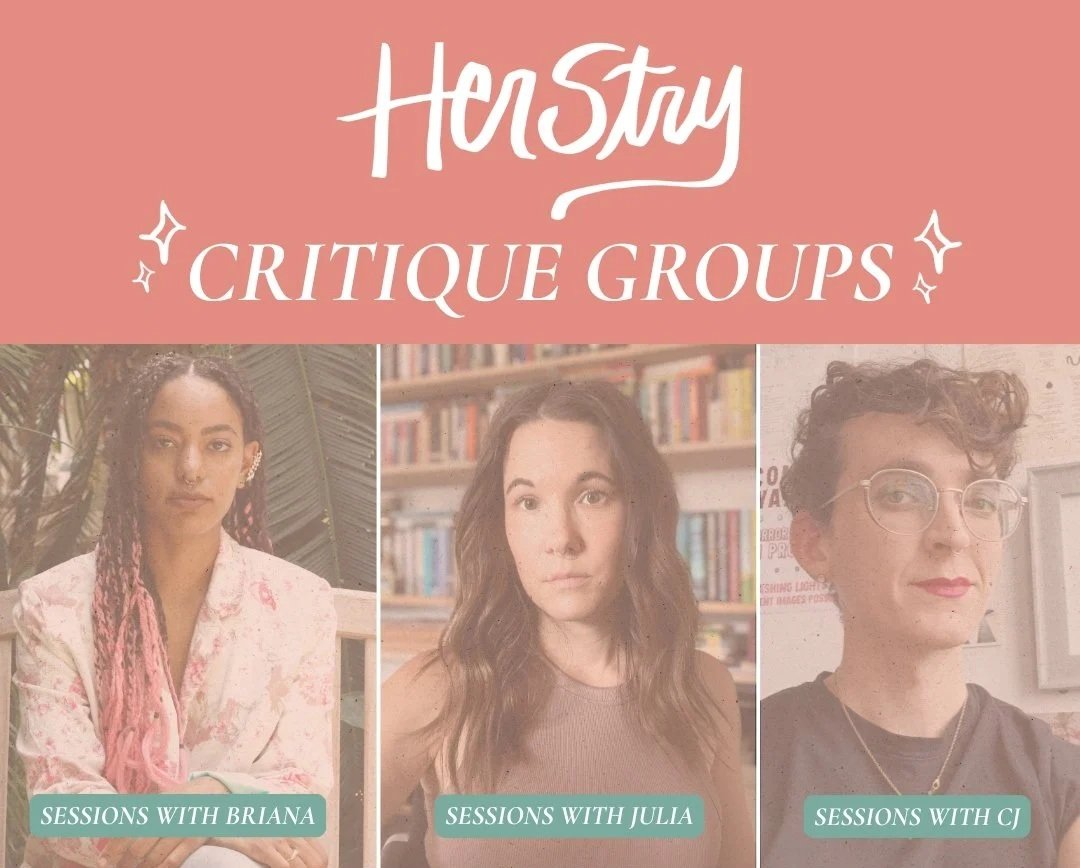
IT’S NO SECRET THAT FEEDBACK IS AN IMPORTANT PART OF THE WRITING PROCESS.
In fact, we argue that it might be the most important part of the process.
But it’s hard to find a writing community. It’s hard to find the people who are willing to take the time and the effort to read your work and give the feedback you really, truly deserves.
That’s where HerStry Critique Groups come in!
HerStry Critique Groups are small groups of 6 women who gather online for 6 weeks to share their writing, give constructive feedback and gain skills as writers.
Weekly online sessions last approximately ninety minutes, with three women sharing their work each week. Writers of all genres and levels are welcome and you may share both works of fiction and nonfiction.
Sessions take place on Mondays 7PM CT, Tuesdays 11AM CT, Fridays 11AM CT
WHAT’S INCLUDED IN THE HERSTRY CRITIQUE GROUPS?
Six 90 minute live workshop sessions
Three 20 minutes sessions in the “hot seat” to get you work critiqued
Written and verbal feedback from your fellow workshop participants
A weekly in depth edit and critique of your work from the group leader after each session
Weekly writing goals and accountability check ins
Full video recordings of each session to keep for your records
Say goodbye to the lonely, stuck in your head writing life!
LET’S WRITE!
From conception to submission. Let’s make summer sizzle with stories.
Writing a short story doesn’t happen in one session. It takes multiple drafts to get it exactly right, to create characters that come to life for the reader and a world they can’t stop thinking about. In this seven week course we will work on a single short story from conception to submission ready. The seven week session will include generative brainstorming sessions, short story craft talks, multiple workshops for feedback from fellow writers, and detailed line by line feedback and edits from your instructor. Plus, we’ll talk about submission venues, cover letters, and when to know if your story is ‘finished.’
IT’S NO SECRET THAT FEEDBACK IS AN IMPORTANT PART OF THE WRITING PROCESS.
In fact, we argue that it might be the most important part of the process.
But it’s hard to find a writing community. It’s hard to find the people who are willing to take the time and the effort to read your work and give the feedback you really, truly deserves.
That’s where HerStry Critique Groups come in!
HerStry Critique Groups are small groups of 6 women who gather online for 6 weeks to share their writing, give constructive feedback and gain skills as writers.
Weekly online sessions last approximately ninety minutes, with three women sharing their work each week. Writers of all genres and levels are welcome and you may share both works of fiction and nonfiction.
Sessions take place on Mondays 7PM CT, Tuesdays 11AM CT, Fridays 11AM CT
WHAT’S INCLUDED IN THE HERSTRY CRITIQUE GROUPS?
Six 90 minute live workshop sessions
Three 20 minutes sessions in the “hot seat” to get you work critiqued
Written and verbal feedback from your fellow workshop participants
A weekly in depth edit and critique of your work from the group leader after each session
Weekly writing goals and accountability check ins
Full video recordings of each session to keep for your records
Say goodbye to the lonely, stuck in your head writing life!
October 7, 14, 21, 28, November 4 and 18 CT
There is no class on November 11.
WRITING THE SEX SCENE.
Writing a sex scene can be delirious fun, a harrowing challenge, a literary milestone—possibly the most important part of building your short story or book. In our six weeks together, you’ll experience just about every possible emotion as you explore the erotic in different modes: comic, tender, harrowing, soul-shattering … because it really is all about the characters’ feelings, not just the mechanics. So we’ll talk about tone. Vocabulary. Metaphor. Sensory detail. How to get big emotions on the page … and when to pull back and let the reader’s imagination go to work.
This is a course for writers who want to explore the intersection between the novel and short stories, and would like to weave their short stories into a story cycle (or collection of "linked stories" or "composite novel"). This is also a class about the interaction of form and content, and how one influences the other. We will read works of interlinked stories by writers from diverse cultural and ethnic backgrounds, focusing on modern classics and contemporary practitioners of these hybrid forms. Weekly discussions will center on elements of craft, such as the expansion and compression of time, setting as an organizing and connecting principle, character development within and between stories, structure and plot for interconnected stories, and responding to literary influences in the same genre.
This six-week course guides writers through the literary submission process, offering insider insight and practical tools to help you get your work into the world. We’ll demystify everything from reading submission calls to writing cover letters and choosing the right journals. Along the way, we’ll workshop short bios, develop submission trackers, and build personalized plans that align with your voice and goals.
By the end of the course, you’ll walk away with a polished piece ready to send, a tailored submission list, and the confidence to navigate the lit mag world with clarity and purpose.
Ideal for writers of literary fiction, poetry, personal essay, memoir, and hybrid forms.
Tension feels tangible to a reader, an active experience. But from a craft perspective, tension is often a function of restraint, palpable from what is withheld, delayed or left unresolved. Why do some stories feel urgent even in stillness while others fall flat despite dramatic events? Our impulse to resolve tension often comes from a deeply human instinct to seek coherence and moral clarity, but resisting that instinct creates compelling narratives. When we let characters misbehave or allow ambiguity in their actions, we pull readers closer to them.
This course examines tension as a narrative force. We’ll consider how writers can counter the impulse to resolve too quickly, to justify wrongful acts or to redeem a character’s behavior. By looking at ways to sustain tension without escalation into spectacle, we’ll experiment with evoking it in the ordinary and the unspoken. The class will combine close reading, craft reflection and writing prompts to practice distinct approaches to writing tension. This course is designed for writers working in fiction, nonfiction, and hybrid forms who are interested in deepening the psychological and structural complexity of their work. Ultimately, tension is what compels the reader to turn the page.
In this generative writing workshop, ecologist and poet Anne Marie Wells will introduce participants to some of today's eco-poets and essayists and guide participants through a series of writing prompts that will use the outdoors and personal experience as inspiration for creative expression. No writing experience is necessary to participate.

Sunday Dutro is a creative nonfiction writer with publications in or forthcoming with Bear Paw Arts Journal, Panorama Journal, Nunum, and BarBar. She is a UCDavis, Writing By Writers Manuscript Boot-Camp, and Haven I Writing Retreat alum. Sunday lives in Montana with her family, and is actively working on a memoir. Find her at sundaydutro.com