
To the Rescue
When I was a kid, my gender and race lived together, tightly tied in a braid on top of my head. My brothers and I share a skin tone that is pale in the winter, and cinnamon in the summer. Our father was the only black person in our rural town, and as far as we knew, we were the only mixed-race kids on Earth. Our skin tone gives a clue that we’re different, but our hair confirms it. It grows coarse from our heads, and winds into kinky, impermeable, squiggly rings. Every few weeks my mother would mow the boys’ hair down to a number two buzz cut. I envied them. I so badly wanted to shave off the mop that made me look different from the other girls at school, with their straight cornsilk. The scent of vanilla and sugar from their drugstore shampoos was so soft compared to the motor oil stench of Lusters Pink that kept my curls from matting. I wore my hair wound in a tight ponytail that contained a single, long braid down the back, hiding my otherness. But it was in my bones. As much as I resisted, it was part of me.
The first time anyone ever saw my hair outside of its braid was the first lice check day in grade one. One of the lice ladies, as we called them, guided my timid frame into the chair before her, and she went to work. Tears welled in my eyes as she jerked my bauble to loosen it, and I felt the rebound of my braid untwisting behind me. She made a show of fluffing my hair to see how big it was, and took off her plastic glove to feel its texture. “It’s like a Brillo pad!” she exclaimed, making a show of her exclusive ticket to the petting zoo. “How do I find a scalp in this big, dark mess!”


The lice lady took what felt like an eternity, using her small wooden stick unknowingly as an afro pick. I felt heat in my ears as my curls expanded, and my classmates gawked at this foreign mop like I was a circus show. My hair was a big, dark, unruly spectacle. The other girls’ hair was so bright and shiny and flowy, and the jealousy I felt in the pit of my stomach was nauseating. The unfairness of it was not something that my six-year-old brain was able to understand.
Afterward, the girls filed into the bathroom with their hairbrushes. I joined them because I was a girl, just like them. But I was not just like them. They had feminine features and hair they could brush and skin that was clean. I had big lips and small eyes, a mop of black hair, and brown skin. I was a girl, but I wasn’t one of those girls. My small fingers could barely grip the handle of my Denman brush, so I used two hands to rake its teeth through the matted mess. I felt the familiar pull of knots, the consequences of the lice lady’s showy adventure. There was pain from all angles. The physical pain from the pulling of hair. The frustration as my hair expanded with each pass. The clumsiness of being a too-small child performing a too-hard task. The embarrassment of my classmates’ questions and jokes. The defeat of realizing that I could not fix this on my own.
Prompted by my sobs, the school secretary called my mom. A ten-minute eternity was all it took for her to arrive, the sound of the front door’s crashbar announcing her entrance. She was a scorching light in the dark foyer. In a show of disregard for the order of the day, my mother snatched one of the kid-sized chairs from the lice line, moved it ten paces from the action, and plopped me onto it. The volunteer moms glared at one another, speechless. They dared not stare into the sun.
Mom smiled, but she did not speak to them. She spoke to me, her human daughter, asking me questions about my day while she brushed and braided. She parted my hair down the middle and kissed the top of my head. It was comforting to feel that little act of caring in a place where I had just felt so much hurt. The scalp is such a delicate place to feel pain, or love. She wove two beautiful, tightly bound French braids. The feeling of her pinky nails grazing my scalp, pulling strands into the braids is so engrained in my memory that it is part of my DNA. My mom freed me from my zoo cage, hugged me, and turned me back into a little girl. After that day, and for the next seven years, my mom became a lice lady volunteer so that I would never again feel like a zoo animal at school.
Decades later, I rarely think about the lice ladies. But the experience in those hallways lives in my body, in a way that I cannot deny nor escape. It is always there.
I wore that braid until I left for the Big City, as a young adult. The first day I let my curly hair down, it felt like an act of resistance. My hair is my gender and my race, and my personality, and I wear it like a crown.
-Catie Sahadath
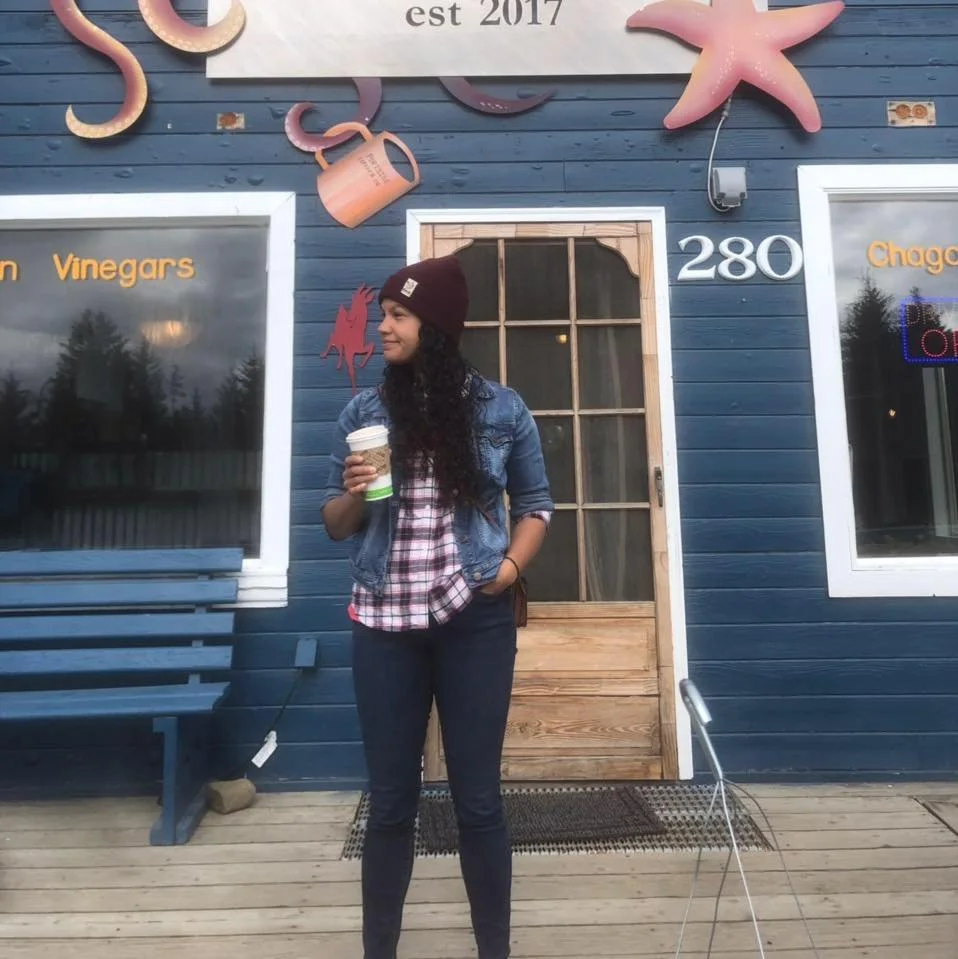
Catie Sahadath is a librarian from Port Perry, Ontario, Canada. She writes about the lived experiences of mixed-race folks through short stories and creative non-fiction. When she isn't in the book stacks, you can find her in a canoe, or on a trail. Yes, she would like to meet your dog.
When I was a kid, my gender and race lived together, tightly tied in a braid on top of my head. My brothers and I share a skin tone that is pale in the winter, and cinnamon in the summer. Our father was the only black person in our rural town, and as far as we knew, we were the only mixed-race kids on Earth.