
Dear Leah
Dear Younger Self,
How could you have known? You came naked into a world that didn’t want you. Born on a kitchen table because your mother didn’t have the money for a hospital. Like everything else in your life, you’ve pretended this is cool when it’s actually pathetic. You have to admit it makes for an interesting story.
You will learn to make the best of your ancestors’ botched deal. What else can you do? Narcissist parents, crazy dad who split for California before you were born. Another man stood in as your dad for a few years, then abandoned you. Your mother married again, this time for many years.
Your abusive stepfather set himself on fire when you were nineteen. You were in New Orleans, but your younger half-siblings still lived in the house. You flew home to watch him die, and the images still haunt your unconscious. Still, bad as this was for you, your siblings will fare even worse. All three of them will die before you’re sixty, but you’ll still be alive.

I remember being you. Being you, with your hands tucked under your thighs in skinny jeans that never quite fell to the ankle. I remember those hands, & how they wanted to wander over into his & how you told him with your lips that you would always wonder what it would be like to kiss him, but your lips stayed tucked together. He said he'd always feel that way too, and you let the moment pass, utterly kissless.

I am so sorry everyone deconstructs and changes your beautiful,
complicated name. The pieces of your soft “ca” and lopping “o”
rebranded into southern alternatives like Caroline or Coraline or Carol
or even Carly once, after the doctor said the only Carolyn he’d ever heard

Dear me from one year ago,
I regret to inform you that tomorrow will be one of the worst days of your life.
Tomorrow you will reset the password to log into your joint bank account. You asked him for the password many, many times. He always says, “Oh it’s on my phone… I don’t remember it…I will get it to you when I have time…I can’t do it right now.”

There is no time for pleasantries, let’s get to it.
You will fight a good fight from a place of absolute terror. You will list improbable reasons why you might be the person for whom antidepressants just really aren't the solution. You will throw pseudoscience and bad journalism against a woman with twenty years’ experience and a prescription pad. And then you will give in.

Dear Trish,
It was so annoying how Marlee slid on her jeans, buttoned them easily, and pulled a cream-colored, cable-knit sweater over her head, ready to party. She didn’t wonder if the pants were too tight, if they made her look fat, if the shirt covered the soft rolls of her stomach.

Dear Melina,
I write this love-letter to you when I am old enough to be your grandmother, and when Grandma was my age. Time is a funny thing. It unspools before us and then folds in on itself to be carried forward into the memories of body and soul. You are eleven years old in this memory. You are a child on the cusp of womanhood, and I am a woman on the cusp of old age.

At this time, your purpose is unclear. But eventually, it will be apparent why you are here on Earth. I know every day is routine – your forty-five-minute commute to your job, the mundane workday, the chaotic drive back home through traffic to smoke weed in your living room, then eat something and fall asleep.

Dear Teenage Deb,
Coming of age in the 1970s, you sometimes marvel at the inconceivable notion of one day living in the twenty-first century, of being forty-three (ancient!), when chimes clang and horns blare, welcoming a fresh numeral on humanity’s odometer. However, you also doubt the probability of living to the year 2000, since the Rapture is bound to occur at any moment.

Dear Past Me,
Congratulations. You are flying high and holding on tight. From the perspective of those on the ground, it seems like you could be floating up there forever, gripping the strings of a colorful bunch of balloons, symbols of success in a society that requires outward markers. One of yours is filled with the confidence of a post-graduation job as a public defender, where you will save the lives of your clients and probably fix the entire criminal justice system while you’re at it.

Look at how beautiful you are. What a liability it is to be a beautiful young woman. It’s like giving a set of Ferrari keys to a toddler. Plenty of people will use you, figuring you deserve the punishment. Men already harass the shit out of you, and you’re expected to take it with a smile. It won’t come as a surprise when you fall in love with abusive jerks. You’ll love them anyway, until one day you wake up and there’s no juice left in your sippy cup.
Go ahead, tell some of these folks to fuck off. Don’t feel guilty. They deserve it. That teacher who screamed at you because you used the phrase “by the way” when addressing her. The boyfriend who complained because you dressed like you were headed to Woodstock but fucked you anyway. The so-called friend/neighbor who slept with another boyfriend and wore his tee shirt around the building for a week. Your first husband, who smacked you in the face when you were pregnant with your son. Your mother, who told you she never wanted to speak to you again, then called you when she needed something. Your grandmother, who said you were always dirty.
One day you’ll be older than all of them. You’ll be sixty, living in a 550 square foot rental house, wondering what the hell happened. You’ll have hangnails and kidney stones and IBS. You’ll be overweight and worried about the goddamn IRS. It’s a good thing you don’t know that now. You’ve already got way too much on your platter. But perhaps if you did, you wouldn’t waste so much time on people who don’t deserve it.
Life isn’t for the squeamish. You already know that, or you wouldn’t be here. It takes courage to come into the world without a cushion, or at least a stubborn refusal to surrender to the odds. Take your talents seriously. In the end, they will be all you have.
Your No-Bullshit Friend,
Older Self
Many writers feel drawn to write about their lives but struggle with uncertainty: Why this story? Why now? And who is it really for? This workshop is designed to help writers move beyond doubt and toward clarity by focusing on the deeper meaning and purpose beneath their story.
In this interactive, craft-forward session, participants will be introduced to the Memoir Compass, a practical framework that helps writers articulate their motivation (why they are writing), mission (who the story serves), and message (what meaning or insight the story carries). Through guided reflection and writing exercises, participants will begin shaping a personal narrative rooted in intention rather than overwhelm.
This workshop is ideal for writers interested in memoir or personal narrative, as well as fiction writers drawing from lived experience, who want to move forward with greater confidence, focus, and direction.
Some of the most compelling creative nonfiction begins with the feelings we are tempted to avoid: anger, resentment, shame, fear, or the sense that we have an axe to grind. In this six-week workshop, writers will explore how to follow that emotional heat toward deeper, more honest work—without sacrificing compassion, complexity, or craft. Through close readings, writing exercises, discussion, and constructive feedback, we’ll consider how to transform strong feelings into writing that reaches beyond catharsis and connects with readers.
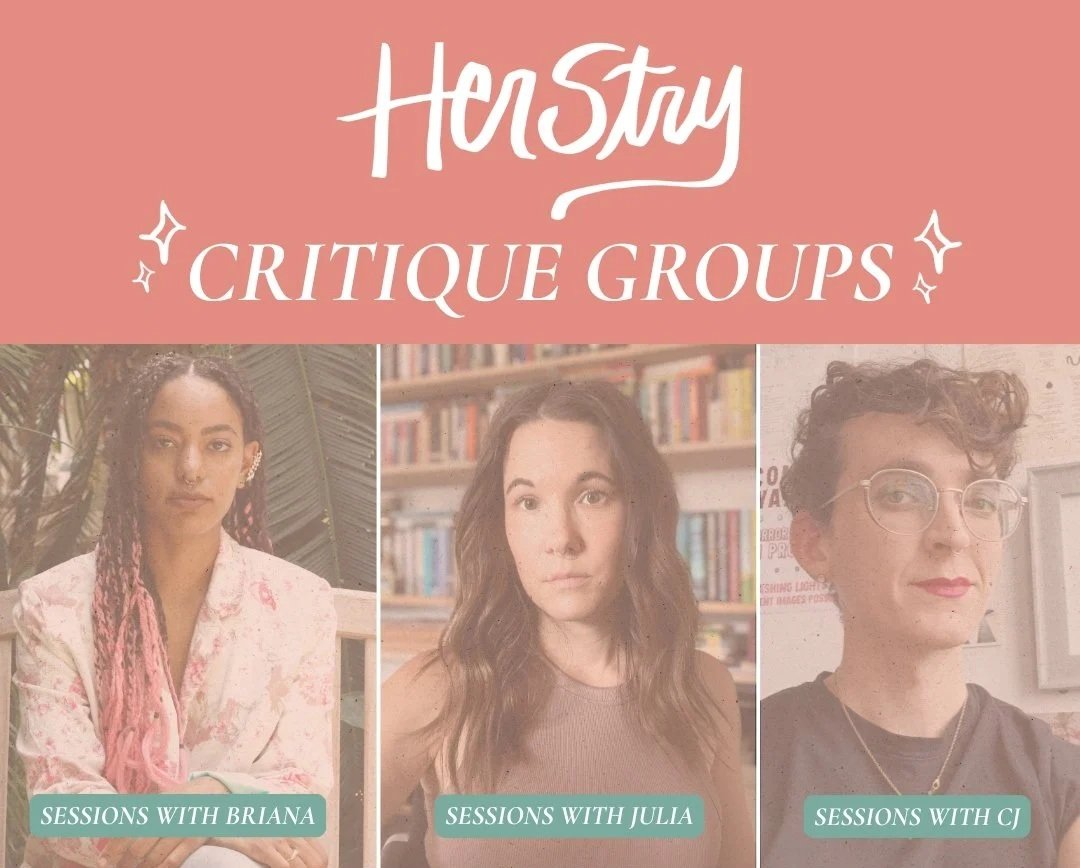
IT’S NO SECRET THAT FEEDBACK IS AN IMPORTANT PART OF THE WRITING PROCESS.
In fact, we argue that it might be the most important part of the process.
But it’s hard to find a writing community. It’s hard to find the people who are willing to take the time and the effort to read your work and give the feedback you really, truly deserves.
That’s where HerStry Critique Groups come in!
HerStry Critique Groups are small groups of 6 women who gather online for 6 weeks to share their writing, give constructive feedback and gain skills as writers.
Weekly online sessions last approximately ninety minutes, with three women sharing their work each week. Writers of all genres and levels are welcome and you may share both works of fiction and nonfiction.
Sessions take place on Mondays 7PM CT, Tuesdays 11AM CT, Fridays 11AM CT
WHAT’S INCLUDED IN THE HERSTRY CRITIQUE GROUPS?
Six 90 minute live workshop sessions
Three 20 minutes sessions in the “hot seat” to get you work critiqued
Written and verbal feedback from your fellow workshop participants
A weekly in depth edit and critique of your work from the group leader after each session
Weekly writing goals and accountability check ins
Full video recordings of each session to keep for your records
Say goodbye to the lonely, stuck in your head writing life!
LET’S WRITE!
From conception to submission. Let’s make summer sizzle with stories.
Writing a short story doesn’t happen in one session. It takes multiple drafts to get it exactly right, to create characters that come to life for the reader and a world they can’t stop thinking about. In this seven week course we will work on a single short story from conception to submission ready. The seven week session will include generative brainstorming sessions, short story craft talks, multiple workshops for feedback from fellow writers, and detailed line by line feedback and edits from your instructor. Plus, we’ll talk about submission venues, cover letters, and when to know if your story is ‘finished.’
IT’S NO SECRET THAT FEEDBACK IS AN IMPORTANT PART OF THE WRITING PROCESS.
In fact, we argue that it might be the most important part of the process.
But it’s hard to find a writing community. It’s hard to find the people who are willing to take the time and the effort to read your work and give the feedback you really, truly deserves.
That’s where HerStry Critique Groups come in!
HerStry Critique Groups are small groups of 6 women who gather online for 6 weeks to share their writing, give constructive feedback and gain skills as writers.
Weekly online sessions last approximately ninety minutes, with three women sharing their work each week. Writers of all genres and levels are welcome and you may share both works of fiction and nonfiction.
Sessions take place on Mondays 7PM CT, Tuesdays 11AM CT, Fridays 11AM CT
WHAT’S INCLUDED IN THE HERSTRY CRITIQUE GROUPS?
Six 90 minute live workshop sessions
Three 20 minutes sessions in the “hot seat” to get you work critiqued
Written and verbal feedback from your fellow workshop participants
A weekly in depth edit and critique of your work from the group leader after each session
Weekly writing goals and accountability check ins
Full video recordings of each session to keep for your records
Say goodbye to the lonely, stuck in your head writing life!
October 7, 14, 21, 28, November 4 and 18 CT
There is no class on November 11.
WRITING THE SEX SCENE.
Writing a sex scene can be delirious fun, a harrowing challenge, a literary milestone—possibly the most important part of building your short story or book. In our six weeks together, you’ll experience just about every possible emotion as you explore the erotic in different modes: comic, tender, harrowing, soul-shattering … because it really is all about the characters’ feelings, not just the mechanics. So we’ll talk about tone. Vocabulary. Metaphor. Sensory detail. How to get big emotions on the page … and when to pull back and let the reader’s imagination go to work.
This is a course for writers who want to explore the intersection between the novel and short stories, and would like to weave their short stories into a story cycle (or collection of "linked stories" or "composite novel"). This is also a class about the interaction of form and content, and how one influences the other. We will read works of interlinked stories by writers from diverse cultural and ethnic backgrounds, focusing on modern classics and contemporary practitioners of these hybrid forms. Weekly discussions will center on elements of craft, such as the expansion and compression of time, setting as an organizing and connecting principle, character development within and between stories, structure and plot for interconnected stories, and responding to literary influences in the same genre.
This six-week course guides writers through the literary submission process, offering insider insight and practical tools to help you get your work into the world. We’ll demystify everything from reading submission calls to writing cover letters and choosing the right journals. Along the way, we’ll workshop short bios, develop submission trackers, and build personalized plans that align with your voice and goals.
By the end of the course, you’ll walk away with a polished piece ready to send, a tailored submission list, and the confidence to navigate the lit mag world with clarity and purpose.
Ideal for writers of literary fiction, poetry, personal essay, memoir, and hybrid forms.
Tension feels tangible to a reader, an active experience. But from a craft perspective, tension is often a function of restraint, palpable from what is withheld, delayed or left unresolved. Why do some stories feel urgent even in stillness while others fall flat despite dramatic events? Our impulse to resolve tension often comes from a deeply human instinct to seek coherence and moral clarity, but resisting that instinct creates compelling narratives. When we let characters misbehave or allow ambiguity in their actions, we pull readers closer to them.
This course examines tension as a narrative force. We’ll consider how writers can counter the impulse to resolve too quickly, to justify wrongful acts or to redeem a character’s behavior. By looking at ways to sustain tension without escalation into spectacle, we’ll experiment with evoking it in the ordinary and the unspoken. The class will combine close reading, craft reflection and writing prompts to practice distinct approaches to writing tension. This course is designed for writers working in fiction, nonfiction, and hybrid forms who are interested in deepening the psychological and structural complexity of their work. Ultimately, tension is what compels the reader to turn the page.
In this generative writing workshop, ecologist and poet Anne Marie Wells will introduce participants to some of today's eco-poets and essayists and guide participants through a series of writing prompts that will use the outdoors and personal experience as inspiration for creative expression. No writing experience is necessary to participate.

Leah Mueller is an indie writer and spoken word performer from Tacoma, Washington. She is the author of two chapbooks and four books. Her next two books, "Death and Heartbreak" and "Misguided Behavior, Tales of Poor Life Choices" will be published in Autumn, 2019 by Weasel Press and Czykmate Press. Leah’s work appears in Blunderbuss, The Spectacle, Outlook Springs, Atticus Review, Your Impossible Voice, Mockingheart Review, and other publications. She was a featured poet at the 2015 New York Poetry Festival, and a runner-up in the 2012 Wergle Flomp humor poetry contest.
Wash your hands after using the bathroom, before using the bathroom if you’ve been outside first, before dinner, after playing with any toys, instruments, or feeding your fish. Even if you’re about to take a bath, if you’ve just done