
A few months after my mom’s cancer diagnosis, I was having trouble inserting a tampon. I had never really used them, since I was still pretty young and unfamiliar with exploring that area of my body. I had gotten my period earlier than most in my grade, around the age of nine. An avid pad user at fourteen, I figured the real way to become a woman was to use a tampon. Unfortunately, when I finally mustered up the courage to try, I couldn’t figure out how to insert it in a way that wasn’t painful. I talked to my mom about it through the bathroom door, as she laid in bed after her most recent chemotherapy. The stairs had become difficult for her, and she rarely left her room. Days when I came home from school and found her on the living room couch were good days.
Yet my mom’s soft voice floated under the door: I want to help. She was crying.
I didn’t mean to make her upset. Of course I wanted her to help me, but I knew that she was unable. All she had ever done in life since I was born had been for me. It took me two years after her passing for me to figure out how to properly use a tampon.
***
In college, I dated a boy named Thomas who, after two years together, chose Jesus over me. Thomas broke the news in July before my senior year, and I drove fifty minutes home while sobbing. I slowly climbed out of the white jeep, slammed the car door, and my dad was waiting there for me on the doorstep. He met me halfway between the driveway and the front door and wrapped me in a tight embrace. I heaved loudly. As a child, I used to cry so hard that I threw up. Come on, my dad said, let’s go inside.
For three weeks, he fed me toast and eggs and oatmeal, some half eaten and most untouched. I stalked Thomas’ location on my phone and tried not to vomit, and hated that every moment I was awake was a moment I had to think. I watched three TV shows. The Office, Heartstopper, Sex and the City, but the romance made me even sicker.
At some point you are going to need to get over him, my dad said softly.
I lost fifteen pounds, five more than I could afford to. The doctor said, I’m concerned.
I told her, I am going through a breakup, and she laughed and said she understood. I didn’t understand. My mom wasn’t there to help me understand.
***
I thought my mom was perfect. Only at the beginning of her sickness, and in hindsight, I realized she was not. The year before her death she broke the news to me that my dad was her second husband. I was mortified. In my eyes, my mom had a halo in the midst of a lavender haze for so long, and this information shocked me. My mom being unsure of anything in her life unsettled me. After her death, I met up with her life-long best friend, and asked her about the situation. She told me that she wasn’t sure if my mom ever loved her first husband, that she was just doing what she thought she was supposed to do: marry young, even if it is straight out of high school, move in together, start a family. When I learned this, I felt heartbroken for her, and immediately wanted to talk to her about what she was thinking, how she felt, and what made her realize that the man she married was not the one she wanted to spend her life with. Perhaps he didn’t love her the way she deserved, or maybe he did, and that is why it took her so long to leave him. But I never will be able to ask her that, and I guess now how she decided to divorce her first husband is up to my imagination.
My relationship with my mom would not have been perfect. Maybe we would have fought over my stupid boyfriend, or my moodiness when I got home from school. Maybe we would have been closer afterwards, apologized and laughed about how silly I was being. My teenage moody years were beginning just as she was getting sick, and I would sometimes choose to hang out with my friends instead of laying in bed with her, waiting for her to wince at pain I couldn’t feel. She was hurting, and I was scared.
One afternoon after school, I had asked my dad if I could go over to my friend's house. He had preferred that I go upstairs and spend some time with my mom. She doesn’t bite.
I can still hear my ignorant voice snapping back: She might as well.
My dad’s face turned sullen, and then angry. She’s dying, Emma. And she wants to see you.
On those rare occasions when I would join my mom in bed, she would be sucking on a lemon ice from the local parlor. I would sit next to her, kiss her on the forehead, rub her arm. But in my mind she was fragile, and I didn’t want to hurt her. Her favorite movie, Dirty Dancing, would be on the TV, or one of those house-hunter shows she liked. She would be dressed in her pajamas, grey sweatpants and a light, navy flannel. My mom explained important things that I should know, like how her mother came over from Norway, where some of our family heirlooms are from. Her hands shook when she was nauseous. She would make a pained call for my dad: John.
He would run up the stairs, each one creaking with his hurried weight. I forget most of what we talked about now. I wear her flannel to bed, and can see why she loved it so much. Above my parents’ bed still sits a large framed picture of me when I was around six-years-old with my arms out like the wings of a bird.
Even when my mom first was married, her new house with her husband was down the street from her childhood home. She was a homebody like me, and dropped out of college in Niagara Falls after the first semester because she was too far from the people she loved. I once found her journal from that time, with the leather cover tattered and the pages yellowed around the edges. She recounts being depressed. This was surprising to read, having seen her mostly happy as I was growing up. It gave me solace that she was also sad and lost at some point in her life, especially when I feel lost now without her.
***
During my freshman year of college, I loved to run. I brought pepper spray with me, in case I felt uneasy. My favorite path, the Greenway, was an asphalt paved trail alongside the highway in Bethlehem, Pennsylvania. On one particular run, the air was oddly quiet and colder than usual for a spring day. The dark clouds must have scared everyone away. Around 1.3 miles in, a man on a bike sped towards me. A naturally anxious person, I moved to the right of the path, trying to make myself small. As the bike came closer, it started to slow down. I thought I imagined it at first; it couldn’t actually be slowing down. But when I realized that the bike was in fact slowing down to meet me, the hair on my arms stood up. My mind raced through my options. We were alone on this path. He was on a bike. I couldn’t outrun him. The highway is the only way off the trail. The biker rode straight at me, and as he approached within ten feet he started to get off his bike. Unsure of what to do next, I pulled out my pepper spray. He was unnervingly close to me, and I smelled gas on his jacket. What happened next was a blur; I know he reached for me, I know I swerved and showed the pepper spray. Whether the pepper spray stopped him from following through with his plan, or he was just trying to scare me, I guess I will never know. Afterwards, I immediately called my dad in borderline hysterics. He was sympathetic, of course, and is always concerned for my safety. Although, I didn’t miss when he slipped in a remark that went something like, Are you sure he didn’t just drop something off his bike? Maybe it was an accident.
After a good run, the adrenaline would rush down through my veins to my finger tips, and I frequently find myself missing that feeling. After a twenty-two-year-old college student in Georgia was murdered while on a run in her college town, I thought of how that could have been me when I was approached on the Greenway near campus, so I stopped running all together and stuck to the gym. After videos circulated involving the attempted kidnapping of a girl at a Florida gym, I stuck to the fifth floor of my gym, which mostly girls attend. Many girls call their mom on the Greenway so that they feel safer. That would make me feel safer too.
***
One experience was especially jarring for me. Even when the men I love are present, I wonder if my mom would have understood my fear. She was always good at sensing it when I was a child. On the way home from a road trip, Thomas and I stopped for gas at a well-lit but mostly deserted station. My knees were resting against the passenger side dashboard in a comfortable position, my hair tied back into a messy bun after a long day of hiking. The man who approached to take the credit card from Thomas stared at me for about ten long seconds before saying to him, Wow, she is beautiful. Is she available?
At first, we laughed, and to this random man for complimenting me, I said an obligatory, Thank you. In the back of my mind, I could hear my mom’s voice, say thank you, after she would hand me dinner as a child. I don’t think she meant in moments like this.
He became more aggressive with Thomas. Are you married? Is she still available? How much to have a go with her?
I felt icky and uncomfortable while I sat there in utter shock, unsmiling. I couldn’t stop my hands from shaking, so I clenched them tightly in my lap. I pulled my legs down off the dashboard and crossed them in front of me as if to block the possibility of the words seeping under my clothes and through my skin. Thomas could sense my discomfort, but knew the man had his credit card and was currently pumping gas in our car per New Jersey laws. After we pulled away, I couldn’t hold back my fear, sobbing into my palms.
Thomas tried to be understanding but seemed confused. He was complimenting you, he said carefully. Maybe he didn’t mean it in the way you think.
But what if I was alone at this gas station, my window down to hand my credit card over, my license plate exposed? What could I have done to prevent myself from being followed, pulled from my vehicle and taken? The answer is nothing. Right then, in the car with Thomas, I wish I could have called my mom.
These comments were not compliments. During that conversation, I felt less like a human and more like an object in the room, on the mantle overlooking two men speaking. A time before, I could stay above my parents bed, framed by dark wood, overlooking my mom and dad. They would be sitting on their creaky bed, the comforter covered in pink roses, and my hands reach out to them. I was safe.
***
This past summer, my social media was flooded with women being followed out of the grocery store at night and perpetrators opening car doors before women had a chance to lock it. I stopped shopping at the grocery store in the late hours, and then stopped shopping alone all together. Now I revolve my shopping trips around my boyfriend’s schedule so he can play the role of protector. Growing up, my mom would always bring me grocery shopping with her, and hold my hand through the aisles. She didn’t care that it made picking the ripest bananas or finding the tomato sauce shelf more difficult for her. Even though I am grown now, I can feel the hollowness in my hand as my boyfriend walks ahead of me, looking for the grilled chicken.
When I see videos of women’s experiences on social media, I dig for more. Maybe I think hearing stories will teach me to prepare for the worst and show me how to protect myself, or maybe I just can’t seem to pry my eyes away from my phone. Maybe social media is all I have to rely on to tell me what to do in situations like these. After I graduate college, I will be moving to Wyoming for a few months for my job. What will I do there, without a boyfriend or a father to protect me? Perhaps I will carry pepper spray everywhere I go. Perhaps that won’t be enough.
***
Recently, I had the stomach bug, which I loathe more than any other illness. I spent two days with a fever over one hundred and two degrees. I couldn’t keep any food down, and every time I took a sip of water, I threw it up five minutes later along with the last of my stomach bile. As I lay shivering on my bed, my sheets soaked through with sweat and my body wrapped in three fuzzy blankets, all I could think was, I want my mom. When I was little and I had the stomach bug, my mom would stay up late into the night with me and rub my back, a simple trick that always convinced me that everything would be okay. She didn’t have to do that, and she always ended up catching the stomach bug herself because of it. I couldn't imagine feeling this way for fifth months with no end, like she did when she was undergoing chemotherapy. I’m sure she wanted her mom too.
In her first job interview to become a kindergarten teacher, my mom started sobbing in response to the question, Can you tell me about someone who inspires you and why? My mom had just lost her own mother not long before the time of the interview, so she recounted that the person who inspired her the most was her mother. She left thinking that she would never get that job. She was hired. The principal later wrote about that interview in her book, and reported that my mom exhibited the exact quality she wanted from a kindergarten teacher: empathy.
I understand more and more about my mom as I grow older. In that way, she helps me understand the experiences of a woman, and she grounds me, even if it is only through the stories of others. I search in their narratives for new pieces of her I can cling on to, a hidden piece of advice that she may know that I need somehow. Generationally, women have understood how to exist from those that came before them. Mothers teach daughters to brush long hair, say please and thank you, cross one leg over another when wearing a short dress. Mothers help daughters to understand how the world works. Mothers show daughters how to protect themselves, tell them never to walk alone at night, to always be on high alert, to call whenever you feel unsafe. Mothers always pick up the phone.
***
399: Queen of the Tetons is a documentary about a well-known bear in Wyoming named 399. The difference between 399 and other bears was she used an unusual survival tactic: she stayed close to humans. It so happens that one of the largest threats to female grizzly bears and her cubs are male grizzly bears, who will kill the cubs of a female in order to mate with her. It so happens that male grizzly bears hate humans, and that is why 399 stuck so close to us. She would mosey along the sides of highways and roam the outskirts of rural towns in order to protect her cubs from those males.
She ended up successfully birthing and raising many cubs over the years, and became very popular with photographers and nature lovers. People came to love 399. They lined up every spring to watch her emerge from hibernation, and exchanged excited whispers about seeing how many cubs she would have that year.
Most of 399’s cubs grew to adulthood safely, when they separated from her altogether. However, one of 399’s cubs, Snowy, was killed by a careless driver in 2016 while crossing the road at dusk. 399 picked up the limp body of her cub and carried it to a nearby spruce tree. She ran up and down the side of the road, roaring with her face to the sky. You could really feel her grief, they said. Before now, she had never failed to protect one of her cubs.
She, too, was killed by a driver last October. They never found who did it. One of her cubs was with 399 when she was hit, now left to brave the forest alone, motherless.
-Emma Moriarty

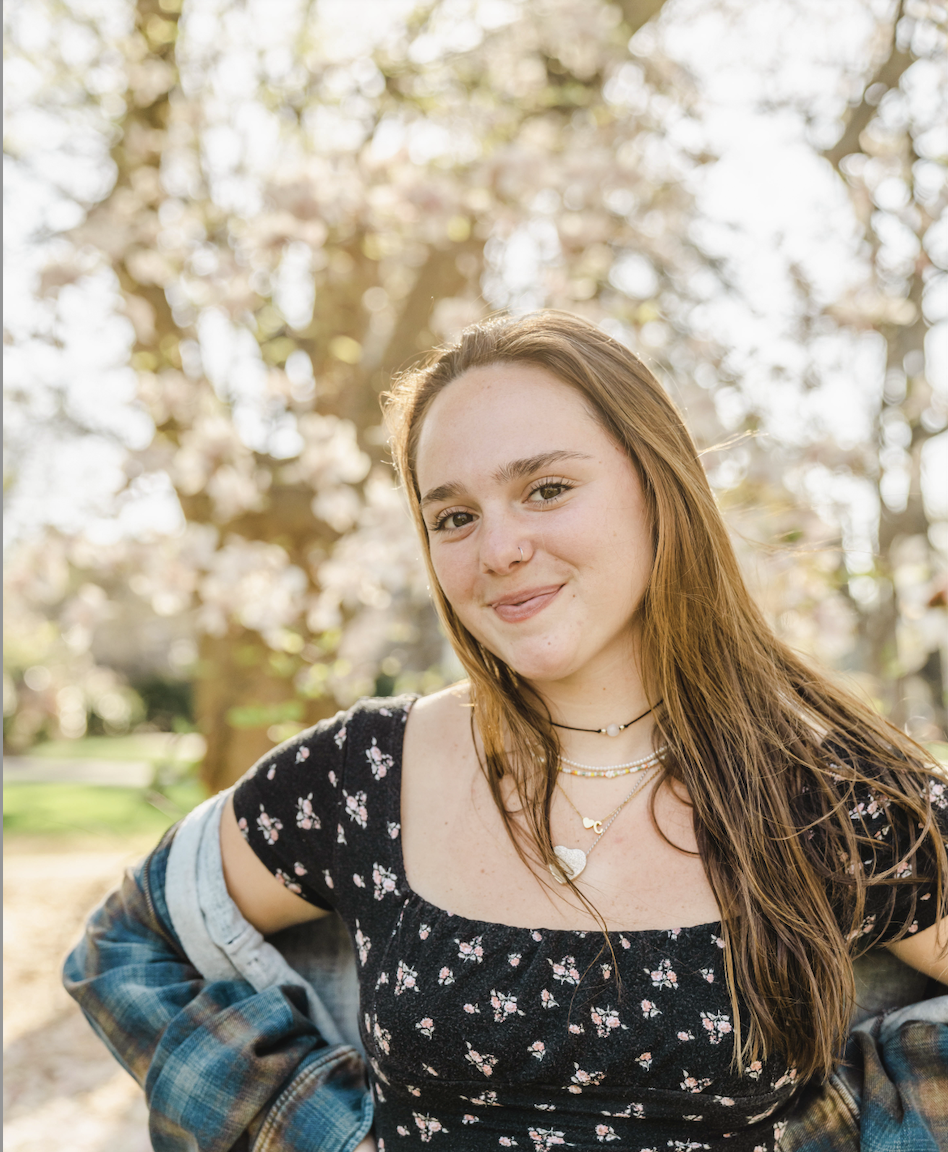
Emma, originally from Shrewsbury, NJ, graduated from Lehigh University in May 2025 with a BS in Psychology and a minor in Creative Writing. She has been published in Lehigh University’s Amaranth Magazine in 2023 and 2025. She has been awarded the 2024 & 2025 Williams Prize in Creative Writing Non-Fiction, the 2024 Williams Prize for Creative Writing Poetry, and the 2024 & 2025 Kachel Prize. She currently has a column in bookinc journal, and is looking to publish in her first literary journal.
I left on a clear October Monday. Seated at the bulkhead, my elbow rested next to a man who asked if I was going to Chicago for business. I lied, nodding my head yes. Ambivalence prevented me from updating my second-generation iPod earlier in the day, leaving Missy Elliott and Usher to comfort me. A leathery skinned smoker picked me up at baggage claim. She drove me forty-five minutes to our rural destination while I imagined what happens when car doors open and bodies land on I-55 at seventy-five miles per hour.