
Our Mothers' Filters
The last time I saw my mother, I received the gift of some powerful clarity about something, and it's something I need reminding of every day.
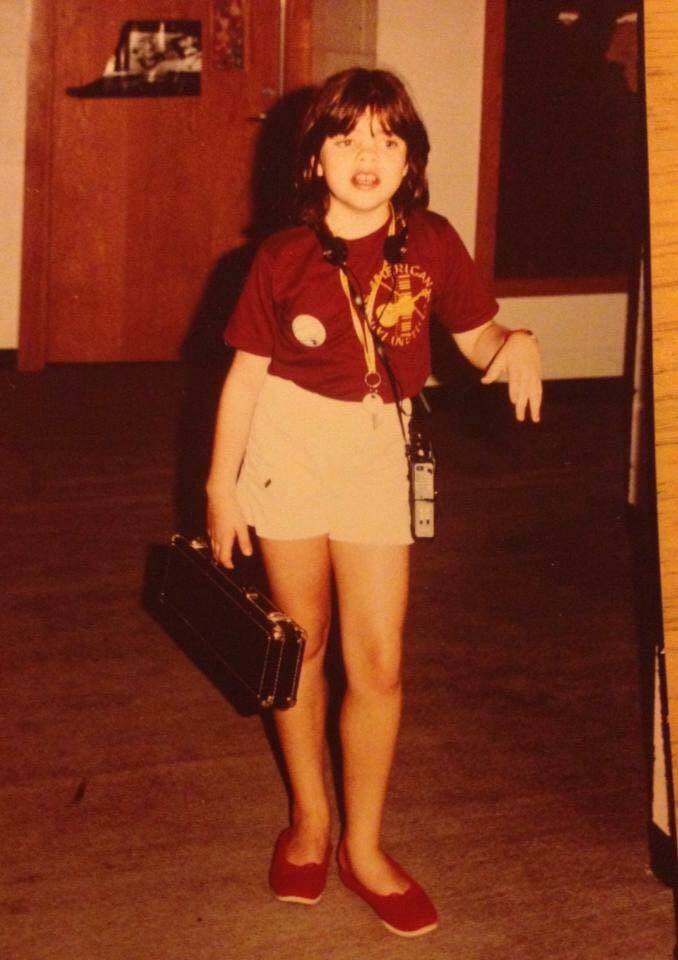
She saw herself, and thus this world and me, through a filter where all she saw was weight. It truly was ALL SHE SAW when she looked at me. Or at anyone.
This photo is me around the time my mother started controlling every single bite I ate. She called this little girl you see here fat, and put a padlock on the pantry because she could not be trusted to make her own choices about what to put in her mouth. We ate out most all the time, and I was allowed to have half of something from children's menu. There was no regard for nutrition, only regard for portion control ... Trying to make sure that I would not be fat.
Because that would make me worthless.
I was hungry from 10 to 18. That is a shattering sentence for me to write, and it makes me weep as I sit here at 43 years old.
This thing that happened on our last visit was such an incredible gift. My mom was a pianist, and she happened to be playing for a funeral while I was visiting. The niece of the woman who had died wrote a song for her aunt, and she played and sang it during the service. It was an absolutely beautiful song, and a powerfully moving moment as she sang about her aunt she clearly loved so much.
My mother leaned over to me after this song, and made her only comment about this beautiful moment: An admiring "Look how thin she is!"
I grew up listening to my mom criticize her stomach. Having children had done this, she would say as she ran her hand over her loose stomach. Being pregnant and giving birth had changed her body forever, leaving behind stretch marks and large breasts and a stomach that jiggled and bulged. She didn’t like how her stomach looked, but she didn’t starve herself or excessively exercise. In every fitting room we shared, she commented. If only I could get rid of this, she’d say as she patted her stomach. Look at this, she said, as she shook her head and looked at her side profile in the dressing room mirror. If I didn’t have all this, these would fit better, she would say, while pulling down the pair of pants that didn’t fit. She saw, and continues to see, her stomach as a negative, a defect.

I used to place Ken’s hand right on the mound of Barbie’s breast. It fit, almost precisely, as if the rounded palm was created for this small act of intimacy. Of course, further south it was merely a place where two legs connected, a smooth sweep of plastic that neither confirmed nor betrayed pleasure. But that didn’t stop me from imagining. I used to sit on the floor between the two twin beds in the upstairs bedroom at my grandmother’s house.
I have a problem with many words in the English language, the most recent and personally applicable being “menopause.” Apparently, the term is a Greek mashup of “month” and “cease.” I’d have less of a problem if the English term were “menocease,” since “menopause” suggests that something about the female body—my body in this case—is “pausing” and will, ASAP, resume its regularly scheduled programming. But, that’s not the case. My body is going off the air.
She was doing Pilates when she saw the first sign. She should have noticed. It was like last summer when the cop stopped her, leaned into the window, and asked if she’d seen the “STOP” sign. Of course she hadn’t, she told him; if she had seen it she’d have stopped. But that, too, was no kind of explanation.
Some Girls
In 1966, a teenage girl walked into a fancy salon in London, England wanting a simple shampoo and set. Instead, persuaded by the owner, she had her long locks cut into a short crop. After the cut, a picture was taken, revealing an almost waif-ish yet intriguing schoolgirl: pretty, wide-eyed, and made up beyond her years. Barry Lategan, the photographer, said of the girl, “She was gawky, but she had a sort of elegance…I think it was the eyes…she had such a presence.”

The tires turned left into the driveway, just as my mind turned right. I never thought that I would have to pull up to another house, or rather facility, with luggage in the back of my car, ready to be unpacked into The Perfectly White Dresser. The Perfectly White Dresser recycled by dozens of girls with one thing in common: a parasite that has driven them far enough into misery that they must stay locked up in its drawers, subdued, away from the harmful society that is primarily to blame for their destructive race to perfection.

NOLA Pride Week 2018 was my first large pride event, and I was determined to get comfortable with my androgynous aesthetic ideals. My partner and I planned to meet up with a few of our queer friends and ride the streetcar to the Quarter to attend a fem party at the Coyote Ugly Saloon. Getting dressed was an exhausting undertaking. I fought off a spell of dysphoria triggered by my depression weight loss.

In Starvation Mode, all I thought or dreamt about was food, even though eating terrified me more than anything. I didn’t care about anyone or anything except losing weight. It was like the line between human and animal had become so thin it collapsed. I was gone. I was starving. I was addicted to starving myself. I went feral for a little while.

I began losing my eyesight when I was three – a result of poor genetics and squinting at the television too often. My sight worsened until I was nineteen; by then, I was nearly legally blind and opted to have my vision corrected through surgery. Until that point, losing my eyesight afforded me both a gift and a curse – the gift of insight and the curse of knowledge. I saw the world in layers of truths and half-truths, of what people thought they knew and what actually happened behind closed doors.
I realized in that moment that that was the filter through which I had been seen by the most important woman in my life. Which is to say, I had not been seen. Ever.

I need reminding of this every day, because it is so easy for me to see myself through that same filter, where I have absolutely no value if I am not thin.
Most of the time I know that's not true. I truly do, and I have been extremely fortunate in my lifetime really never to have experienced any kind of cruelty about being overweight. (Well, except from my mother every day of my life.)
But it is very easy for me to see myself through that filter when I consider whether I ever get to be loved in my life. Particularly when as there happens to be at the moment, there is a person who has someone's love I so deeply long to have. As far as I can tell from the little I know, she seems to be very much like me.
Except she is literally a model.
There are dark corners of my heart that feel like that makes my mother right. That she gets to be with him because she's thin, and I don't because I'm not.
But the truth is, that is completely untrue, not to mention unfair both to me and to her.
These stories, about what I deserve or don't deserve because I'm not thin, and that I am somehow in competition with this girl, are just completely made up. Their relationship has absolutely NOTHING to do with me, any more than my getting to be with him or not has anything to do with my worth or value or prospects of being with anyone ever.
But we sure tell ourselves that story.
I am so incredibly grateful for the discovery of that filter through which my mother saw me. It makes it so clear how this feeling of being unworthy can be so powerful.
And completely untrue.
-Susan Compton
This product gives you access to all four weeks of the workshop. Purchase one or more drop-in sessions here.
Build a habit in 20 sessions. In this 4 week workshop that meets Mondays through Fridays from 8:00-9:00 AM CST, we will focus on generating new writing—making headway on a current project, reviving an old project that’s been gathering dust, or writing based off of the daily prompts Leigh provides.
The first 45 minutes of class are a gentle, camera-off, silent writing session. The remaining 15 minutes are an opportunity to share excerpts of our work, reflect on progress made, and set intentions for the following day. Then we will read a passage together on the writing life and close each class with a new learning about habit formation. By the end of this course we’ll have a morning writing habit that is each our own to continue and build upon.
This listing is for an individual class. To purchase access for the full 4-week workshop, click here.
Build a habit in 20 sessions. In this 4 week workshop that meets Mondays through Fridays from 8:00-9:00 AM CST, we will focus on generating new writing—making headway on a current project, reviving an old project that’s been gathering dust, or writing based off of the daily prompts Leigh provides.
The first 45 minutes of class is a gentle, camera-off, silent writing session. The remaining 15 minutes are an opportunity to share excerpts of our work, reflect on progress made, and set intentions for the following day. Then we will read a passage together on the writing life and close each class with a new learning about habit formation. By the end of this course we’ll have a morning writing habit that is each our own to continue and build upon.
Many writers feel drawn to write about their lives but struggle with uncertainty: Why this story? Why now? And who is it really for? This workshop is designed to help writers move beyond doubt and toward clarity by focusing on the deeper meaning and purpose beneath their story.
In this interactive, craft-forward session, participants will be introduced to the Memoir Compass, a practical framework that helps writers articulate their motivation (why they are writing), mission (who the story serves), and message (what meaning or insight the story carries). Through guided reflection and writing exercises, participants will begin shaping a personal narrative rooted in intention rather than overwhelm.
This workshop is ideal for writers interested in memoir or personal narrative, as well as fiction writers drawing from lived experience, who want to move forward with greater confidence, focus, and direction.
Some of the most compelling creative nonfiction begins with the feelings we are tempted to avoid: anger, resentment, shame, fear, or the sense that we have an axe to grind. In this six-week workshop, writers will explore how to follow that emotional heat toward deeper, more honest work—without sacrificing compassion, complexity, or craft. Through close readings, writing exercises, discussion, and constructive feedback, we’ll consider how to transform strong feelings into writing that reaches beyond catharsis and connects with readers.
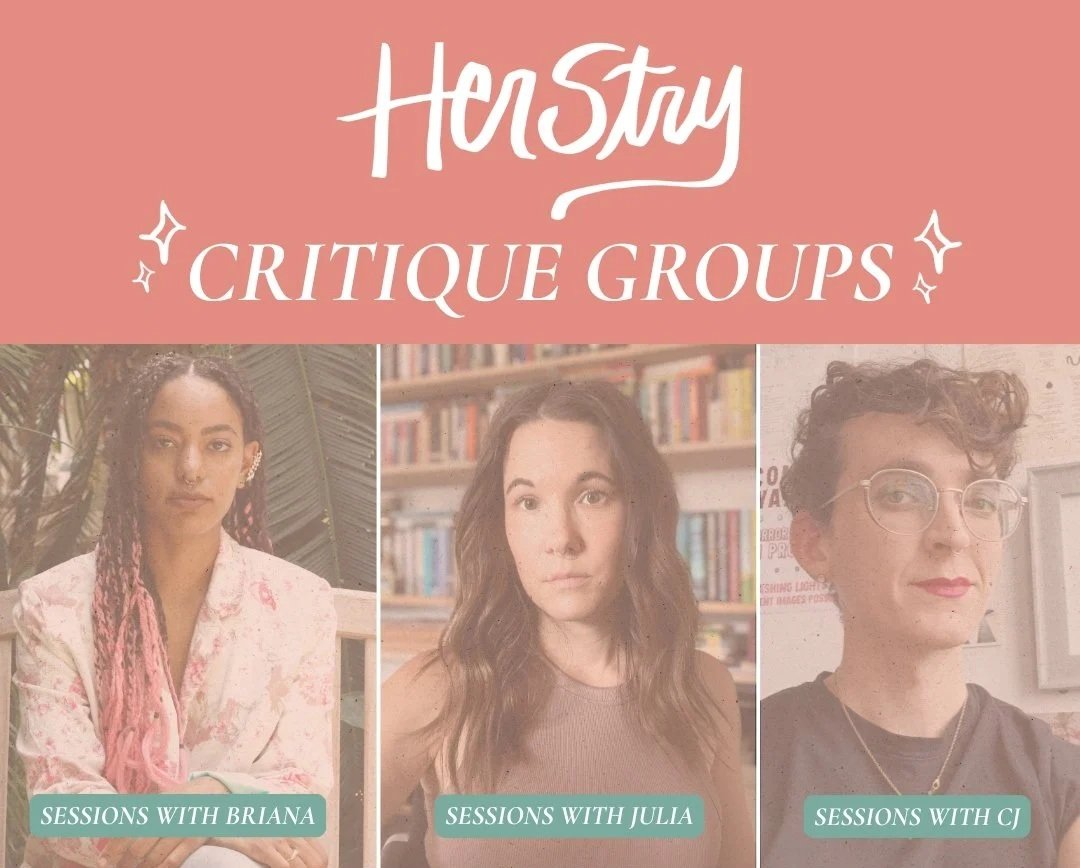
IT’S NO SECRET THAT FEEDBACK IS AN IMPORTANT PART OF THE WRITING PROCESS.
In fact, we argue that it might be the most important part of the process.
But it’s hard to find a writing community. It’s hard to find the people who are willing to take the time and the effort to read your work and give the feedback you really, truly deserves.
That’s where HerStry Critique Groups come in!
HerStry Critique Groups are small groups of 6 women who gather online for 6 weeks to share their writing, give constructive feedback and gain skills as writers.
Weekly online sessions last approximately ninety minutes, with three women sharing their work each week. Writers of all genres and levels are welcome and you may share both works of fiction and nonfiction.
Sessions take place on Mondays 7PM CT, Tuesdays 11AM CT, Fridays 11AM CT
WHAT’S INCLUDED IN THE HERSTRY CRITIQUE GROUPS?
Six 90 minute live workshop sessions
Three 20 minutes sessions in the “hot seat” to get you work critiqued
Written and verbal feedback from your fellow workshop participants
A weekly in depth edit and critique of your work from the group leader after each session
Weekly writing goals and accountability check ins
Full video recordings of each session to keep for your records
Say goodbye to the lonely, stuck in your head writing life!
LET’S WRITE!
From conception to submission. Let’s make summer sizzle with stories.
Writing a short story doesn’t happen in one session. It takes multiple drafts to get it exactly right, to create characters that come to life for the reader and a world they can’t stop thinking about. In this seven week course we will work on a single short story from conception to submission ready. The seven week session will include generative brainstorming sessions, short story craft talks, multiple workshops for feedback from fellow writers, and detailed line by line feedback and edits from your instructor. Plus, we’ll talk about submission venues, cover letters, and when to know if your story is ‘finished.’
IT’S NO SECRET THAT FEEDBACK IS AN IMPORTANT PART OF THE WRITING PROCESS.
In fact, we argue that it might be the most important part of the process.
But it’s hard to find a writing community. It’s hard to find the people who are willing to take the time and the effort to read your work and give the feedback you really, truly deserves.
That’s where HerStry Critique Groups come in!
HerStry Critique Groups are small groups of 6 women who gather online for 6 weeks to share their writing, give constructive feedback and gain skills as writers.
Weekly online sessions last approximately ninety minutes, with three women sharing their work each week. Writers of all genres and levels are welcome and you may share both works of fiction and nonfiction.
Sessions take place on Mondays 7PM CT, Tuesdays 11AM CT, Fridays 11AM CT
WHAT’S INCLUDED IN THE HERSTRY CRITIQUE GROUPS?
Six 90 minute live workshop sessions
Three 20 minutes sessions in the “hot seat” to get you work critiqued
Written and verbal feedback from your fellow workshop participants
A weekly in depth edit and critique of your work from the group leader after each session
Weekly writing goals and accountability check ins
Full video recordings of each session to keep for your records
Say goodbye to the lonely, stuck in your head writing life!
October 7, 14, 21, 28, November 4 and 18 CT
There is no class on November 11.
WRITING THE SEX SCENE.
Writing a sex scene can be delirious fun, a harrowing challenge, a literary milestone—possibly the most important part of building your short story or book. In our six weeks together, you’ll experience just about every possible emotion as you explore the erotic in different modes: comic, tender, harrowing, soul-shattering … because it really is all about the characters’ feelings, not just the mechanics. So we’ll talk about tone. Vocabulary. Metaphor. Sensory detail. How to get big emotions on the page … and when to pull back and let the reader’s imagination go to work.
This is a course for writers who want to explore the intersection between the novel and short stories, and would like to weave their short stories into a story cycle (or collection of "linked stories" or "composite novel"). This is also a class about the interaction of form and content, and how one influences the other. We will read works of interlinked stories by writers from diverse cultural and ethnic backgrounds, focusing on modern classics and contemporary practitioners of these hybrid forms. Weekly discussions will center on elements of craft, such as the expansion and compression of time, setting as an organizing and connecting principle, character development within and between stories, structure and plot for interconnected stories, and responding to literary influences in the same genre.
This six-week course guides writers through the literary submission process, offering insider insight and practical tools to help you get your work into the world. We’ll demystify everything from reading submission calls to writing cover letters and choosing the right journals. Along the way, we’ll workshop short bios, develop submission trackers, and build personalized plans that align with your voice and goals.
By the end of the course, you’ll walk away with a polished piece ready to send, a tailored submission list, and the confidence to navigate the lit mag world with clarity and purpose.
Ideal for writers of literary fiction, poetry, personal essay, memoir, and hybrid forms.
Josh and I sat in the waiting room, an office building with a view of the Manhattan skyline. I stared at the other women, wondering what they were getting done. I wondered how many of them were here not by choice. How many of them had never contemplated getting fake breasts before they learned they had breast cancer. I couldn’t have been the only one. But I was definitely the only pregnant woman getting a boob job in the crowd.