
Cowboy, Take Me Away
He’s never been there before, but my husband drives through Arizona like he’s a native. Our kids bicker in the backseat as he squints into the Southwestern sunshine.
The highway carves a groove into the hills. Forests of saguaro fade to arid plains. Endless interstate stretches through hours of tanned earth, unfurling at the feet of piney, snow-capped forests. Our rental car pushes higher and higher. We tug layers over jeans and t-shirts.
Three thousand feet. Four thousand. Five. Six. Seven.
By the time we reach the Grand Canyon, we’re speechless, reduced to grinning and snapping photos. We gape for hours, breathless. We shake our heads in frozen wonder. We’re frigid in the wind, but ecstatic.
“Can you believe this?”
“Have you ever seen anything like it?”
“Pictures just don’t do it justice!”
Awestruck and chilled to the bone, we drag ourselves back the way we came. First to Valle. Then Williams. Flagstaff. A stop in Sedona. By the time we arrive in Phoenix hours later, shedding layers of outerwear as the temperature climbs, I’m breathless. Maybe it's the thrill of travel, maybe it’s something more. Nausea drags me under as our car skates over enormous hills. Each descent makes my head throb. Anxious. Dizzy. Sleep-deprived from insomnia. Head pounding, I close my eyes and focus on breathing. When I open my eyes again, my husband glances between my face and the road. His brow furrows. I know this look.
“You’re going to the ER,” he announces.
There’s no room for arguing, not with an ER doctor like him. He’s a born diagnostician. A scientist’s mind, a surgeon’s hands, a pediatrician’s heart. He doesn’t second-guess himself about medicine.

LOVE
noun | \ lev : an intense feeling of deep affection; a great interest and pleasure in something.
LUST
noun | \ lest : very strong sexual desire.

I met you by the river the first time while the mist rose from the banks like it was trying to change elements. You were more fun to run from the cops with than anyone else I’d met, and man you made me reckless. I never had to test my legs though, the minivan did it for us while Jerry blasted through the blown speakers in the cornfield. You walked 2,000 miles up the country on trail and wrote me letters back home while I watched, sidelined. I could have walked myself from Georgia to Maine with you, but it was your own pilgrimage to undertake, your season spending nights under a green tarp.

Before she died, Nancy compiled a list of appropriate women she thought could be a good partner for me, which I told her was ridiculous. I was doing everything I could to keep her alive, nor did I like the women she had chosen for me. I had loved her for twenty-seven years. She would never be replaceable. My everything wasn’t enough; all I had of Nancy were her ashes. At sixty-one, I had vaulted into old age overnight, with grey roots grown inches during Nancy’s last months of hospice. I was the solo parent of two grieving teenage daughters, one who was depressed, the other defiant. My eros was exhausted, maybe dead even. But Nancy was not five months into her grave when I hooked up with Tami.

We had a tradition for birthdays: a call once it was midnight so that we’d be the first of everyone else to groggily whisper our well wishes for each other. It started as a promise from me that I’d do it every year for you, no matter what I was doing, who I was with, or how tired I was.

You listened to Joni Mitchell’s Blue while you were abroad. Some say an unhealthy amount, but you beg to differ. Something about the timbre of her voice resonates with traveling, long-distance train rides and loneliness. Because that’s what the feeling was, right? Loneliness?
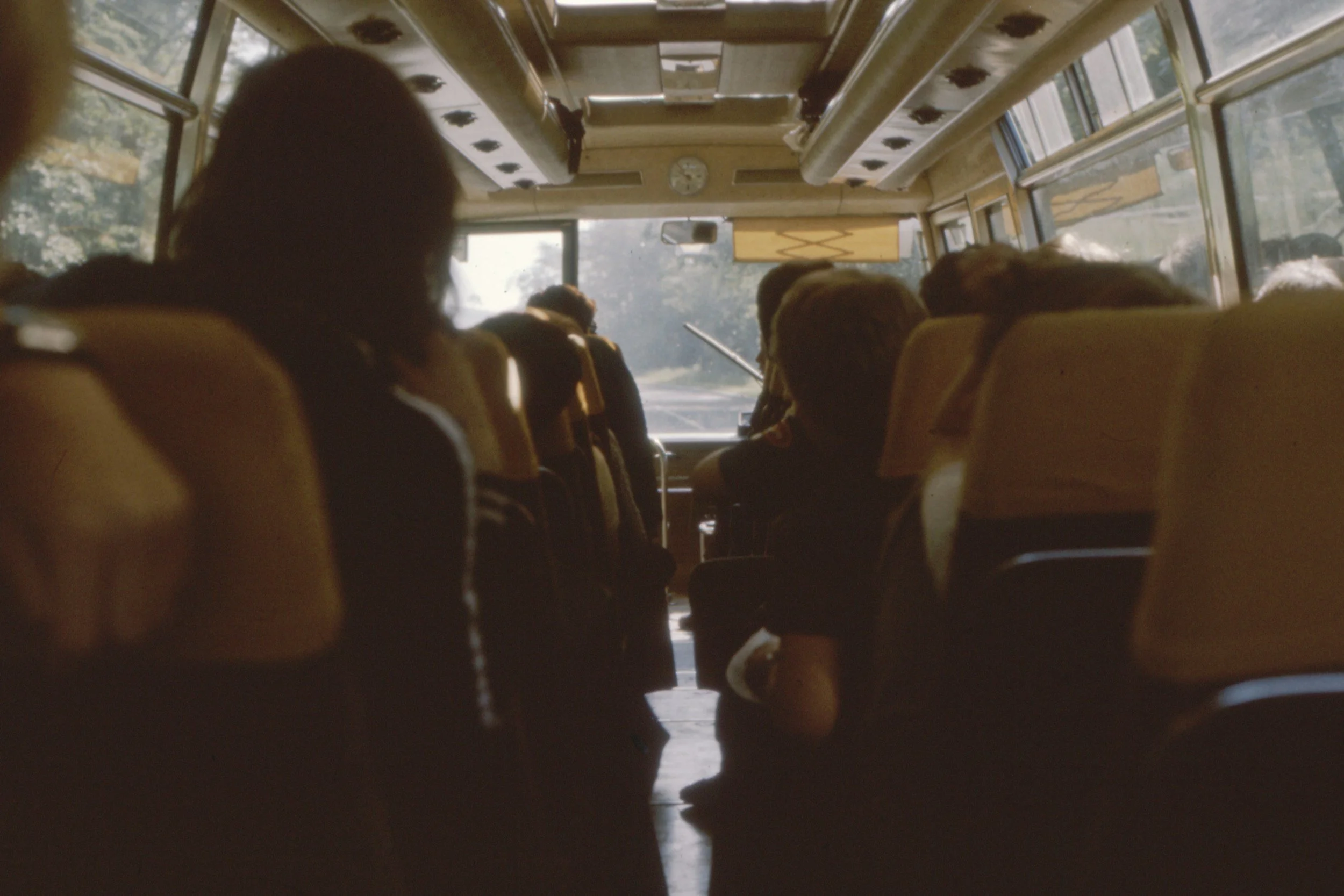
We stand together near the bus station, inhaling the smell of cow shit, watching miniature dust devils swirling around in the street like tiny tornados. Two hippie imposters, my boyfriend Don and I, wait for a Greyhound bus to take us from Stockton to Pasadena, California.

It was time for our one rehearsal, the day of my daughter’s wedding. A group of family and friends who had been practicing alone now gathered, anticipating the thrill of voices blending and harmonizing, woven together by the glistening thread that is my daughter’s life force. In the run-up to this event, all said, “Yes, we will sing…We are honored to sing…We are thrilled to be part of this special surprise,” a touching tribute to a father long dead. All coming together from different places, different times, different experiences, to fuse in song.

Sometimes I wonder why lovers hold hands when they walk around. I wonder how long they have been dating. Are they in that new stage, where it feels like they have to hold on tight, constantly let the other person know that they are there, that they aren’t going anywhere, that they want to touch them, that they want to be touched. Or is it the older couples, the ones who have been together for longer that hold hands. A gesture they don’t even realize they’re doing, their fingers just mindlessly reaching for each other, keeping their connection as they pace around the city.

The amygdala assigns emotional significance to clutter I can’t throw away. To souvenirs and books throughout our house. To clawhammers, backpacks, yard signs we hang on pegboards. To ordinary places we visit again and again. This precious tiny thing deep inside my head also helps form shiny new memories. I want to hold on to my amygdala for a long time. Keep it healthy and functioning. Feed it. Maintain it. That sort of thing.
I have the iron will, but he has the steel-trap mind and strong gut. He’s Mr. Steady, I am a living rollercoaster. He’s the strong, silent type, I’m the strong, noisy type.
“Cowboys,” other doctors call ER doctors, as if they’re reckless. But they’re not. Nothing like cowboys, except for their courage, their audacious calm despite chaos swirling around them. Pioneers dressed in white coats instead of spurs.

Years ago, my husband’s senior thesis stated, “There’s no running in the ER.” He graduated from an Emergency Medicine residency in Tampa. “Someone’s going to get hurt,” he said sensibly when he presented to his peers. Made of granite.
As he drove, I fought to keep the dizziness at bay. Even if I could force myself to argue with him despite the timpani drum beat of pain in my head, it wouldn’t matter; he was the one driving. My first stop inside an ER in fifteen years. I gulp at air and grit my teeth against the pain and crashing nausea.
I’m stuck, weighed, prodded, labeled, and deposited in a bed, still shaking and miserable under lights brighter than the surface of the sun. A cousin comes to rescue our kids. My husband sits next to my ER bed, eyes glued to me every time I glance at him. He holds my hand, glances at the monitors, bounces his knee impatiently. I know he wishes he was in charge. Wishes he could see the printouts and the labs and the EKG strips.
It’s hours before we know what’s happening.
“Just a bad case of altitude sickness,” the ER doctor finally says. “You need fluids. And meds. Decadron, Compazine, Benadryl.”
The pace of the trip, the fast climb was brutal. I melt with relieved tears and fall asleep under blazing fluorescents while medicine surges. Four sticks, tubes of blood, an I.V., two E.K.G.’s. Worry recedes like moisture on sand. My husband’s still holding my hand when I wake, very much alive and discharged.
“I gotcha,” he says. “I’ve got everything.”
He leads me outside by the hand. It’s dusk. I have no recollection of where we parked, but it’s okay. He knows where we’re going. He always has.
-Esty Loveing-Downes
This product gives you access to all four weeks of the workshop. Purchase one or more drop-in sessions here.
Build a habit in 20 sessions. In this 4 week workshop that meets Mondays through Fridays from 8:00-9:00 AM CST, we will focus on generating new writing—making headway on a current project, reviving an old project that’s been gathering dust, or writing based off of the daily prompts Leigh provides.
The first 45 minutes of class are a gentle, camera-off, silent writing session. The remaining 15 minutes are an opportunity to share excerpts of our work, reflect on progress made, and set intentions for the following day. Then we will read a passage together on the writing life and close each class with a new learning about habit formation. By the end of this course we’ll have a morning writing habit that is each our own to continue and build upon.
This listing is for an individual class. To purchase access for the full 4-week workshop, click here.
Build a habit in 20 sessions. In this 4 week workshop that meets Mondays through Fridays from 8:00-9:00 AM CST, we will focus on generating new writing—making headway on a current project, reviving an old project that’s been gathering dust, or writing based off of the daily prompts Leigh provides.
The first 45 minutes of class is a gentle, camera-off, silent writing session. The remaining 15 minutes are an opportunity to share excerpts of our work, reflect on progress made, and set intentions for the following day. Then we will read a passage together on the writing life and close each class with a new learning about habit formation. By the end of this course we’ll have a morning writing habit that is each our own to continue and build upon.
Many writers feel drawn to write about their lives but struggle with uncertainty: Why this story? Why now? And who is it really for? This workshop is designed to help writers move beyond doubt and toward clarity by focusing on the deeper meaning and purpose beneath their story.
In this interactive, craft-forward session, participants will be introduced to the Memoir Compass, a practical framework that helps writers articulate their motivation (why they are writing), mission (who the story serves), and message (what meaning or insight the story carries). Through guided reflection and writing exercises, participants will begin shaping a personal narrative rooted in intention rather than overwhelm.
This workshop is ideal for writers interested in memoir or personal narrative, as well as fiction writers drawing from lived experience, who want to move forward with greater confidence, focus, and direction.
Some of the most compelling creative nonfiction begins with the feelings we are tempted to avoid: anger, resentment, shame, fear, or the sense that we have an axe to grind. In this six-week workshop, writers will explore how to follow that emotional heat toward deeper, more honest work—without sacrificing compassion, complexity, or craft. Through close readings, writing exercises, discussion, and constructive feedback, we’ll consider how to transform strong feelings into writing that reaches beyond catharsis and connects with readers.
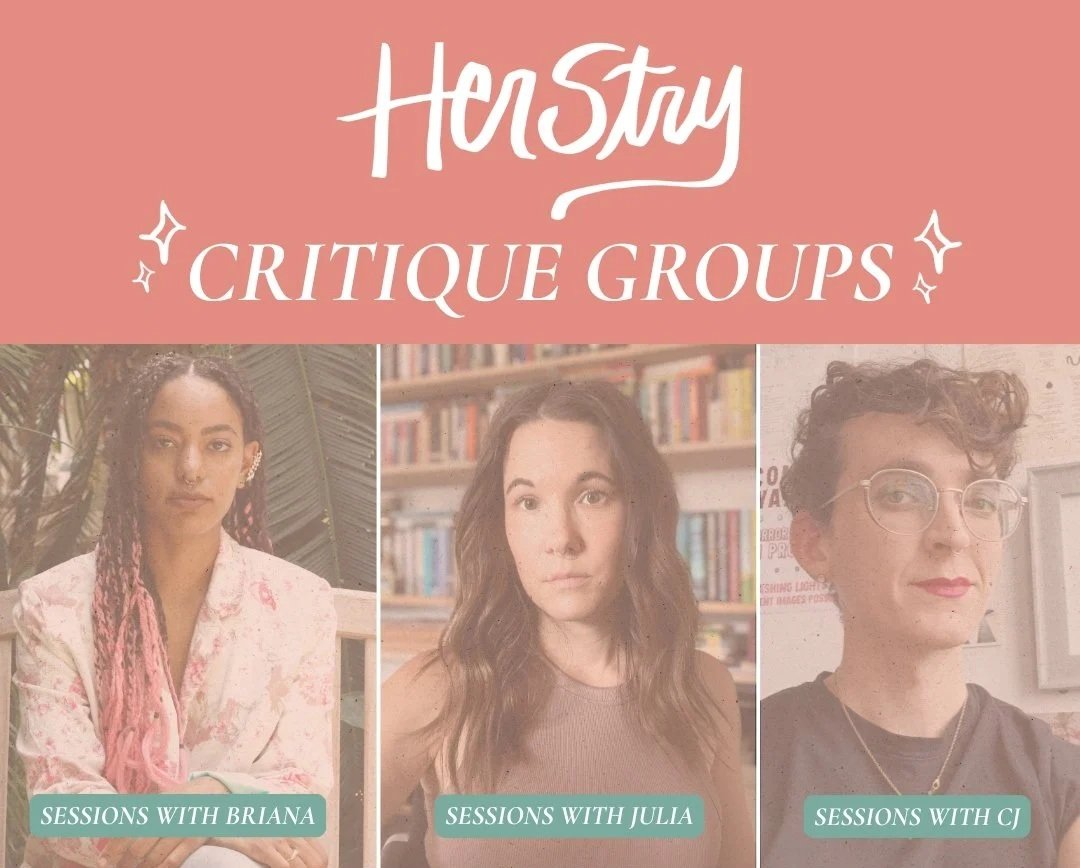
IT’S NO SECRET THAT FEEDBACK IS AN IMPORTANT PART OF THE WRITING PROCESS.
In fact, we argue that it might be the most important part of the process.
But it’s hard to find a writing community. It’s hard to find the people who are willing to take the time and the effort to read your work and give the feedback you really, truly deserves.
That’s where HerStry Critique Groups come in!
HerStry Critique Groups are small groups of 6 women who gather online for 6 weeks to share their writing, give constructive feedback and gain skills as writers.
Weekly online sessions last approximately ninety minutes, with three women sharing their work each week. Writers of all genres and levels are welcome and you may share both works of fiction and nonfiction.
Sessions take place on Mondays 7PM CT, Tuesdays 11AM CT, Fridays 11AM CT
WHAT’S INCLUDED IN THE HERSTRY CRITIQUE GROUPS?
Six 90 minute live workshop sessions
Three 20 minutes sessions in the “hot seat” to get you work critiqued
Written and verbal feedback from your fellow workshop participants
A weekly in depth edit and critique of your work from the group leader after each session
Weekly writing goals and accountability check ins
Full video recordings of each session to keep for your records
Say goodbye to the lonely, stuck in your head writing life!
LET’S WRITE!
From conception to submission. Let’s make summer sizzle with stories.
Writing a short story doesn’t happen in one session. It takes multiple drafts to get it exactly right, to create characters that come to life for the reader and a world they can’t stop thinking about. In this seven week course we will work on a single short story from conception to submission ready. The seven week session will include generative brainstorming sessions, short story craft talks, multiple workshops for feedback from fellow writers, and detailed line by line feedback and edits from your instructor. Plus, we’ll talk about submission venues, cover letters, and when to know if your story is ‘finished.’
IT’S NO SECRET THAT FEEDBACK IS AN IMPORTANT PART OF THE WRITING PROCESS.
In fact, we argue that it might be the most important part of the process.
But it’s hard to find a writing community. It’s hard to find the people who are willing to take the time and the effort to read your work and give the feedback you really, truly deserves.
That’s where HerStry Critique Groups come in!
HerStry Critique Groups are small groups of 6 women who gather online for 6 weeks to share their writing, give constructive feedback and gain skills as writers.
Weekly online sessions last approximately ninety minutes, with three women sharing their work each week. Writers of all genres and levels are welcome and you may share both works of fiction and nonfiction.
Sessions take place on Mondays 7PM CT, Tuesdays 11AM CT, Fridays 11AM CT
WHAT’S INCLUDED IN THE HERSTRY CRITIQUE GROUPS?
Six 90 minute live workshop sessions
Three 20 minutes sessions in the “hot seat” to get you work critiqued
Written and verbal feedback from your fellow workshop participants
A weekly in depth edit and critique of your work from the group leader after each session
Weekly writing goals and accountability check ins
Full video recordings of each session to keep for your records
Say goodbye to the lonely, stuck in your head writing life!
October 7, 14, 21, 28, November 4 and 18 CT
There is no class on November 11.
WRITING THE SEX SCENE.
Writing a sex scene can be delirious fun, a harrowing challenge, a literary milestone—possibly the most important part of building your short story or book. In our six weeks together, you’ll experience just about every possible emotion as you explore the erotic in different modes: comic, tender, harrowing, soul-shattering … because it really is all about the characters’ feelings, not just the mechanics. So we’ll talk about tone. Vocabulary. Metaphor. Sensory detail. How to get big emotions on the page … and when to pull back and let the reader’s imagination go to work.
This is a course for writers who want to explore the intersection between the novel and short stories, and would like to weave their short stories into a story cycle (or collection of "linked stories" or "composite novel"). This is also a class about the interaction of form and content, and how one influences the other. We will read works of interlinked stories by writers from diverse cultural and ethnic backgrounds, focusing on modern classics and contemporary practitioners of these hybrid forms. Weekly discussions will center on elements of craft, such as the expansion and compression of time, setting as an organizing and connecting principle, character development within and between stories, structure and plot for interconnected stories, and responding to literary influences in the same genre.
This six-week course guides writers through the literary submission process, offering insider insight and practical tools to help you get your work into the world. We’ll demystify everything from reading submission calls to writing cover letters and choosing the right journals. Along the way, we’ll workshop short bios, develop submission trackers, and build personalized plans that align with your voice and goals.
By the end of the course, you’ll walk away with a polished piece ready to send, a tailored submission list, and the confidence to navigate the lit mag world with clarity and purpose.
Ideal for writers of literary fiction, poetry, personal essay, memoir, and hybrid forms.

Esty Loveing-Downes (she/her) writes from Florida. Her words can be found in West Trestle Review, Shift: A Journal of Literary Oddities, Survivor Lit, and the Santa Clara Review, or on Twitter at @estywrites.
Dear Ezra,
I know we’ve never met…
And yet my hungry mind keeps feeding me
slow-burning images of you in your kitchen.