
Oreo
I do not remember the name of the first child, buck-toothed, big-eyed, who called me an Oreo—a racial slur meaning someone who is black on the outside; white on the inside. I do not remember the name of the second, either. I remember sticky summers in blistering Birmingham, Alabama, legs itching from the long, prickly grass and perpetual mosquito bites. I remember waiting for night fall, the symphonious synth-sounds of crickets, the steady flicker of lightning bugs. I remember sitting on the crumbling porch of Bunk’s house, alone. Distanced from cousins whose Bama dialect compelled them a unique kind of elide, swallowing the sharp point of R’s, so when they said (speaking of me) She talks like a white girl, it came out sounding like gull. I remember biting back tears, picturing myself; head of a girl, body of a seagull, grey wings flapping, soaring above the stifling Hooper City ghetto with its collection of shotgun houses in various stages of dilapidation, far, far away to AnywhereButHere, anywhere the colour of my skin wouldn’t define me.
There was truth in what they said, we did speak differently. My almost neutral North Carolina accent sounded as soft as the sand dunes on the Outer Banks, sparsely populated barrier islands, home to wild horses that frolic in the surf. Free from the heavy twang of a deep South drawl, I only sounded slightly Southern, peppering a few ‘y’alls’ and ‘’nems’ in my sentences. My cousins spoke with their full chest, borrowing the Southern ebonics and phrasing belonging to their city, to an entire Civil Rights movement. In Alabama, it feels like if you’re going to be Black, you need to talk Black—an extremely confusing realization to 10-year-old me.
I listened as my parents slipped back into Alabama drawl, how they seemed to be able to pick it up, toss it over their shoulders like a shawl. My mother was the most overt. You could tell just by the sound of her voice when she was talking on the telephone if she was speaking to someone from Alabama, a sister, her brother or mother or not. Her voice relaxed, her syllables slipped. And in person, in Alabama surrounded by her family, she was loud and bubbly. Responding to her nickname, Pig, hustling around the house, looking after her brother, her favourite aunt, blind from birth, using phrases I’d never heard her utter in North Carolina. Going to the grocery store and coming back with poor, Black delicacies: Zeigler’s souse meat and jars of Duke’s mayo and crinkly bags of Golden Flake potato chips. She’d sit on the porch or in the grass outside with her sisters and cousins in dirty, plastic deck chairs, rolled up newspaper for swatting bugs and she’d relax into her accent. She didn’t call me by my name in Alabama, instead she called me child, but in that gentle southern way, the D swapped for an E so that it rhymed with Nile. And it sounded like a cool breeze. I liked being Chile, liked her with her Alabama voice, how laidback her family made her.
Away from the safety net of the historically Black neighbourhoods my parents grew up in, life was different. In North Carolina, on many occasions, our family was the only Black family in our social circles. At my mother’s work, the predominantly white private Christian school I attended, there were three Black teachers. My mother and Mrs Miller, the fourth grade teacher, also from somewhere in the South, raising her two children as a single mother. And Mr Harris, a tall Black man from Shreveport, Louisiana who taught history. The school also had an unbalanced ratio of Black to white students. The handful or so of us students with melanin experienced a subtler, more Christian type of racism—being overlooked by a staff who professed not to see colour. Which meant, they didn’t see us. To be seen meant to adapt white personality traits, to talk like our white classmates and teachers, to be interested in the same music, movies and hobbies. To not see colour meant they wouldn’t see me or my culture. To be seen, I did indeed have to talk like a white girl. To be accepted, I had to be as much of a white girl as possible.
Eking out an identity in predominantly white spaces wasn’t new territory in my Christian high school. Even before I could articulate it or understand the complex nuances of what being Black meant, I knew I was different. As a child, I’d spend hours of the day wandering around the house, playing make-believe games. My favourite? Little White Girl. In which I did all of the activities I’d normally do but with a hand towel fastened to my head with rubber hands or headbands, giving me a curtain of hair like a white girl. Hair that moved when the head it was attached to turned. Hair that didn’t require the suffocating smells of chemical perms meant to straighten the natural kinks and coils into white-accepted submission. Hair that didn’t require me to stay statue still from the age of 6, fingers folding my ears down flat against my skull and praying not to be burned by the metal comb my mother heated on the stove burner until it was red hot then raked through tiny baby hairs at the nape of my neck. Over the years, I had countless burns from torturing myself with barbaric beauty treatments to make my natural kinky coils more palatable to white eyes. Small c-shaped burns along the cartilage of my ears from curling wands, the sizzle and pop of raw skin instantly melting under the heat of a flat iron or that time, in the salon chair, when the stylist, whilst chatting animatedly with women in the shop, let the curling iron slip from his hands and burned 80% of my right cheek. At least the chemical burns left on my scalp from the relaxers weren’t visible, even if they did hurt just as much. I envied the brush-and-go haircare routine of the white girls in my school. Stared in awe at the white women who arrived at school each morning, their hair still wet from the shower, looking like they’d been caught in a storm. It amazed me how, within an hour, their hair would dry and be full of volume. I dreaded getting my hair washed, the hours spent in the salon, the heat of the overhead hair dryer blistering the back of my neck. The time and money spent, the risk of putting ourselves in danger of extreme temperatures to force our hair to relax, flow like a white girl’s, not a kink or coil in sight.
Many years later when I decided to eschew white beauty standards and stop chemically straightening my hair and to ‘go natural’, more than just overly-processed hair fell to the floor of the salon where I had my Big Chop. I let go of years of contorting to align with the white gaze.
When I moved in with a man for the first time, I was terrified of being too Black. For the first few years, I was too embarrassed to Doobie wrap my relaxed hair, swirling the chemically straightened locks around my head followed by a mesh wrap with velcro closure and a silk scarf bought for pennies from a consignment shop. It was a routine I’d perfected since college and it meant my hair had grown healthy, finally and was, without too much intervention from me, relaxed and yielding to the white standards I wanted to adhere to. You can’t wrap your hair in front of him, I argued with myself, he’s not going to understand what a head scarf is. He’ll never have seen that before. It’ll freak him out. Convinced by my own self sabotage, I went to bed night after night, resting my head on cotton pillowcases, the pilling from the fabric twisting around my hair, drying the ends, pulling it out at the root. Still, it was better to look like I had alopecia than risk the cultural unpacking and explanation that would come with getting my silk scarf out and protecting my hair.
Being like a white girl leaked into every aspect of my life. Like trying in vain to fit my thiccc body with its afro build (fuller tits, big booty) into the slim-fit fashions on the pages of my mail-order Allure and Delia*s magazines — sizing which stopped at XL, by the way. I’d spend hours pouring over the pages, staring at the models with their thin arms, smiling wide under khaki bucket hats, in cropped shirts revealing their tiny flat stomachs and dimple belly buttons. Even the few models with brown skin didn’t look like me. They were slim size 0s or size 2s and biracial which meant they had white girl hair: acceptable curls that grew long and flowy and didn’t require a Just For Me Kids box perm. I felt defeated, lonely. I couldn’t find one person who looked like me: a slightly chubby dark-skinned black girl with glasses and braces, therefore I thought there was something wrong with the way I looked.
Trying to assimilate as a white girl meant trips to the mall, loitering in Limited Too, disheartened when none of the clothes fit my curvy frame, but desperate to own something from the shop, so settling for cheap jewelry which would irritate my nickel allergy, causing my neck to develop a rash that would crack and bleed. It also meant buying buckets of the Bath and Body Works cucumber melon shower gel and the pink fuzzy loofahs sold in wicker baskets next to the display. Loofahs, which, as explained to me by my mother one day in a confusing mix of anger and exasperation, were intended for white folks— I should use wash cloths to be sure I’d get clean. I loved the way loofahs foamed the soap, making big TV commercial bubbles that I just couldn’t replicate with a terry towel, no matter how much soap I used. It didn’t occur to me that our skin would require different cleansing tools. I knew about the extra oils we produced and there was my parents’ obsession with my neck.
There was no greater faux pas than leaving a ring of dirt around the collar of the white Oxford shirts I was forced to wear as part of my school uniform. The fact that my neck, collector of all the oils, greases and balms put in my hair on a daily basis that slid from my dry scalp, was perpetually ‘dirty’ irritated my parents to no end. They’d chide me into the bathroom, standing before the sink with a wash cloth laden with rubbing alcohol and would scrub the skin on my neck, desperately trying to lighten it. Once scrubbed raw, they’d turn the wash cloth over for me to inspect. See? they’d say, so I could see the streaks of brown dirt on the once-white towel. You have to be clean, Jenea. I didn’t learn about epithelial cells until many years later, in my early 30s, when I realized that it wasn’t dirt on the towel; I wasn’t unclean.
I never learned how to love my black body growing up. I never learned how to embrace it. How to look at the landscape of cocoa colored skin and delight in it. I don’t know the particular history of my ancestors, I know some were slaves in Alabama. That fact and the concept of generational trauma are enough for me to understand that my hesitation at embracing my melanin is deep-seated. It is a ballad of love and hatred, hidden within my bones. It is the very thing that inured my ancestors to abuse and unimaginable hardship. It is the very thing that has made my life difficult, though nowhere near as extreme as slavery. It is often one of the first things people notice about me when I walk in a room or join a Teams call for work.
In 2008, when I first emigrated to the United Kingdom, it was the differentiator between me and the three white students I travelled with. As rain fell quietly outside, soaking into gaps in the cobblestone road, we waited in the reception of what would be our accommodation for the next 6 months. Huddled together from the January cold, jet-lagged and excited, we took it all in. The quaint shoebox of an office with its steamed up glass. The cars cruising by on the bridge just overhead, their wipers squeakily clearing the windshield briefly before being dappled again with a smattering of raindrops. He, the porter at reception, rummaged for keys in brown pay packet envelopes and a worn clipboard with funny skinny paper on it, our names printed with a dotted line for us to sign to say we’d checked in. All keys except mine were accounted for. Just a moment, love, he called to me through the window. Then a moment later, whilst on the phone: Yes, that’s right; I’m looking for the keys for the coloured girl. Everything stopped. It felt like there’d been a sonic boom and all sound and air and surroundings were sucked away. It was just me, suspended on some astral plane, with those words teasing and taunting, dancing around in my brain: coloured girl, coloured girl, coloured girl, nanner nanner nanner.
I don’t remember when I first began to fall in love with my Blackness. I don’t remember when I stopped feeling anxious and panicked in every scenario: afraid that the white people would ostracize me for not being white; afraid that the Black people would ostracize me for not being black enough. I don’t remember when I started to crave the words of James Baldwin, when his essays knocked the wind out of me, made me cry in defiance and frustration. I don’t remember when I lost myself and found myself in Audre Lorde’s work, or when I first felt that twang of belonging listening to Nina Simone, Billie Holliday or Earths Kitt warbling—captivating, eerie and beautiful. I don’t remember when it felt safe to be the kind of Black girl that I am: one who wears her hair natural, who slathers smudges of fragrant cocoa butter over her skin, who twists her hair in bantu knots held together with hemp hair grease and who sleeps in a silk bonnet every night, no matter whom I’m sharing my bed with. One who vacillates freely and comfortably from Miles Davis’s soulful trumpet to the lyrical genius of Tupac to the Cockney accented, soulful Amy Winehouse. One who feels at home serving heaping piles of buttery grits and homemade biscuits to my English boyfriend for breakfast and also enjoying some Caucasian delicacies, under seasoned though they may be. One who understands that we can simultaneously be both a product of our ethnicity and a product of our environments and the fact that they may be contradictions of each other makes them all the more endearing.
-Anyonita Green
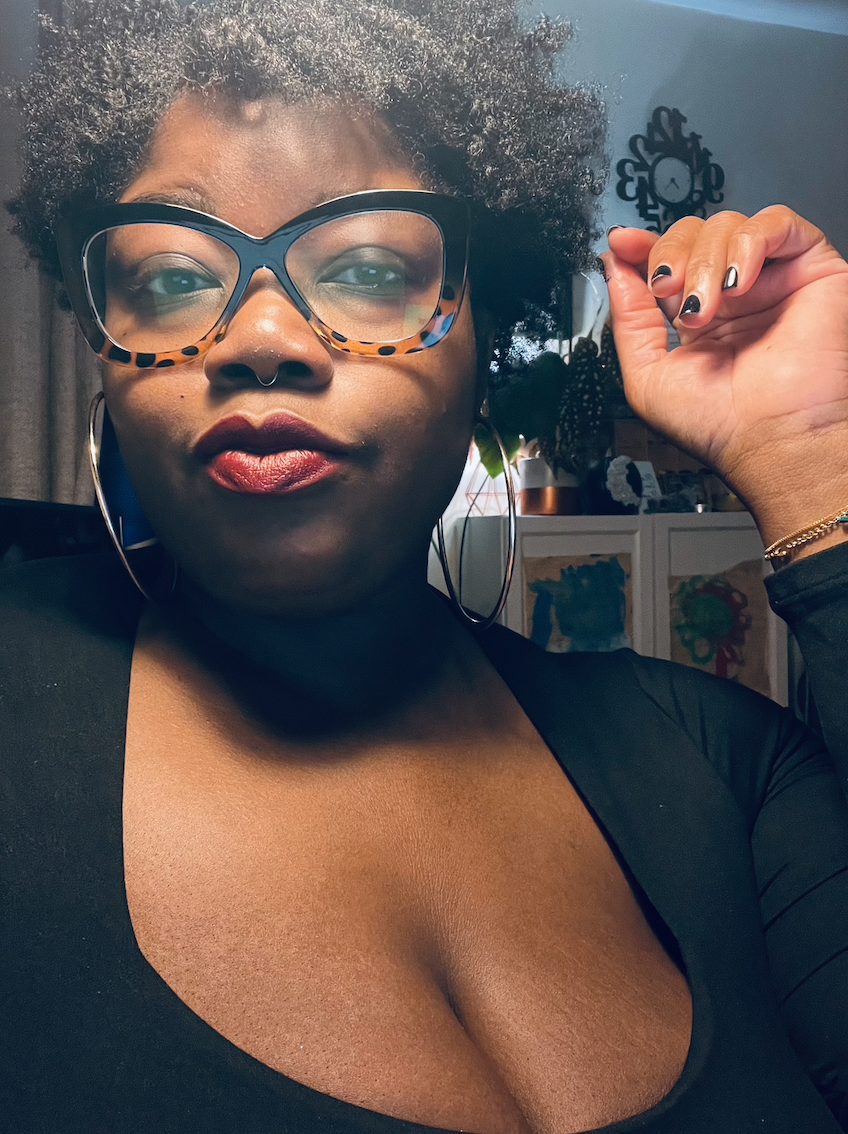
Anyonita Green is an American immigrant living in Manchester, England. She has an MA in poetry from MMU and enjoys writing confessionalist poetry and essays. Her work has appeared in Rainy City Stories and Propel Magazine.