
We Didn't Have a Word for Fun
In the Dalmatian hinterland village where I was born, there was no word for "fun." There were words for work. For bread. For grit. For silence. There were even words for hunger and sorrow. But not for joy without purpose.
There was a word—zabava—that meant celebration or festivity. But that was for weddings, saint’s days, or church holidays. You didn’t say, “I’m going out to have fun.” That sounded indulgent. Maybe even shameful.
Men played, yes. In the afternoons, after the work was done, they’d head to the tavern and play games like šijavica, a fast-paced, hand-pounding contest of numbers and reflexes. No women watched. It was for men only, a place where laughter cracked open the day’s silence. Over shots of rakija, they’d slap the table, laugh until their bellies hurt, and lean back in their chairs like kings. They didn’t call it fun. They didn’t call it anything. It was enough to be there—hands moving, voices rising, the world narrowed down to the game and the breath between slaps.
The women stayed home. Their hands were full—children, bread dough, boiling water, tobacco leaves stitched to twine. They kept the inner circle: the hearth, the slow-turning wheel of survival. If they sang, it was while their fingers worked. If they rested, it was while stirring a pot, patching a shirt, stitching a wound. Their immersion was not a pursuit of pleasure. It was a falling-in, a narrowing born of need.
There was no room for “play.”
Decades and continents away, my women’s group teacher in California said, “Let’s do a ninety-day fun challenge.” The words dropped into me like a stone.
“Fun?” I asked. The word felt foreign in my mouth, like a phrase from a language I was supposed to know but didn’t. My voice caught—tight, unsure—and I felt a flicker of shame. Why was I, a grown woman, asking what fun meant? My body didn’t know the shape of the word. That’s what unsettled me most.
“Yes,” she said. “One thing a day. Something that brings you joy, happiness. Not something you already love. Not something productive. Something new. Something playful.”
I laughed. Then I resisted. A week passed. Then two. I kept meaning to start, but the days filled up—emails, errands, obligations. The idea sat there like an unopened letter.
When I didn’t do it, I offered excuses. “I was at a writing conference,” I said. “I was too busy.”
She smiled gently. “Maybe you don’t think you deserve it.”
Her words wrenched something loose in me—an old shame I already carried. How could I deserve this? It felt selfish even to ask. She was right. It wasn’t about time. It was about permission. About worth. About how deeply I’d been shaped by the belief that pleasure must be earned—that joy is the last thing, only allowed if everything else is done.
Still, I agreed to try. Quietly. Cautiously.
The first day, I listened to a piece of music a friend once had played for me—Stephen Halpern’s “Mindful Music for ADHD,” a gentle, ambient composition with subliminal affirmations buried beneath the tones. I don’t have ADHD, but I remembered how it had calmed me years ago, and I was curious what it might do now.
It was designed for focus, but I wasn’t using it to get anything done. I wasn’t multitasking or organizing or responding to emails. I just… listened. And something shifted—so softly I almost missed it. A looseness in my chest, a breath I didn’t know I was holding. I sat still, let the music move through me. After twenty minutes, I wrote one line in my journal: It felt like the breath of a lake at dusk.
That was my first fun thing.
The next day, I walked into the woods and gave myself a simple assignment: gather five leaves that spoke to me. That was all. When I got home, I laid them in a circle on the table—one was spotted, one translucent, one curled like a sleeping child. I stared at them for ten minutes. I couldn’t explain why, but they made me feel peaceful. As if something inside me had paused.
On the third day, I blew bubbles in the backyard. Real ones—not the push-button kind you see now, but the old-fashioned wand dipped in liquid, blown softly with breath. The first one burst in my face and made me laugh. The second floated toward the neighbor’s yard like a secret. That laughter startled me. It felt like something small but holy had returned—something I hadn’t felt since childhood. A lightness. A kind of innocence I didn’t realize I’d misplaced, buried beneath years of purpose and proving
And then I started making nature mandalas. Camellias from my yard—some tight and secretive, others loose and ruffled—became the centerpieces. I ringed them with acorns and leaves. I didn’t take pictures. I didn’t share them. I just let the wind scatter them when it came. They were for no one. Not even me, really. Just for the moment itself. As a former Montessori teacher, I thought of the way we guided children to arrange objects, not to impress but to self-soothe. That’s what I was doing—without realizing it. I was regulating my own joy.
Each activity began with resistance. And each one left me softer. Less guarded. More open. Not euphoric—just real. I was touching something I hadn’t touched in a long time. A part of myself I hadn’t spoken to.
I realized then: I hadn’t just been resisting fun. I’d been resisting myself.
There’s a line in Christian theology: kenosis—to empty oneself. But what if emptying doesn’t mean depletion? What if it means making space to be filled again? Not with more tasks, but with something that replenishes us.
Maybe that’s what fun really is: a seam. A crack in the hardened structure of our days. A place where light enters.
And maybe that’s love. Not the romantic kind, though I love those stories too. But the kind of love we extend to ourselves when we believe we are worthy of joy for no reason. No product. No purpose. Just because we’re alive.
In my language, there’s zabavit se—which loosely means to amuse oneself. But even that carries a shade of apology. It suggests keeping oneself pleasantly occupied, yes, but also hints at indulgence. When someone asks zabavljaš li se?—are you having fun?—the question can feel edged, intimate, not quite innocent.
Growing up Catholic, I learned early that even mild self-focus could carry moral weight. Pleasure was something to approach carefully, sideways, as if too much ease might slip into something improper. The word itself seemed to hesitate in the mouth. Not forbidden. But not free.
I don’t know if there’s a word that fully captures what I’m learning now in midlife: that joy, chosen and unmeasured, is not childish. It’s not frivolous. It’s a portal.
To return to that part of us—the girl who once picked flowers without needing a reason, the boy who skipped rocks just to watch them dance—we must be willing to look foolish. To blow bubbles. To walk in the woods and pick five leaves. To make art out of petals and let the wind undo it. Petals dancing on the wind became my moment of focus, just as the šijavica hands slapped the table in rhythm—a small, defiant wonder in a world that doesn't always make space for it.
I didn’t keep a list of what all ninety days held. But I remember moments: a dance in the kitchen while dinner simmered. A new tea—oolong with dried rose petals—that smelled like spring. A stone I picked up on a walk and carried in my pocket all day. Nothing spectacular.
Each act of unproductive joy opened a door. And on the other side, there I was. The part of me that has waited quietly, patiently, to be invited back in.
-Maria B. Olujic
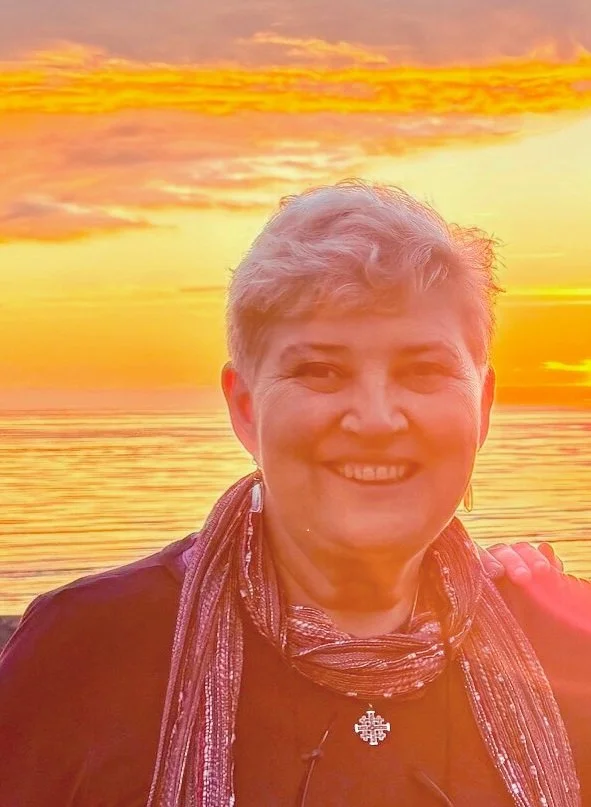
Maria B. Olujic, Ph.D. is an anthropologist and writer. Born in the former Yugoslavia under communism, she immigrated to the U.S. as a child and later returned to serve as Deputy Minister of Science and Technology in wartime Croatia. Her writing examines gendered violence, inherited silence, and the stories held in land and language. Her work has appeared in AGNI, Public Seminar, Brevity, 100 Word Story, Dorothy Parker’s Ashes, and elsewhere. Her memoir, Fields of Lavender, Rivers of Fire: A Memoir of War, Womanhood, and Bearing Witness, is under editorial review.
Dear Ezra,
I know we’ve never met…
And yet my hungry mind keeps feeding me
slow-burning images of you in your kitchen.