
Dear Younger Me,
I’m not that old, only 24…but I’m old enough to want to talk to you and tell you everything I’ve learned so that maybe you can feel better about who you are.
I wanted to start by telling you that I know you’ve had a mature understanding of life since you were born and from this intellectual prowess sprung some unexpected problems. Let me rephrase that: nothing about your personality and capabilities caused problems but, perhaps you did make your childhood and teenage years a little more difficult than they needed to be.
Everything that happened to you was the most important thing in your life whether it was a boyfriend when you were 13, or if you had a test, or if you and your friend had a falling out, or if you made a new best friend every year and every best friend moved. EVERY. SINGLE. YEAR. I’m here to tell you that your problems aren’t important. They seem important to you because you don’t know what beautiful things and people and places are out there in the world. You just see what’s in front of you. That’s okay, as you physically get larger your world will get larger too and you’ll be able to look past your mother’s leg.
I don’t know what exactly makes you grow up. It could have been when you learned that “All Things Must Pass” I know from that moment when there was a bad time you would close your eyes and wait until it was over. If it was a good time you’d hold onto the moment as long as possible not knowing if something so wonderful would happen again. Maybe you started to grow up when you realized that people were taking advantage of you and that you had given out all the time and energy you could spare. Maybe you started growing up recently when you became aware of some of your value and would not forgive those who stepped over you. If growing up were so easy to pinpoint I’m sure that someone would have found a way to stop it already.


LOVE
noun | \ lev : an intense feeling of deep affection; a great interest and pleasure in something.
LUST
noun | \ lest : very strong sexual desire.
I attended AWP for the first time this year. In my memory now, it is a fluorescent lit blur of searching for faces I recognize, of endless flyers and stacks of books and a lanyard around my neck. And the men. I can’t stop thinking about the men.

One of the reasons I love children's books is that there's always an invitation to loosen and lighten up, be poured into, be lulled into a place of deeper reflection—to see yourself in mid-grapple. For that reason, happy to be nappy is much more than a children's story.

I study myself in the mirror. The same glass in the square wooden frame that has stared back at me ever since I was tall enough to see over the top of the dresser. I concentrate on the small round bumps barely rising from my chest. I call them “my breasts.” “Boobs” sounds like the noise my brother Kenny makes when he imitates drums. “Bust” sounds violent. “Titties” sound silly. I’m not sure about “chest,” the word could belong to a man or a woman. I choose to think of them as “my breasts.”

My birthday is December 30, five days after Jesus’s and one day before New Year’s Eve. It is the perfect day to be born if, like me, you prefer your birthday slide by unnoticed. I never had to bring any classroom cupcakes. Not a single black streamer hung from my office door on my fortieth, which suited me just fine.

It is the wettest, coldest winter you can have without the gift of any snow. We slog through one rainy day after another. My husband is working late, and I know I will crash into bed before he gets home. That means that only conversations I will have today are with people who call me “mom.” I am swallowed up in momming. As I trudge upstairs with another bowl of cereal, and a towel to clean up the first bowl my son knocked over in anger that it was “too milky”, I recall a time when I didn’t feel like a mom at all.

I sat in Taylor’s chair in the high-ceilinged hair salon on Madison Avenue, watching all the wealthy Upper East Siders, as they rested their five-figure handbags on velvet stools like beloved pets. My newfound sense of mortality had no place in this land of excess. This was the room T.S. Eliot must have been referring to when he spoke about the “women [who] come and go/ Talking of Michelangelo.”

Dear Catherine,
You are a girl. You’re proud of that. You’ve always loved attention, whether your modesty shows or not. You love showing off your talents, presenting yourself well, feeling beautiful, and having friends and family around to support you. As you get older, you will find things start to change.

The Kingdom Hall was my second home. Sometimes, when my parents’ screaming wouldn’t quiet, it was my first.
I’d run in. The smell of pine trees would greet me. Smiling faces surrounded me, kind hands reached out to me. I never wanted to leave.
In your case growing up was good because your perception grew into your brain. You’ll miss being a child, you’ll look back on how silly all your worrying was and all the fun things you truly can only enjoy before you become jaded. Trick-or-Treating. Christmas. Trips to the farm. The list goes on. I’ll tell you what you don’t miss: the extra acid from worrying or the knots from bouts of social anxiety. I promise you will be able to walk into a room where you’re not supposed to know anyone, bump into someone from your past, admit you have no idea who they are and be instantly forgiven. When other people grow up they’re more forgiving and now finally in the same league as you. It only took 20 years for them to catch up. You’ll also find in these newly formed adults, some helping hands and some bended ears. No longer will you have to bear one sided friendships and conversations. You won’t have to worry about how you look or what people think of you. You have a good heart and a solid mind and as long as you’re yourself you’ll be able to tackle the toughest of problems.
So please worry less. Have fun if you can and don’t worry, things will start to be okay when you grow up.
With this knowledge, don’t rush to adulthood- it will come soon enough.
I love you dearly and preciously,
Your Older Self.
This product gives you access to all four weeks of the workshop. Purchase one or more drop-in sessions here.
Build a habit in 20 sessions. In this 4 week workshop that meets Mondays through Fridays from 8:00-9:00 AM CST, we will focus on generating new writing—making headway on a current project, reviving an old project that’s been gathering dust, or writing based off of the daily prompts Leigh provides.
The first 45 minutes of class are a gentle, camera-off, silent writing session. The remaining 15 minutes are an opportunity to share excerpts of our work, reflect on progress made, and set intentions for the following day. Then we will read a passage together on the writing life and close each class with a new learning about habit formation. By the end of this course we’ll have a morning writing habit that is each our own to continue and build upon.
This listing is for an individual class. To purchase access for the full 4-week workshop, click here.
Build a habit in 20 sessions. In this 4 week workshop that meets Mondays through Fridays from 8:00-9:00 AM CST, we will focus on generating new writing—making headway on a current project, reviving an old project that’s been gathering dust, or writing based off of the daily prompts Leigh provides.
The first 45 minutes of class is a gentle, camera-off, silent writing session. The remaining 15 minutes are an opportunity to share excerpts of our work, reflect on progress made, and set intentions for the following day. Then we will read a passage together on the writing life and close each class with a new learning about habit formation. By the end of this course we’ll have a morning writing habit that is each our own to continue and build upon.
Many writers feel drawn to write about their lives but struggle with uncertainty: Why this story? Why now? And who is it really for? This workshop is designed to help writers move beyond doubt and toward clarity by focusing on the deeper meaning and purpose beneath their story.
In this interactive, craft-forward session, participants will be introduced to the Memoir Compass, a practical framework that helps writers articulate their motivation (why they are writing), mission (who the story serves), and message (what meaning or insight the story carries). Through guided reflection and writing exercises, participants will begin shaping a personal narrative rooted in intention rather than overwhelm.
This workshop is ideal for writers interested in memoir or personal narrative, as well as fiction writers drawing from lived experience, who want to move forward with greater confidence, focus, and direction.
Some of the most compelling creative nonfiction begins with the feelings we are tempted to avoid: anger, resentment, shame, fear, or the sense that we have an axe to grind. In this six-week workshop, writers will explore how to follow that emotional heat toward deeper, more honest work—without sacrificing compassion, complexity, or craft. Through close readings, writing exercises, discussion, and constructive feedback, we’ll consider how to transform strong feelings into writing that reaches beyond catharsis and connects with readers.
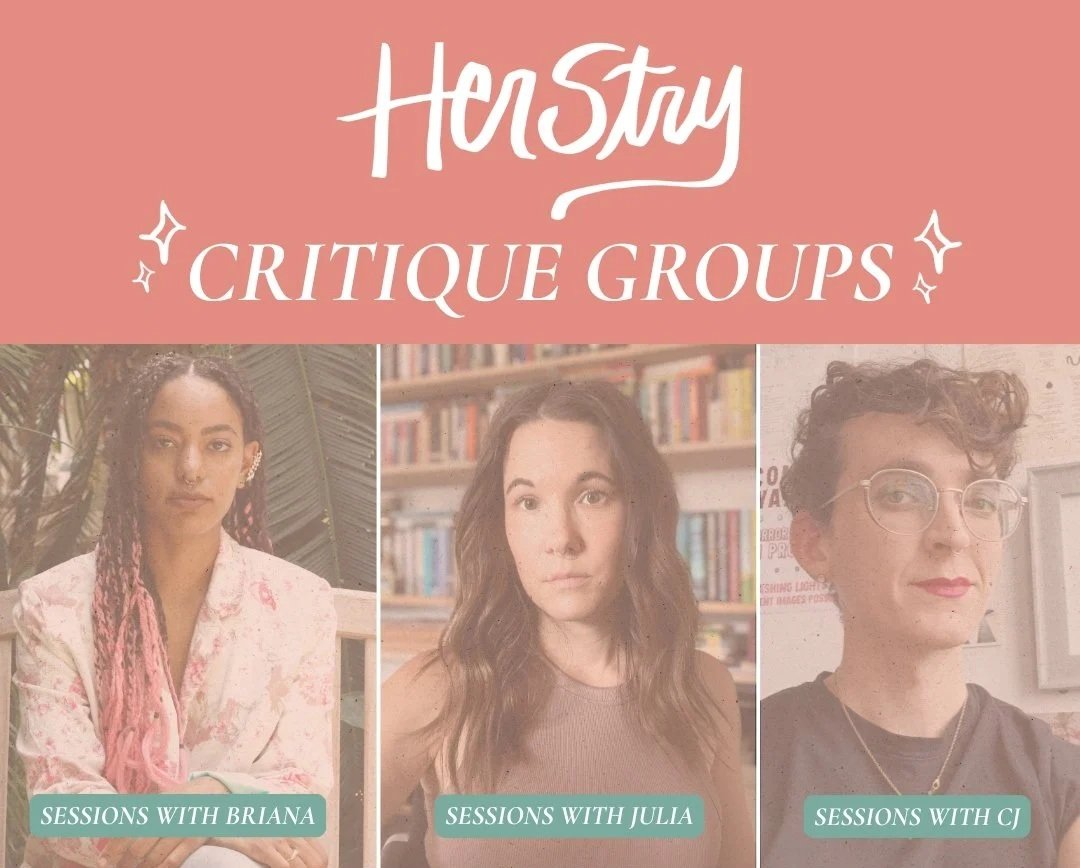
IT’S NO SECRET THAT FEEDBACK IS AN IMPORTANT PART OF THE WRITING PROCESS.
In fact, we argue that it might be the most important part of the process.
But it’s hard to find a writing community. It’s hard to find the people who are willing to take the time and the effort to read your work and give the feedback you really, truly deserves.
That’s where HerStry Critique Groups come in!
HerStry Critique Groups are small groups of 6 women who gather online for 6 weeks to share their writing, give constructive feedback and gain skills as writers.
Weekly online sessions last approximately ninety minutes, with three women sharing their work each week. Writers of all genres and levels are welcome and you may share both works of fiction and nonfiction.
Sessions take place on Mondays 7PM CT, Tuesdays 11AM CT, Fridays 11AM CT
WHAT’S INCLUDED IN THE HERSTRY CRITIQUE GROUPS?
Six 90 minute live workshop sessions
Three 20 minutes sessions in the “hot seat” to get you work critiqued
Written and verbal feedback from your fellow workshop participants
A weekly in depth edit and critique of your work from the group leader after each session
Weekly writing goals and accountability check ins
Full video recordings of each session to keep for your records
Say goodbye to the lonely, stuck in your head writing life!
LET’S WRITE!
From conception to submission. Let’s make summer sizzle with stories.
Writing a short story doesn’t happen in one session. It takes multiple drafts to get it exactly right, to create characters that come to life for the reader and a world they can’t stop thinking about. In this seven week course we will work on a single short story from conception to submission ready. The seven week session will include generative brainstorming sessions, short story craft talks, multiple workshops for feedback from fellow writers, and detailed line by line feedback and edits from your instructor. Plus, we’ll talk about submission venues, cover letters, and when to know if your story is ‘finished.’
IT’S NO SECRET THAT FEEDBACK IS AN IMPORTANT PART OF THE WRITING PROCESS.
In fact, we argue that it might be the most important part of the process.
But it’s hard to find a writing community. It’s hard to find the people who are willing to take the time and the effort to read your work and give the feedback you really, truly deserves.
That’s where HerStry Critique Groups come in!
HerStry Critique Groups are small groups of 6 women who gather online for 6 weeks to share their writing, give constructive feedback and gain skills as writers.
Weekly online sessions last approximately ninety minutes, with three women sharing their work each week. Writers of all genres and levels are welcome and you may share both works of fiction and nonfiction.
Sessions take place on Mondays 7PM CT, Tuesdays 11AM CT, Fridays 11AM CT
WHAT’S INCLUDED IN THE HERSTRY CRITIQUE GROUPS?
Six 90 minute live workshop sessions
Three 20 minutes sessions in the “hot seat” to get you work critiqued
Written and verbal feedback from your fellow workshop participants
A weekly in depth edit and critique of your work from the group leader after each session
Weekly writing goals and accountability check ins
Full video recordings of each session to keep for your records
Say goodbye to the lonely, stuck in your head writing life!
October 7, 14, 21, 28, November 4 and 18 CT
There is no class on November 11.
WRITING THE SEX SCENE.
Writing a sex scene can be delirious fun, a harrowing challenge, a literary milestone—possibly the most important part of building your short story or book. In our six weeks together, you’ll experience just about every possible emotion as you explore the erotic in different modes: comic, tender, harrowing, soul-shattering … because it really is all about the characters’ feelings, not just the mechanics. So we’ll talk about tone. Vocabulary. Metaphor. Sensory detail. How to get big emotions on the page … and when to pull back and let the reader’s imagination go to work.
This is a course for writers who want to explore the intersection between the novel and short stories, and would like to weave their short stories into a story cycle (or collection of "linked stories" or "composite novel"). This is also a class about the interaction of form and content, and how one influences the other. We will read works of interlinked stories by writers from diverse cultural and ethnic backgrounds, focusing on modern classics and contemporary practitioners of these hybrid forms. Weekly discussions will center on elements of craft, such as the expansion and compression of time, setting as an organizing and connecting principle, character development within and between stories, structure and plot for interconnected stories, and responding to literary influences in the same genre.
This six-week course guides writers through the literary submission process, offering insider insight and practical tools to help you get your work into the world. We’ll demystify everything from reading submission calls to writing cover letters and choosing the right journals. Along the way, we’ll workshop short bios, develop submission trackers, and build personalized plans that align with your voice and goals.
By the end of the course, you’ll walk away with a polished piece ready to send, a tailored submission list, and the confidence to navigate the lit mag world with clarity and purpose.
Ideal for writers of literary fiction, poetry, personal essay, memoir, and hybrid forms.

Concetta was born and raised in Toronto Canada. She loves everything to do with old movies and old literature. Eleanor Parker is the most glamorous actress she's ever seen and her favourite book might be City of Endless Nights by Milo Hastings. She lives with her very loving and supportive family and she hopes to one day find a career she loves as much as she loves all her hobbies combined.