
Rooms Without Men
I attended AWP for the first time this year. In my memory now, it is a fluorescent lit blur of searching for faces I recognize, of endless flyers and stacks of books and a lanyard around my neck. And the men. I can’t stop thinking about the men.
They walked up so confidently to the mic in the dimly lit bar, voices booming. Their shoulders were pulled back as I picked up bits of their casual conversation: “Yeah, I’m working on something new,” they said. “It’s experimental. It’s about my life. It’s autofiction. It's about a mushroom trip. That time I lived in the woods.”
One man came up to my table with a manila envelope that he thrust into my hands. He told me that inside is part of his novel. I could tell it was a spy thriller a la James Patterson because he created a cover for it and imposed it onto his t-shirt and the pen he clipped to the side of the envelope.
“I’d love for you to read it,” he said. “And give me your feedback.” I blinked, realizing he was seriously asking me to critique his novel in progress, the one that I did not ask to read.
“You can tell me what you think. Honestly. You can tell if it sucks. You can even tell me to never write again.”
“I would never say that,” I said, patiently waiting for him to leave so I could put the envelope under my chair.
When I got on the plane to fly home to Boston, a middle-aged man in the seat next to me asked me why I came to LA. He asked enough questions to learn that I’m a writer, that I wrote a novel and got an agent, that we are going out on submission soon. He told me he has also written a book. It's on Amazon. It's about marketing. He wrote down his email address and told me twice to send him my unpublished manuscript so he could read it. His audacity probably should have stunned me more than it did.
But this male confidence is nothing new. These experiences, duct-taped together over three consecutive days, reminded me of my upbringing as a writer. How not only was my writing education fostered by men, but it was also influenced by my need for their approval.
I make a big show of putting my headphones on, fiddling with the movie list so the man will leave me alone. I catch him glancing at my selection, watching my screen after I hit play. He nods to let me know I’ve made a good choice.
*
In my undergrad creative writing program, I did everything I could to be noticed. I longed to be a better writer, desperate to learn all I could. Enrolling as an English major and minoring in creative writing felt, to me, like a declaration of what I truly wanted— to write and be read. As a first-generation college student, it was a reckless act. To not only seek out higher education, but to believe that my creativity would somehow amount to something.
During that time, I longed for my fiction workshop professor’s attention in a way that felt like a burden to me. He made so much sense— the way he interacted with our work, how he explained story structure and interiority, how he pushed us with his red-penned margin notes. I studied those notes with vigor, and I held each compliment like they were tucked into a locket at my throat. One that I nervously fidgeted with during workshop, chain wrapped around my finger as the group picked apart my story. I wanted him to like everything I wrote. I wanted to be the one he praised, the one he saw promise in.
And then it wasn’t just him. During my years in the program, there were boys, other students I dated or spent time with, whom I also sought approval from. What a relief to find a boy who shared my interest. An interest I was no longer keeping private in the notebooks under my bed. I couldn’t remember a time when I wasn’t wondering what a boy thought of me, and this desire for attention, to be seen, naturally crept into my creative work. The boys always seemed to know so much more than I did. Their confidence guided the conversation and told me what books I should read, where the dramatic arc should land, what dialogue should sound like.
I asked them questions and traded my pages.
“How did I do? Do you like my story?”
Really, I was just saying, do you like me?
*
In class, we often read from The Norton Anthology of Short Fiction. I remember reading a lot of Raymond Carver, Tim O’Brien, and John Cheever. I liked these stories and I certainly learned from them, but there was something missing that left me restless. Unsatisfied. I wasn’t able to articulate it then, but when we were finally assigned “Lust” by Susan Minot, everything changed.
“Lust” was solace, an instant connection that validated what I had been repressing. I didn’t actually agree with those boys. I didn’t actually think they knew what was best for me and my writing. What I had actually been craving was the feminine, and here were 15 pages, a series of vignettes that explored a woman’s encounters with men throughout her life. Her desire, her body. Confusions, mistakes, loneliness, and longing. It was all right there in front of me.
“Leo was from a long time ago, the first one I ever saw nude. In the spring before the Hellmans filled their pool, we’d go down there in the deep end, with baby oil, and like that. I met him the first month away at boarding school. He had a halo from the campus light behind him. I flipped.”
“Roger was fast. In his illegal car, we drove to the reservoir, the radio blaring, talking fast, fast, fast. He was always going for my zipper. He got kicked out sophomore year.”
“You wait till they come to you. With half fright, half swagger, they stand one step down. They dare to touch the button on your coat, then lose their nerve and quickly drop their hand so you — you’d do anything for them. You touch their cheek.”
I felt like I had drunk from that swimming pool. Like I was in that fast, fast car, the way I tore through that story, breathlessly. No mention of guns or masculinity in crisis. Just this woman, speaking to me — For a girl, with each boy it's as though a petal gets plucked each time.
I was reminded of what had brought me to writing in the first place. All my journals, those composition notebooks I had collaged with magazine clippings from Nylon and Cosmo Girl. My poems and song lyrics and diary entries from a girl who was desperately reckoning with herself. Who wanted to understand her loneliness and longing, and what it meant to be a girl. Who felt compelled to write and write and write. Minot had found me at the right time, and I reached for my pen, hoping to channel her.
I wrote about the boys in my English department.
Jake was across from me in the workshop circle. He had tattoos and black ear gauges. The professor loved his work and I found myself distracted during class, desiring eye contact from one man and a compliment from another. When I didn’t get either, I left the room feeling hollowed out, on edge, wondering if I existed at all.
But I existed on Jake’s bed, where beside the pile of short stories we were meant to critique by Monday, I tasted his cigarette flavored mouth and felt the pages crunch beneath my hip.
Lucas loved Donald Batheleme and Kurt Vonnegut. For my birthday, he gave me a copy of Cat’s Cradle with annotations and little notes over his favorite parts, and the paragraphs he thought I would like. I couldn’t get into the novel, but I read what he wrote over and over. It was the sweetest gift I’d ever received. I knew he didn’t like my own short stories, but I didn’t like his either.
For a long time, I thought about Theo. At first, he read my stories with care and attention. But when I think about that time we dated, I can’t remember him saying a single word.
You’d try to write without the professor in your head but the Texas in his voice would get hooked around every damn phrase you tried to form.
*
After reading “Lust,” I approached my professor. I know it didn’t happen this way, but I like to think that I dropped the anthology down on his desk, that the loose pages he was grading went flying. That I pointed my finger sharply like they do in the movies, my energy earnest and hot.
“I want more like this,” I said.
The professor was kind. The next time I saw him, he called me after class to hand me his copy of “Bad Behavior” by Mary Gaitskill. He gave it to me cautiously, as one would a tab of acid. Like he knew what might happen the moment this book entered my circulatory system.
It wasn’t that I hadn’t read women writers before. Of course, I had. But in my time in the program—waiting for my professors' anointing, a blessing from these boys— I think I had forgotten about my own girlhood. I needed the women who had gone before me, who had bravely laid out their words, their vulnerability and their bodies, so that I could follow.
*
A boy introduced me to Lana Del Rey. In his cold cement-blocked dorm room, he opened his laptop to show me a new music video: “Born to Die.”
“She is fucking amazing,” he said. He was a guitar player and the judge of my music taste. I’m not sure why I spent so much time with him in that freezing room.
But there she was, on a throne in a white flower crown, tigers at her feet. In red converse high tops and a fridge jacket, running into the arms of a tattooed man.
“Feet don't fail me now,” she sings. “Take me to the finish line
Oh, my heart it breaks every step that I take
But I'm hoping that the gates, they'll tell me that you're mine”
I was ready to worship her like a saint.
The album, also called “Born to Die,” became an essential part of my life at that time. I was enamored with Lana Del Rey’s vulnerability, her lyrics of needing and longing for men. She made me want to write more than ever. Between her and Mary Gaitskill, I was given permission to skip another Tim O’Brien story about war. When it was time for my thesis, I wrote a collection of short stories focused on women. Since I needed a research element to be part of the honors program, I centered the stories around female domesticity. Each story was set in a different room in a house. These women were Lana and Susan and Mary, having affairs and crying about their father and getting stuck in relationships that were going nowhere. It was the first time in that program that I wrote with true passion. I wrote to see what would happen. I wrote to see if I could pull it off. I wrote for myself.
I’m not saying the stories were any good. I was a baby writer after all. But at the time, they were so full of me I could never say they were bad. I was there, everywhere with my girlness strung against the pages like glitter. I called the collection “Rooms without Men.”
*
In September of 2024, I signed with an agent for what I hope will be my debut novel. It was my first attempt at writing a book. I learned how to write it while writing it. I learned how to shape my own voice. It was my obsession for four years, and I poured myself into it.
My protagonist is twenty-one and she desperately wants a man to show her who she is. Is she lovable or worthy? Does she exist while she is working in their space, in a New England country club, and if she does, what do they see in her? She looks for affection in all the wrong places. She longs to be seen.
And I see so much of my own experience in her and her emotional journey. Now, as I reflect, it has become so satisfying to take moments that left me feeling confused or empty and create something out of them. My authentic self is everywhere in the novel. This book has been a gift I've given to myself, proof that I have always known what I loved, have always known what I wanted. That I have always been a woman who writes.
*
On the last night of AWP, I had dinner with three of the editors of my literary magazine. Three women. We have never all been in the same room together before, but we have shared so much of ourselves through text messages and Zoom calls, through pages and pages of our writing. We relish in each other's company as we twirl pasta with our forks and recap the conference. We talk about our novels— of course, we do. They are the women I read now.
-Kailey Brennan DelloRusso
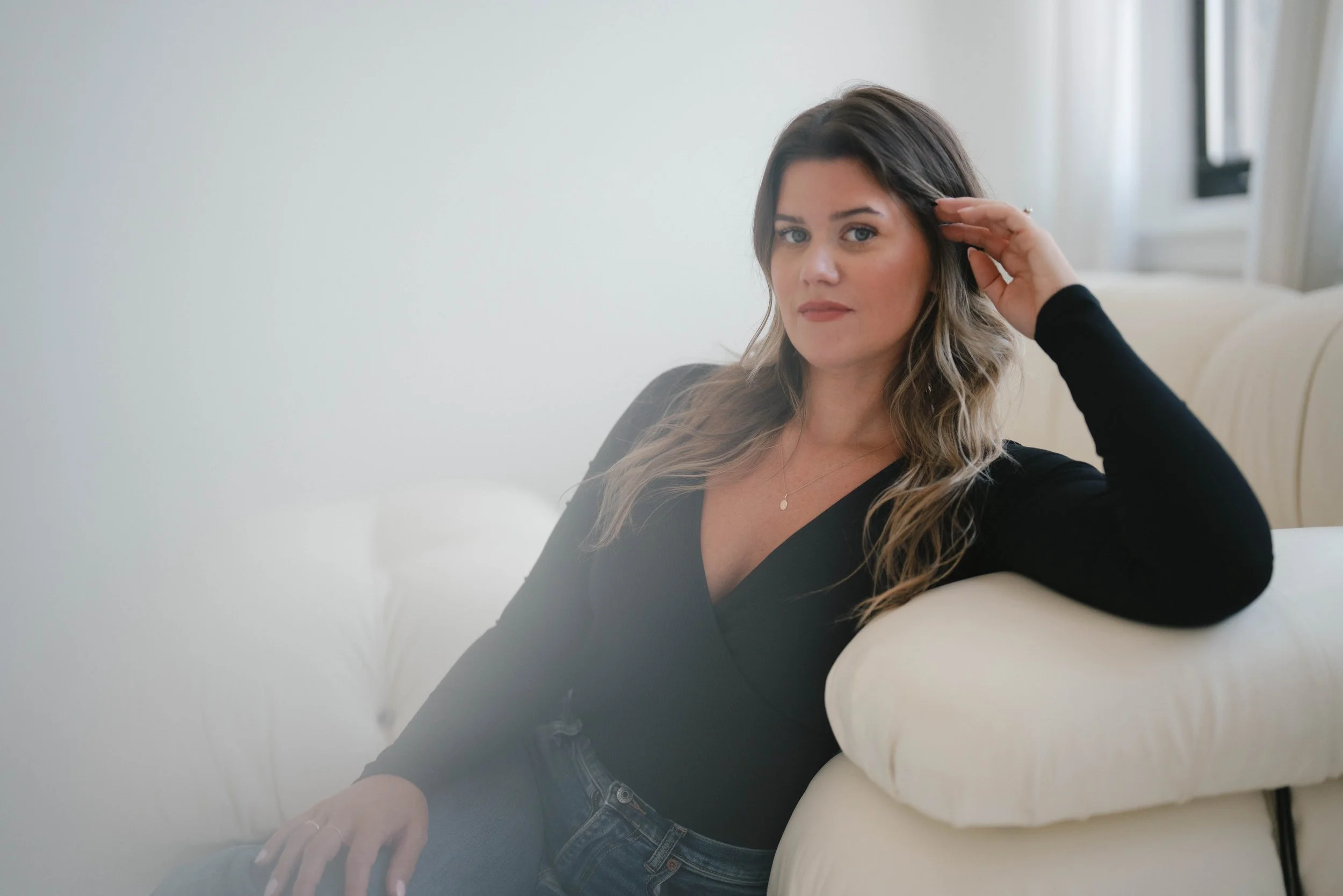
Kailey Brennan DelloRusso is a writer from Plymouth, MA. She’s the founder of Write or Die Magazine and a columnist atChill Subs. Her work has been published inTrashLight Press, Dreamworldgirl Zine, World Insane, and various online publications. She is represented by Creative Artists Agency.