
Losing my mother to Alzheimer’s disease feels like my teeth are being yanked out slowly, painfully, one by one. Our favorite things to do together wither away along with her brain cells. I try to cook with her, but her culinary skills have dwindled to putting the pickled beets on a relish tray.
“Let’s make ambrosia,” I say with enthusiasm, trying to preserve the past and keep her with me forever. Every holiday, she always made her traditional fruit salad. God forbid, if ambrosia was not on that Thanksgiving table and God forbid if there wasn’t enough. She would triple it. We’d reap the benefits of leftover ambrosia all week.
“Pass the ambrosia,” she said with passion, then savored every sweet and creamy chunk of it. My brother called it clown vomit. Still, it was our family tradition. I thought that memory, at least, was safe.
The day she said “What’s ambrosia?” I felt like vomiting. I thought she would always remember her famous five-cup salad. One cup pineapple chunks, one cup mandarin oranges, one cup coconut, one cup marshmallows, one cup sour cream. Mix and chill for 24 hours.
“Don’t you remember?” I asked, trying to mine her hippocampus. “The coconut? The pineapple?” She shook her head. I made it anyway and gave her the spoon. A knot thumped in my stomach as I watched her stir the faded memory. The first time she denied knowledge of ambrosia, a hint of worry scraped across her forehead, as if she knew something bad was happening. All the ambrosia-demanding holidays since have garnered no reaction. I scooped some onto her plate last Christmas. She didn’t eat it.
When the assisted living director suggested she move to memory care, he plucked the heart from my chest. One too many times they had found my mom on street corners, sitting on her walker, purse full of snot rags and rosaries strapped over her shoulder waiting for a bus. “I’m going to visit my family,” she explained to her rescuers.
“We cannot continue to monitor her. If she stays in assisted living, you must hire a private caregiver 24/7. For her safety and your pocketbook, we recommend the locked memory care unit.” He liked to say “we” as if he did not want to be the bad guy. “Wandering is dangerous. At any stage of the disease, someone can become disorientated and forget who they are and where they live. Six in ten people with dementia wander. She will be safer.”
A blitz of emotions rendered me dizzy. I did not want to lock up my mother. I did not want to face it. If she would just stay put she could remain in her nice apartment and enjoy tea and crumpets with the well-dressed, tightly-permed, card-playing ladies in assisted living.
“Will she be challenged? I don’t want her to get worse if she is around people below her level. She might not remember what she ate for lunch. She might forget my name, but she is smart. She can do Jumbles!” I slapped my hand on his mahogany desk in defiance.
“Well, we are not going to lie to you. She will be one of our highest functioning residents. But her memory will deteriorate. It’s a progressive disease,” he said, feigning empathy as he probably had done to many a stressed-out daughter a million times over. He was a businessman and wary of lawsuits.
Dismal. That was pretty much my first impression.
Behind the locked door, an absence prevailed—no lingering scent of warm candles and fresh baked cookies. No happy chatter or bustling activity. A slight scent of urine and old skin lingered in the faded carpet and stained upholstery. A secret code unlocked the door, but care needed to be taken as residents would amble toward it, intending to make a break. On the assisted living side there were vaulted ceilings, airy breezeways, tropical flowers in tall glass vases. A bar. Inside the locked unit, the ceilings were low, as if the sky was falling. Frowns instead of lively card games and line dances. The world was locked out. Life, as she and I knew it, had ended.
I wished it could lock out the fear of loneliness. The stench of loss.
People wilted in chairs as if part of the old furniture—listless, staring, the light long gone from their eyes. Some heads dropped forward like ripe grapefruit ready to fall. Stillness brushed against death.
A woman with a nest of wiry gray hair emitted an attention-grabbing scream. “Take me to my room,” she moaned from her wheelchair, a book opened on her knees. Sadness stabbed my heart when I realized it was the same book opened to the same page every day. Her hand reached toward me. I held in tears and looked for help. Another lady had a dog on her lap, its long ears flopped over her bony legs. She stroked the moth-eaten fur of her tattered pet and counted to ten, her voice crescendoing as she neared the final number, then began again.
A caregiver sprinted by and noticed my dismay. “The prize for living long enough,” he whispered in my ear.
A wave of queasiness assailed me and I plopped into the nearest plastic-adorned chair. I felt like I was being sucked under the earth, gasping for breath as I struggled to stay above ground. My mother noticed my sudden malady and said, as she has said all my life, “Sweetheart, are you okay?” She surrounded me with her loving arms. I nuzzled my forehead between her neck and shoulder and inhaled the lilac scent—one of my first childhood memories, as if permanently stitched into her skin. Wrapped in her blanket of love, for a few seconds I forgot where I was, treasuring the joy. If heaven exists, I am sure it’s that feeling. I wished I could freeze time. My brother once froze some leftover ambrosia. An icy Ziplocked glob became a gag gift on several occasions among us siblings. My mom wanted to thaw and eat it. “It’ll still be good,” she said, reaching for it to no avail.
One day, I spotted her in the memory care dining room. A large hibiscus adorned her salt and pepper hair. She wore matching red lipstick, albeit a bit smudged, and she was talking to a man, probably charming the suspenders right off him. As she slid a piece of cake towards him, saliva dribbled down his face—mouth agape, unresponsive. That’s it. She can’t live here. As I shepherded her down the grim hallway trying to shield her from the circle of lost souls collapsed in wheelchairs, she talked to everyone. Complimented their hair and outfits. Some residents didn’t respond. Some glared. Some smiled. Then a wave of joy overtook her and she sang “Take Me Out to the Ball Game” with gusto. She knew all the words. A few residents sang along. I exhaled, as if someone had been holding my head underwater way too long. Maybe it will be okay.
A few months later, the nurse called. “We need to report an incident.”
“What happened?” My heart quivered, fearing the F word. Fall.
“A resident punched your mother today during activity.”
“What?” I yelled. She doesn’t belong there I mouthed to my husband.
“We are contacting the attacker’s family and checking for a bladder infection.”
“She hits my mother and you think it’s a bladder infection?” I said, certain she could discern my anger. “I thought my mother was in the higher functioning group.”
“She is. UTIs in the elderly can cause confusion. Alzheimer’s can damage the part of the brain that controls inhibition. The line between thought and action becomes blurry and frustration can turn to aggression. We checked your mom for bruises. She is okay.”
“That’s it,” I said to my husband, disconnecting the call with an angry jab. “She’s out of there. I was coming to terms with it, but someone hitting my mother! What’s next?”
“Well the good thing is she’ll probably forget about the smack,” he chuckled.
I glared at him. My worried eyes travelled toward our guest bedroom.
“Honey, she can come live with us. We can make it work.”
His words were as comforting as a bowl of ambrosia. I wondered whether it was best and decided to give it more time.
Weeks turned to months. As mom’s dementia worsened, I grew more aware of my own mortality. Fifty-seven million people worldwide live with Alzheimer’s disease or other forms of dementia. There is no cure. I couldn’t help but wonder about my own neurons and tried not to dwell on how the feared A word might befall me in thirty years.
“You’re under stress,” my husband said, trying to make me feel better about my forgetfulness. “Accentuate the positive, like your mom does.”
*
“Look what your mother did today,” said the bubbly activity director. I followed her into the activity room where residents painted and crafted. She held up a shark hat fashioned out of green construction paper. “Your mom cut this,” she said with a sizzling enthusiasm I wished I had. “She cuts so good!” She had this utter surprise as if operating kindergarten scissors was a special skill. She showed me a photo of my mom wearing the hat. It was the cutest thing I had ever seen. Pride flooded my body, as if my mom suddenly became my child.
“Let’s go,” I said, clapping my hands. My mother’s face brightened. Those two little words flipped a light switch inside her. Her delight for the simplest things—car rides, clouds, ice cream—ignited a flicker of joy in me, a treasure I wanted to keep in my pocket and pull out whenever things got tough.
The typically gloomy hallway seemed a bit brighter to me. My mom threw kisses which the caregivers caught and put to their lips. It felt more like home. I was visiting more often and staying longer, almost as if I had become part of this alternate reality. I’d been learning the nuances of dementia, such as how stuffed animals “doll therapy” can sometimes ease anxiety and a book on a lap could provide purpose. And, in my mother’s case—bursting into song.
In the quiet of late afternoon outside the memory care window, a sparrow landed on a branch, fluttered its wings, and lifted off. Free. My mom and I looked at each other and smiled.
“Little birdie,” she said.
As we approached that locked door, she stopped in her tracks, pushed her walker away, lifted her arms in biblical fashion and said to the residents perched in wheelchairs or lost in their own galaxies, “I love you all, have a wonderful day.” Heavy heads lifted, as if their worlds just got lighter. Frowns turned to smiles. Eyes twinkled. It felt like grace, like that first dusting of snow lightly covering the bleak remnants of late fall.
Inside, where the world is shut out, my mother no longer worries about the stock market or bills or terrorism. Wrinkles that once traversed her pearly skin have softened and practically disappeared. Some days her face almost appears childlike coinciding with her heart. She may not remember how to make ambrosia, and lately she has not remembered who I am, but she can still make people happy. Even with her life shrunk to one room and her brain a blur of memories, she retains this magical way of getting the most disgruntled naysayer to smile. She lives like each day is a gift. Sometimes, I think it is God’s grace. Shining through her and right into others. Into me.
I had been at the edge of myself. My brain a choppy sea of despair and guilt and denial. Ironically, it was my mother who pulled me out. I have come to realize that it’s not about what we can’t do anymore. It is about what we still have and how much we can still give. Acceptance is making peace with our limitations and having the resilience to find new ways to live and love. I still succumb to grief and sadness because of this disease, but I realize that this place, for now, protects my mother’s quality of life. Just because dementia has burrowed into our lives doesn’t mean joy has to leave.
As my mother slips away, I am becoming more like her. And, much to my brother’s chagrin, I make the ambrosia every holiday. There is something about stirring that fruit and sour cream concoction that will always connect me to her. My mother taught me how to make an ambrosia for living: mix one cup gratitude, one cup humor, one cup understanding, one cup patience, and one cup faith. Chill.
-Sheila Luna
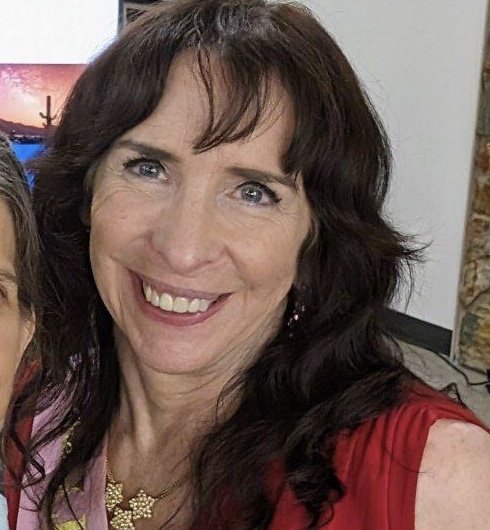
Sheila Luna is an Arizona-based writer whose work has appeared in many journals and magazines including Intima: A Journal of Narrative Medicine, Heart and Flesh Literary Journal, Spry Literary Journal, and DINE: An Anthology. Her writing explores themes of place and family, ability and disability, health and illness. As a long-term care ombudsman for the Area Agency on Aging in Phoenix, she advocates for residents in care homes, ensuring their voices are heard. She also serves as acquisitions editor for AlzAuthors, a global community of authors dedicated to sharing dementia stories that illuminate the caregiving journey for others. Visit her at www.sheilaluna.net.
I was called sand.
My family and I didn’t travel to beaches full of it. We couldn’t. Being Iranian in the 1980s and 1990s came with a label: terrorist.
My nickname didn’t come from a beautiful beach.
It came from hatred.