
The Antiverse of Silence
I’ve always been a good patient—keep my jaw open even when it aches for the dentist, never flinch from the needle of a vaccine, and have thick, easy-to-find veins for blood draws. Maybe I learned it in high school on the soccer field; complain, and be benched. Maybe I carried it in my DNA, passed down from stoic Norwegian farmers; suffering is inevitable, better to keep your mouth shut and your eyes towards God.
The calamity happened anyway.
When I became pregnant, I was handed a long list of dos and don’ts: do drink electrolytes, don’t eat deli meat, do take prenatals, don’t take ibuprofen, do gentle exercise, don’t do hot yoga. But I was also told to listen to my intuition. I followed each prescription with type-A fixation.
I only had three ultrasound appointments during my first pregnancy. One at nine weeks, to determine the due date. At first all I heard was the whoosh of my own body. Then, the monochromatic screen took the shape of something tiny and fluttering. “That’s the heart,” the sonographer told me as she reached over to turn up the volume. The beats were fast, like the being inside me was racing towards life. I had only found out I was pregnant a couple of weeks before. It hadn’t felt real until that moment, hearing life’s drumbeat within me.
The next ultrasound was at twenty weeks. “That’s your baby’s cute little face,” the sonographer said, turning the screen towards my husband, Juan, and me. “I’ll print that one out for you. It looks like baby is smiling!” I left with a strip of photographs that assured me our baby was healthy and hung them on our fridge when we got home like a guarantee.
By twenty weeks, the inner ear connects to the brain, allowing the fetus to begin hearing faint internal sounds, such as the mother’s heartbeat and digestive system. Shortly after that, the fetus starts hearing sounds from the outside world and begins responding to the mother’s voice. I started talking and singing to my belly then, wondering what muffled sounds made it to my baby’s little ears. I hoped my voice was soothing, the way a mother’s is supposed to be.
When I was nine months pregnant, we drove to the hospital for our third ultrasound because our midwife hadn’t been able to find the baby’s heartbeat with her Doppler. All we’d been able to hear was that whoosh of my own body interrupting the silence.
“Is there a heartbeat?” I asked the sonographer at the hospital.
He pointed to the screen and said, “There is your baby’s heart. I do not see any movement.” Our baby was born that night into a silent room, but the absence of life screaming into existence was deafening, as if God himself had lost his voice.
A still heart is a question no one—especially not my intuition—had an answer for.
In the months that followed, Juan and I sat on our deck and looked out over the back pasture of our property. We’d planted a tree for our daughter there, and its golden leaves glimmered and swished in the wind. Birds sang, the sun shone, and flowers bloomed. Traffic hummed on the distant road. We spoke and didn’t speak, two people experiencing the same grief in different bodies. I cried more. Juan worked longer hours.
“It’s just so damn quiet,” he said one morning. His comment came out of a silence between us, but I knew what he was talking about. “I wouldn’t care if our baby cried all day long. I’d love the noise,” he said.
We got pregnant again, only four months after our daughter died. Fear was the voice that spoke loudest in my mind then, while the absence of trust defined my relationship with my body. Listening to my intuition became impossible because I no longer believed that intuition existed.
At the first ultrasound appointment for my second pregnancy, I obediently pulled up my shirt and waited for the sonographer to squeeze warm gel just below my belly button. An air bubble caused it to splatter, and I felt a drop land on my left forearm. Embarrassed for her, I resisted the urge to wipe it away.
“Is this your first pregnancy?” she asked.
“No,” I said.
“Oh, how old is your first child?”
“She was stillborn.”
The Doppler’s movement across my belly stopped. “I am so sorry,” she said, looking at me for the first time.
“Thank you.” I reached across myself then, wiped the drop of gel, and reclaimed jurisdiction over my body.
The sonographer got back to work after an awkward silence, taking pictures of the living baby in my belly, heart beating. She turned up the volume like she could read my mind. That sound could not have been loud enough. The rapid beating of that heart was my sacred drum. An ocean of sound. I wanted to swim in it every moment until my son was born.
If my son is born, I would always correct myself. If.











During my first pregnancy, I’d believed that if I did what I was told and willed my body to be the perfect vessel, I’d be rewarded. I’d opted for a natural birth, believing in the adage, “a woman’s body is wise and intuitive. It knows what to do.” Before my daughter’s death, I was relaxed, not because I trusted my body and the process, but because I was accustomed to my body complying with my will. After she died, I clung to control more than ever, even though I knew it was a sham—a paradox I hoped wouldn’t crack open before I brought my son’s first cry into the world.
My second pregnancy was documented with the accuracy of an archeological dig, countless ultrasounds conducted by specialists who only saw high-risk patients. At their office, sonographers didn’t ask casual questions about older siblings. They knew better. They knew the people under their Dopplers were pregnant with worry, not just babies. They took silent, rapid measurements—femurs, kidney, stomach, skull circumference, the chambers of the heart—all the parts that make up a life. I studied the screen, hoping I’d find the measurements for the part my daughter had been missing and catch what I had fatally missed, but never could. Some questions remain unanswerable.
I’d stopped caring about being a good patient by then. I asked the techs questions I knew they couldn’t answer. I lay on the exam table crying and shaking, holding Juan’s hand. My son’s measurements were low; he was smaller than ninety-five percent of other babies in utero. I started going to the hospital twice a week in addition to our weekly ultrasounds for non-stress tests. A nurse strapped a monitor to my belly that charted his heart rate on a roll of paper. Sometimes, I was there so long that the paper spooled out over the table and onto the floor before the nurse came in to tear it off and bring it to the doctor for inspection.
“Everything looks good,” she always said.
My therapist reminded me of this each time I spiraled into fear. “In this moment, you are safe,” she’d say. “From the information you have, from what your doctor tells you, it’s very likely everything will be okay.”
I’d nod and wipe my eyes. I willed myself to push the fear out of my mind, down into my stomach, where it could be digested into something else, like bravery, or resilience, or trust.
“Have you thought about what you want your son’s birth to look like?” she asked at our last session before I was induced.
I was supposed to have wishes and hopes, preferences even, stemming from some intuitive knowing of how my child was supposed to enter the world. I knew women were encouraged to write down their birth plans and give them to the nurses at the hospital to make sure they honored them during labor and birth. I had prepared one during my first pregnancy, a piece of paper I eventually pulled out of the bottom of the hospital bag, balled up in my fist, and threw into the fireplace.
“I don’t care,” I told her. “I just want him to live.”
On induction day, they strapped the monitor to my belly, and Juan and I listened to our son’s heartbeat for the entire twelve hours of my labor. When a nurse turned down the volume, I asked her to turn it back up. I guess I did have one preference—I wanted to hear every single heartbeat.
A heartbeat isn’t a question—it’s the universe discovering itself through movement and sound.
My son’s first cry vibrated through my body like a whale song. Like the plates of the earth shifting into place. I asked my husband to record it on his phone, but when I listened to it later, the sound had disappeared into a muffled whimper. That sound could not be trapped in time because it exists somewhere, always happening, as fundamental to my existence as the Big Bang—the antiverse of silence. It exists in the body of my child, shrieking as he runs into the cold salt water at the beach, wailing for more TV when I turn off Peppa Pig, whispering I love you into the side of my face before bedtime.
When our now three-year-old is having a meltdown, Juan will look at me over the din and say, “We did wish for this.” And this comment makes the hardest moments a little less overwhelming. Motherhood is hard, no matter how much worse the silence was. Motherhood is having to make decisions almost as rapidly as a heart beats, hoping you are making the right ones.
I still bristle when another woman, usually a fellow mother, leans in and says anything about “mother’s intuition.” What does intuition’s voice sound like? I want to ask. Are the intrusive thoughts that make my heart race warnings? Or are they evidence that I haven’t fully healed?
I promise myself I will always keep my child safe, even though I know I can’t guarantee it. I promise I will not let my fear hold him back, even though I know it sometimes will. The intuition I am reclaiming exists between these contradicting truths.
Every night, I put my hand on my son’s little back while he is sleeping. I keep it there until I fall asleep too, listening to his breath and feeling the rise and fall of his warm body next to mine.
-Georgia Chehade
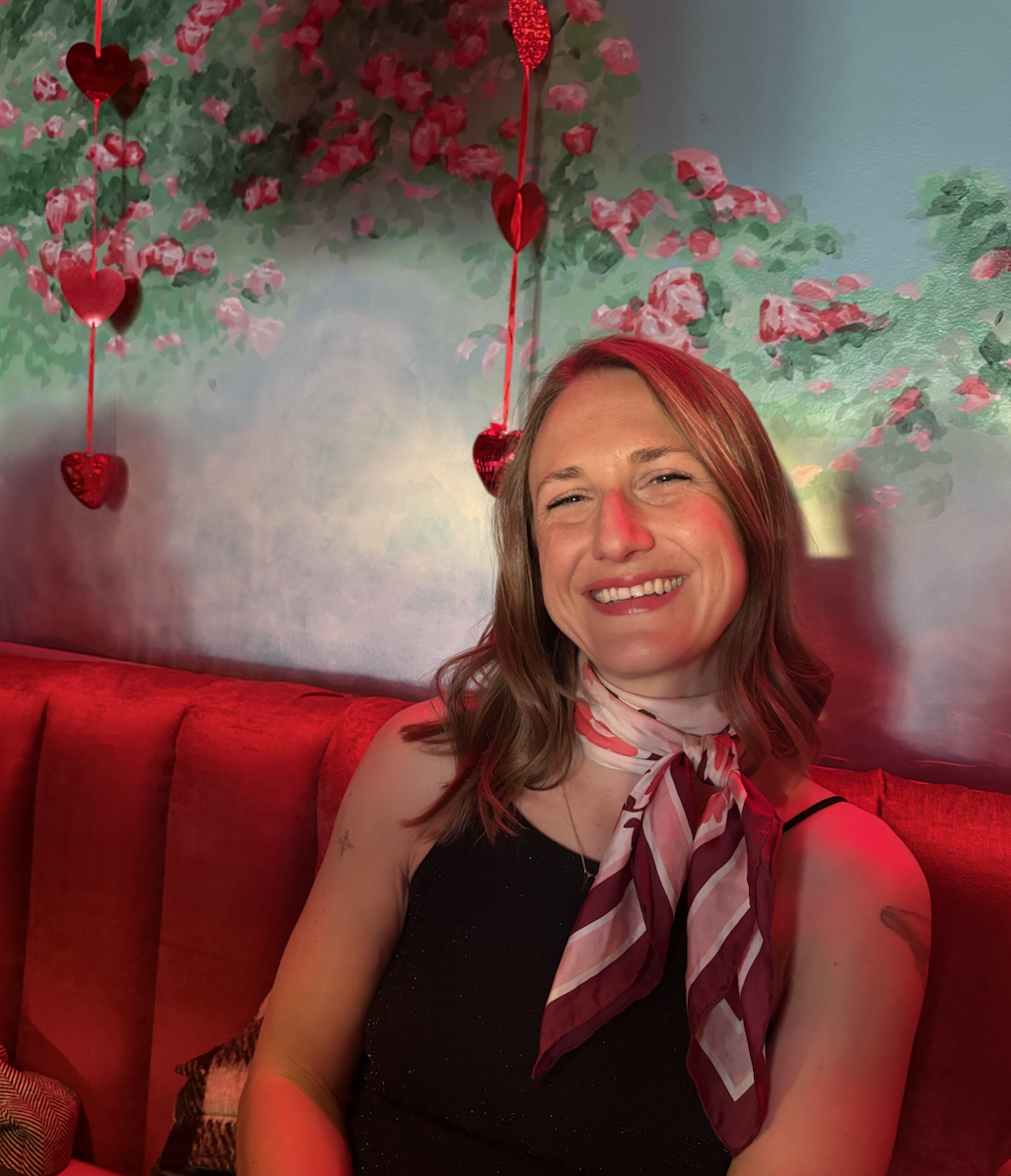
Georgia Chehade is a multi-genre writer from the Pacific Northwest. Her obsessions include walking in the woods with her toddler and writing about how grief and joy intermingle. She is currently working on a memoir, and her work has recently been published on Beautiful Things. Once a secondary school teacher, she now runs writing groups and workshops for her community.

I left on a clear October Monday. Seated at the bulkhead, my elbow rested next to a man who asked if I was going to Chicago for business. I lied, nodding my head yes. Ambivalence prevented me from updating my second-generation iPod earlier in the day, leaving Missy Elliott and Usher to comfort me. A leathery skinned smoker picked me up at baggage claim. She drove me forty-five minutes to our rural destination while I imagined what happens when car doors open and bodies land on I-55 at seventy-five miles per hour.